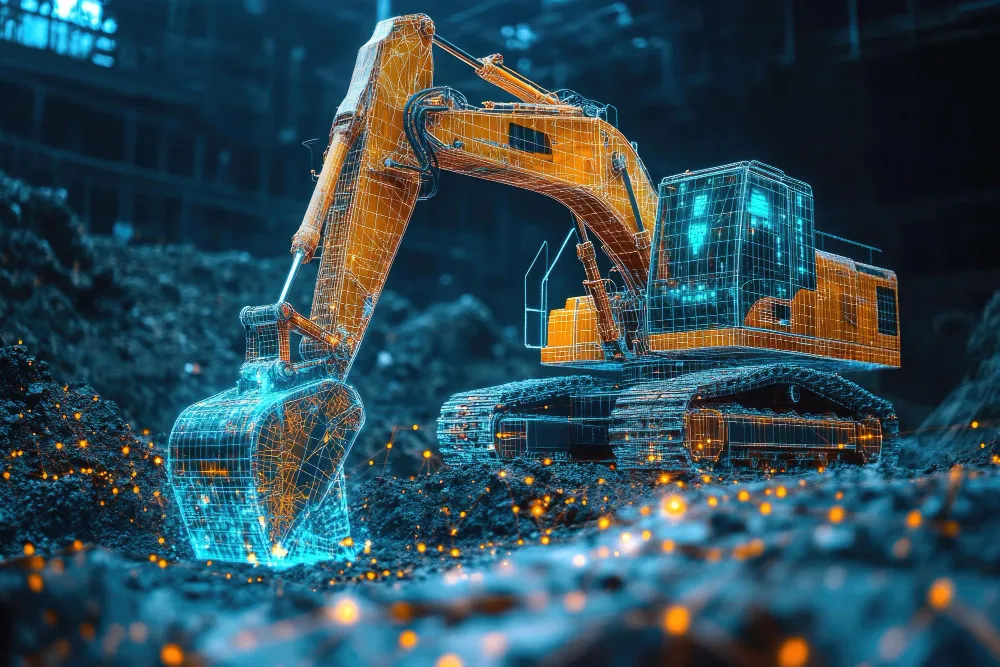
Autonomous excavators combine site plans, environmental sensing and machine control to carry out earthmoving tasks without a person continuously operating the controls from the cab. Unlike a self-driving road vehicle, an excavator must change the terrain it observes. Each bucket movement alters the surface, affects the next digging path and can create new hazards for nearby workers and equipment.
The underlying technology involves more than recognizing objects with artificial intelligence. A working system must locate a heavy machine, interpret where material belongs, control hydraulic movement and verify what actually changed. Human crews remain responsible for planning, coordination, maintenance and safe operations within the project’s defined limits.
A Construction Plan Must Become a Machine Task
Consider a hypothetical contractor preparing a level area for a water-treatment structure. Engineers define excavation limits, target elevations, underground utility constraints, and where excavated soil can be placed. A machine cannot safely treat those instructions as a simple command to dig until the ground looks flat.
The digital task needs a coordinate reference, an approved work boundary and a representation of the intended finished surface. It may also specify slopes, allowable excavation depths and locations that must remain untouched. Machine software uses that information to generate candidate work sequences, subject to its operating constraints.
A drawing alone does not prove that site conditions match the design. Temporary access roads, stored materials, unexpected obstacles and earlier excavation may change the available workspace. The system needs current observations and a procedure for resolving differences from the approved plan.
How the Machine Knows Where It Is
Autonomous earthmoving depends on localization: estimating the excavator’s position and orientation relative to the site design. Depending on the system and environment, a machine may use satellite positioning, inertial measurements, cameras, laser scanning or other sensors. The exact sensor combination varies by platform and should not be assumed from a product demonstration.
Onboard measurements must also describe the machine itself. The upper structure can rotate while the tracks remain stationary. The boom, arm and bucket move through several joints, so knowing the vehicle’s location does not automatically reveal the cutting edge’s position.
Coordinate errors can become excavation errors. Satellite signals may be obstructed near structures, while accumulated inertial error can affect a position estimate over time. Survey control and independent checkpoints help confirm whether the coordinates a machine uses are suitable for the intended work.
The U.S. Geological Survey’s LiDAR specification illustrates the importance of documented geospatial reference systems and accuracy testing. It governs defined federal elevation data collection, not the certification of any commercial autonomous excavator.
Perception Must Track a Changing Worksite
A construction site is not a fixed driving route. Workers walk through changing access areas, trucks reverse to new positions and spoil piles grow as digging continues. Dust and rain can obscure sensors, while excavated ground can alter the geometry that the machine previously used for navigation.
Perception software may combine detections with tracked movement and mapped obstacles. A system must distinguish a permanent boundary from a temporary object without assuming every camera image or point-cloud measurement is correct. Blind spots, reflective surfaces and sensor contamination require explicit safeguards.
The National Institute for Occupational Safety and Health’s October 2026 construction robotics guidance specifically identifies degraded sensing, changing work areas, unexpected movement and human-robot interaction as risks. That guidance supports task-specific risk assessment, not a blanket claim that robotics are safer under every condition.
Detection is only one part of protection. The machine must also respond appropriately when it cannot reliably determine whether its working area is clear. Depending on the risk, that may mean slowing, pausing or transferring the situation to authorized personnel.
From an AI Decision to a Hydraulic Movement
Excavators use hydraulic systems to move the boom, arm, bucket and rotating upper structure. An autonomous controller must translate a desired digging motion into commands consistent with those mechanisms. The relationship between a command and the resulting movement depends on load, joint position, and the machine’s operating state.
Low-level control can use position, motion and pressure-related feedback to adjust commands as a movement proceeds. Higher-level planning can choose the next cut or decide whether to reposition. Learned AI policies may assist those decisions, but the machine still needs bounded, predictable control behavior and independent protective functions.
Digging is contact-rich work. The bucket may encounter compacted soil, loose gravel or a buried obstruction. A trajectory that works in one material may stall or place excessive load on equipment in another. The system needs conditions to stop or change the task rather than simply increasing force until something moves.
TechAmerica.ai’s robot foundation models explainer discusses learned robot behavior more broadly. Excavation adds a distinctive challenge: the robot changes the physical environment that its next action must interpret.
Digging to Grade Is More Than Moving Dirt
A planned excavation may specify a target surface, allowable slope and boundaries near equipment or structures. The controller can compare an estimated current surface with the design to identify material that remains to be removed. It then selects a sequence of feasible bucket movements.
Each pass must be checked against updated measurements. A pile may collapse into the work area, or one movement may remove less material than expected. If the system relies solely on its planned trajectory, it can continue working from an incorrect terrain estimate.
The aim is not always to remove material as fast as possible. Excavating too deeply can require backfilling, compaction and additional inspection. Near buried utilities or sensitive structures, approved procedures and human judgment may impose tighter restrictions than an automated system can independently verify.
Survey-grade acceptance is separate from an AI model’s confidence score. The project should define suitable tolerances, independent measurement methods and who can approve the completed surface. A smooth digital terrain model does not prove the actual excavation meets its design.
Loading Trucks Requires Coordination, Not Just Accuracy
Earthmoving often involves a repeating cycle: excavate material, lift the bucket, rotate and load a waiting truck. An autonomous machine must know where material may be deposited and whether the receiving vehicle is correctly positioned. A person may drive the truck, even when the excavator has no operator in the cab.
A site procedure should govern when trucks approach, where they wait and how loading begins or ends. The excavator’s moving boom and rear counterweight create hazards beyond the bucket’s immediate position. Communication signals alone do not replace physical clearance checks and suitable exclusion arrangements.
Remote connectivity can carry status information and enable authorized oversight, but it does not mean every safety-critical decision depends on a network connection. A credible design documents what the machine can do locally, when it must stop and how personnel can safely regain control after a communication fault.
TechAmerica.ai’s coverage of robot connectivity and fleet services discusses communications used by machines in the field. On a construction site, connectivity requirements must be tested alongside the equipment’s independent operating and safety functions.
Retrofitting Existing Machines Adds Compatibility Risks
Autonomy does not always require manufacturing a new excavator. A retrofit approach can add computing, sensing and control interfaces to an existing machine, subject to the equipment’s compatibility. The engineering challenge is integrating those components without compromising the original machine’s safe operation or serviceability.
Hydraulic response, joint behavior, software interfaces and safety provisions can differ across equipment models and years. A configuration validated on one excavator should not automatically be assumed to work on another. Changes to attachments, maintenance condition and machine calibration may also affect behavior.
Installation time is only one part of readiness. Engineers must test the control interfaces, verify emergency stopping and manual intervention procedures, inspect sensor coverage and confirm the machine’s authorized working limits. A rapidly installed hardware kit has not necessarily completed site acceptance testing.
Earthmoving Safety Still Begins With the Worksite
Autonomous operation does not eliminate trench collapse, underground service strikes, falling loads or workers entering the equipment’s movement envelope. These hazards stem from the activity itself, not merely from a human driver.
OSHA’s trenching and excavation guidance identifies cave-ins, nearby heavy equipment, falling loads, and underground power lines as key risks. Its struck-by guidance addresses the dangers of vehicles and moving construction machinery. Applicable controls and legal duties must be determined for the actual job and jurisdiction.
Safety planning may include defined operating zones, engineered stopping behavior, access controls, worker training and clear procedures for maintenance or recovery. A worker who approaches a paused robot must not have to guess whether it will restart. Isolation and lockout procedures remain important when people service machinery.
NIOSH also recommends tracking leading indicators such as near misses, unexpected disengagements, localization failures and unauthorized entry into robot working areas. A successful demonstration without injuries is not, by itself, a reliable measure of risk over sustained operation.
When the Plan and the Real Terrain Disagree
Unexpected conditions are normal in earthwork. A bucket may encounter a buried object that was absent from the survey, or water may enter the excavation after rainfall. The right response may be to stop the task and request inspection, not to infer a new safe digging strategy from incomplete sensor data.
Operators and supervisors need a readable record of the planned action, detected anomaly, machine state,e and any intervention already attempted. That record helps a qualified person decide whether to revise the work plan or authorize resumption. The machine should not silently cross an approved boundary just because an alternative route seems more convenient.
The same principle applies to updated drawings. When an engineer revises the target grade, teams must verify that the machine received the correct version and that the reference coordinates have not changed unexpectedly. Version control and change approvals are operational safety tools, not merely administrative paperwork.
What a Realistic Autonomous Excavator Trial Must Test
A credible pilot begins with a bounded task, a surveyed site and agreed acceptance criteria. The team should document machine configuration, soil conditions, the approved work zone, expected truck movements and the roles of the personnel monitoring the operation.
Testing should deliberately cover more than ideal digging cycles. The review needs controlled scenarios involving an unexpected person near the operating boundary, obstructed sensors, an interrupted network, a changed terracing, and a failed component. The exact tests and safeguards must be designed by qualified personnel for the equipment and site.
Measure performance across the entire task. Relevant outcomes include material moved within tolerance, unnecessary rework, safety-related stops, manual interventions, downtime and the accuracy of the final surveyed surface. A headline number describing digging speed or hours of autonomy is incomplete without its conditions and failure handling.
TechAmerica.ai’s workplace robot deployment guide examines the difference between pilot demonstrations and dependable daily operation. Autonomous earthmoving demands that distinction because changes to physical terrain can be expensive or unsafe to reverse.
Autonomous excavators demonstrate how physical AI can connect digital plans with heavy industrial machinery. The key technical achievement is not an empty cab or a robot that follows commands. It is a controlled system that can interpret changing conditions, move material within approved limits and make its results available for independent engineering and safety review.