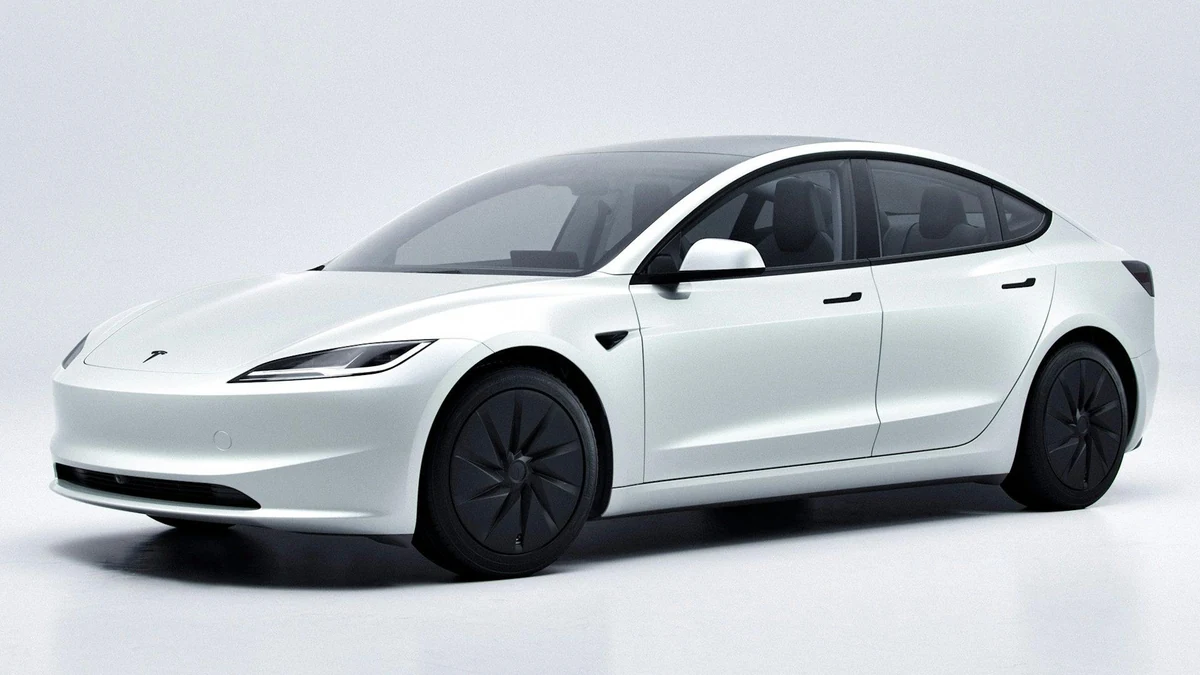
Tesla Model 3 technology combines an electric powertrain, computer-controlled energy management, camera-based driver assistance and software that can be updated after purchase. Understanding the sedan requires more than comparing driving range: its battery, motors, brakes, navigation and onboard computers continuously exchange information to manage efficiency, performance and safety.
How the electric drivetrain moves the car
The Model 3 stores energy in a high-voltage lithium-ion battery pack rather than a gasoline tank. When the driver presses the accelerator, power electronics control electricity flowing from the pack to an electric motor. An inverter converts the battery’s direct current into the alternating current the traction motor needs. The motor turns the wheels through a reduction gear rather than a conventional multi-speed automatic transmission.
Current U.S. configurations include rear-wheel-drive versions with one driven axle and a Premium all-wheel-drive version with two motors. All-wheel drive can distribute propulsion between axles to support traction and acceleration, but tire grip and road conditions still determine how much control is available. Tesla does not specify a universal battery capacity or cell chemistry for every Model 3 configuration, so check claims about exact pack hardware against the vehicle’s build and market.
Battery management matters as much as battery size.
A battery management system monitors the pack and manages operating limits. Temperature, state of charge and the power requested by the driver influence how much energy can be delivered or accepted. Thermal management heats or cools the battery when necessary, helping it operate within an appropriate temperature range. Energy used for cabin heating, air conditioning and battery conditioning also affects distance traveled per charge.
That makes driving range a changing estimate, not a guaranteed distance. Highway speed, cold weather, elevation, wheel choice and aggressive acceleration can all alter consumption. The U.S. Environmental Protection Agency lists the 2026 Model 3 Standard rear-wheel-drive version at 321 miles of estimated range and 24 kWh per 100 miles under its test methodology. Those figures are standardized comparisons, not promises for every journey.
Why charging speed changes during a stop
At home, alternating-current electricity passes through thevehicle’ss charging electronics before energy is stored in the battery. At a compatible DC fast charger, the charger supplies high-power direct current to the pack under the vehicle’s charging controls. Maximum charging power is only a peak rating; it does not remain constant throughout a session. Battery temperature, charge level and the charger itself influence the charging curve.
Tesla lists a maximum Supercharging rate of 225 kW for the current U.S. Standard rear-wheel-drive Model 3, compared with 250 kW for the Premium rear-wheel-drive and all-wheel-drive variants. Its published estimates for miles added in 15 minutes depend on specified test conditions. Drivers should not treat those figures as a guaranteed outcome at every station.
The car’s Trip Planner can add charging stops to a route, estimate remaining battery energy and prepare the pack as it approaches a supported fast charger. This battery preconditioning may shorten charging time, although it uses some energy before arrival. Charging connector standards and compatible networks differ by region, so U.S. charging assumptions should not be applied automatically to European models.
Regenerative braking turns motion back into electricity.
When the driver lifts off the accelerator, the electric motor can act as a generator. It converts some of thevehicle’ss kinetic energy into electricity and sends that energy back to the battery. This is regenerative braking, and it reduces energy wasted as heat in conventional friction brakes. The feature is particularly useful in repeated slowing and acceleration, although it cannot recover all the energy used to move the car.
Regeneration may be limited when the battery is cold or nearly full. Tesla provides an option to apply conventional brakes automatically when regenerative braking is restricted, but physical brake performance and driver attention remain essential. On slippery roads, drivers should expect traction limits regardless of how the vehicle produces braking force.
What the cameras and driving AI actually do
The Model 3 uses exterior cameras to observe lanes, traffic, surrounding vehicles and other parts of the driving environment. Onboard computing processes camera inputs for supported driver-assistance functions. Tesla’s Full Self-Driving (Supervised) option can perform some steering, speed-control and navigation tasks where enabled, but it is not autonomous driving. The driver must watch the road, remain ready to intervene and follow local rules.
Camera systems face practical limitations, including poor visibility, blocked lenses, unusual road layouts and unpredictable behavior from other road users. Features also depend on hardware, software, options and regional approval. For context on the broader technical debate, see TechAmerica’s reporting on the camera-based driving approach and its coverage of Tesla’s European driver-assistance naming.
The software-defined cabin and connected features
A 16-inch center touchscreen is listed for the current U.S. Model 3 range and controls navigation, media, climate settings and many vehicle preferences. Premium configurations add an 8-inch rear touchscreen for passengers. The Tesla app supports selected remote functions, including checking vehicle status and preparing the cabin before a trip. Some features require network connectivity, subscriptions or particular equipment.
Over-the-air software updates can change interface features and improve supported vehicle functions without a workshop visit. However, an update cannot automatically add missing hardware, and availability varies by model year, region and configuration. The owner should consult the installed software and vehicle-specific manual rather than assume that every advertised feature is present.
How the current U.S. versions compare
| Version | EPA-estimated range | Drive layout | Max Supercharging |
|---|---|---|---|
| Model 3 rear-wheel drive | 321 miles | Single driven axle | 225 kW |
| Model 3 Premium rear-wheel drive | 363 miles | Single driven axle | 250 kW |
| Model 3 Premium all-wheel drive | 346 miles | Dual motor | 250 kW |
These figures reflect Tesla’s U.S. listings reviewed in November 2026. Range and equipment can change with wheels, model year, region and future configuration revisions. European WLTP figures use a different testing system and should not be compared directly with EPA estimates.
The trade-offs behind the technology
The Model 3 illustrates how electric vehicles increasingly rely on software and power electronics rather than engines and traditional gearboxes. Fast charging and regenerative braking improve convenience and energy use, but charging infrastructure, battery temperature and real-world conditions still matter. Camera-based assistance can reduce some driving workload, yet it does not transfer responsibility away from the driver. The most useful technology comparison is therefore not simply a range or acceleration number, but how these systems perform together under the conditions an owner will actually encounter.