



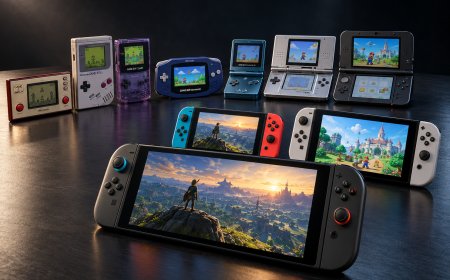























Every Nintendo Handheld Reviewed
From Game & Watch and Game Boy to Nintendo DS, 3DS and Switch 2, Nintendo’s handheld history shows how portable gaming evolved through bold ideas, smart compromises and hardware designed around how people actually play.
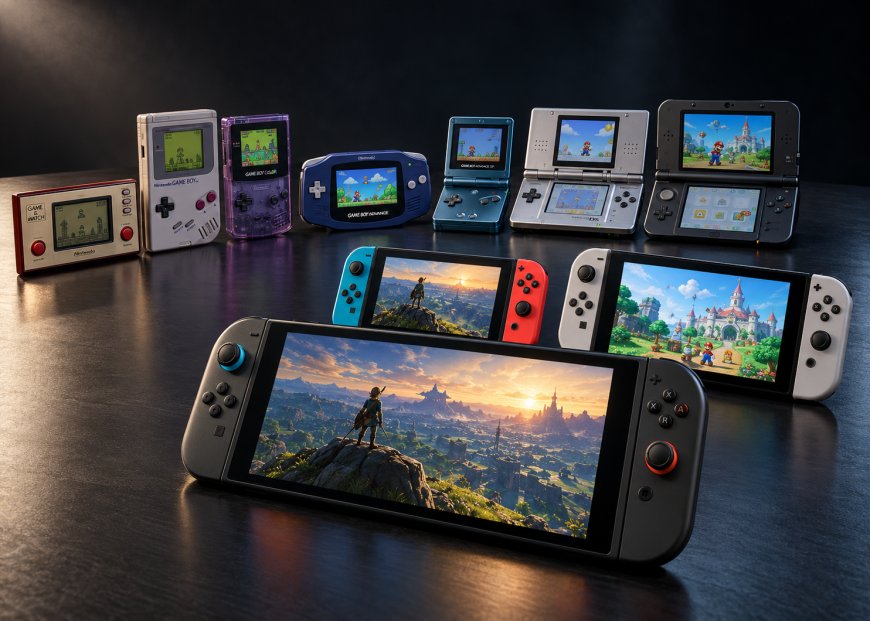
Nintendo’s handheld history makes modern portable gaming look almost inevitable, but going back to the beginning shows how many times the company could have taken a different path. The journey from the calculator-inspired Game & Watch to Nintendo Switch 2 is not simply a story of faster processors and better screens.
Nintendo repeatedly changed what a portable game system was supposed to do. Some ideas immediately made sense. Others looked remarkable in demonstrations but fell flat after hours of everyday use.
Raw power was rarely the deciding factor. The Game Boy succeeded against technically stronger rivals. The Nintendo DS turned two screens and a stylus into one of the company’s biggest successes. The 3DS pursued glasses-free 3D and showed that impressive technology doesn’t automatically become something people want to use every day.
The original Nintendo Switch eventually combined many of Nintendo’s strongest portable ideas into one design. By June 30, 2026, Nintendo reported 156.59 million Switch systems sold worldwide, slightly ahead of the Nintendo DS at 154.02 million units.
Nintendo’s official hardware sales data also shows 118.69 million Game Boy-family systems, 81.51 million Game Boy Advance systems and 75.94 million Nintendo 3DS systems sold worldwide.
Across those generations, the Nintendo handhelds that have aged best are usually the ones where the hardware made playing easier rather than simply making the specification sheet longer.
Game & Watch Was Primitive, but the Core Idea Was Already There
Nintendo’s first Game & Watch arrived in 1980, and using one today makes its technical limitations immediately obvious. The LCD relies on predetermined graphics rather than the freely rendered images expected from a modern gaming system; the controls are simple, and each unit is effectively built around a single game.
Yet the basic experience remains remarkably easy to understand. Games start immediately, objectives are clear, and almost nothing stands between pressing a button and playing.
The familiar story that designer Gunpei Yokoi was inspired after seeing someone use a calculator on a Shinkansen train also appears in Nintendo’s own historical interviews. Nintendo developers later explained that calculator technology influenced the hardware used for Game & Watch.
Nintendo’s Iwata Asks archive discusses that connection and the development of the original Game & Watch: Ball.
What makes Game & Watch important in retrospect is not its power. It is the idea that gaming could fill otherwise empty moments. That behaviour became fundamental to almost every Nintendo handheld that followed.
The Game Boy Is Difficult to Look At and Easy to Understand
The original Game Boy makes Nintendo’s handheld philosophy much clearer.
By current standards, its display is difficult to defend. The screen is dim, viewing angles are narrow, and the lack of a backlight means finding suitable lighting can feel like part of the experience. The audio is unmistakably primitive, while the large grey body makes later Nintendo hardware look extraordinarily refined.
Then a cartridge goes into the back, and most of those complaints become secondary.
Interchangeable games transformed the machine’s value. Instead of buying a different electronic device for each game, the same hardware could become Tetris, The Legend of Zelda, Super Mario Land or Pokémon depending on the cartridge inserted.
The Game Boy’s greatest strength was also something Nintendo would return to repeatedly: restraint. Competing handhelds could offer better-looking screens or more advanced specifications, but Nintendo prioritised battery life, price, durability and software.
That balance helped the Game Boy family reach 118.69 million units worldwide.
Playing an original Game Boy in 2026 requires accepting obvious compromises, especially without display modifications. As a piece of product design, however, its priorities remain easy to understand. A handheld does not have to be the most technically powerful machine. It has to be a machine people are willing to carry and use.
Game Boy Colour Improved the Experience Without Breaking It
The Game Boy Colour remains one of Nintendo’s smartest upgrades because it improved the part of the original system that had aged most obviously without abandoning what already worked.
Colour immediately makes games feel more expressive, while the smaller, lighter body is easier to carry. The controls also feel more refined. Most importantly, Nintendo did not force players to abandon their existing Game Boy libraries to get those improvements.
That backward compatibility became one of Nintendo’s strongest handheld habits. The company repeatedly found ways to move customers toward newer hardware without making their previous software purchases worthless.
The Game Boy Colour doesn’t feel like a completely new category the way the Nintendo DS eventually would. Instead, it feels like a more complete version of an idea Nintendo had already proven.
Game Boy Advance Was the First Nintendo Handheld That Felt Like a Real Console
The Game Boy Advance is where portable Nintendo gaming begins to feel significantly less compromised.
Its wider body sits naturally in two hands, the shoulder buttons expand what developers can do, and the extra processing power lets games become substantially richer in animation, colour, and complexity.
Nintendo handled backward compatibility unusually well. The Game Boy Advance could run its own software alongside older Game Boy and Game Boy Colour cartridges, carrying years of Nintendo’s portable library onto one system.
Its most obvious weakness today is the original display. The games are considerably more advanced than those on the Game Boy Colour, but the lack of proper illumination makes them frustrating to see under poor lighting.
That problem helps explain why the Game Boy Advance SP became such an important revision.
The clamshell body protects the display, the rechargeable battery removes the dependence on disposable AA batteries, and the illuminated screen finally makes portable gaming practical in darker environments. The SP is one of the points where Nintendo’s portable hardware begins to feel much closer to a modern handheld product.
Nintendo ultimately sold 81.51 million Game Boy Advance-family systems worldwide. That is lower than the original Game Boy family, but the hardware and software library have aged remarkably well.
Nintendo DS Looked Strange Until the Games Explained It
The original Nintendo DS is not elegant hardware.
It is thick; its two-screen arrangement initially looked unnecessary, and adding a stylus to a gaming system seemed like exactly the kind of unusual Nintendo idea that could disappear after one generation.
Instead, the DS became one of the best-selling gaming platforms ever made.
The reason becomes clearer when looking at software rather than specifications. Nintendogs made touching and interacting with virtual pets immediately intuitive. Brain Age used handwriting and simple touchscreen exercises to appeal to people who might never have described themselves as traditional gamers.
Conventional games still had physical buttons, while backward compatibility with Game Boy Advance software gave existing Nintendo customers another reason to move to the new platform.
Nintendo had found something more valuable than another increase in processing power: a new way to interact with software.
The DS Lite made the concept considerably more attractive by reducing bulk and improving the industrial design. Later DSi models added cameras, downloadable software and multimedia functionality. Some of those additions now feel dated, but the core idea of the DS still does not.
Nintendo reports 154.02 million DS systems sold worldwide. That success did not come from convincing people that two displays were technically impressive. It came from developers finding useful reasons for both screens.
The 3DS Proved That an Impressive Feature Can Still Be the Wrong Feature.
The Nintendo 3DS remains one of the company’s most fascinating handheld systems because its defining technology genuinely works.
Its upper display uses a parallax barrier to create a stereoscopic image without requiring glasses. Seeing the effect properly for the first time can still be striking. Characters and environments appear to have real depth behind the screen, and very little else in consumer gaming looks quite the same.
The problem is that being impressive for five minutes and being comfortable for several hours are different things.
The viewing position on early 3DS hardware is narrow enough that moving your head can disrupt the effect. Some players experienced discomfort, while others preferred playing with the 3D slider turned down.
Nintendo eventually released the 2DS without stereoscopic 3D at all, which says something about how essential the system’s headline technology ultimately became.
Later New Nintendo 3DS hardware improved the effect with face tracking, added more performance and introduced additional controls. By then, however, the strongest reasons to own the platform were its games rather than the technology that gave it its name.
Pokémon, Animal Crossing, Mario, Zelda and Monster Hunter did more to establish the system than stereoscopic 3D.
Nintendo sold 75.94 million systems across the 3DS family. That remains a substantial result, especially considering the platform’s difficult early period, but it is less than half the lifetime sales of the Nintendo DS.
The lesson is hard to miss: innovation works best when it improves the overall experience rather than requiring users to adapt to it.
Nintendo Switch Solved a Problem Nintendo Had Been Creating for Decades
The original Switch feels like the point where Nintendo finally stopped treating portable and home-console design as completely separate problems.
Instead of maintaining one machine for televisions and another for portable gaming, Nintendo built a tablet-style system that could move between both roles.
Joy-Con controllers could remain attached in handheld mode, detach for multiplayer or connect around a grip. The same game could move from a television to a train without transferring save files or purchasing a second version.
The idea feels less radical now because the Switch made it familiar.
Compared with the 3DS, the difference in presentation is enormous. Games such as The Legend of Zelda: Breath of the Wild no longer feel like reduced handheld approximations of console titles. They are full-scale experiences running on the same machine whether it is connected to a television or held a few inches from the player’s face.
The Switch OLED didn’t make the system meaningfully more powerful, but it showed how much a display can change a portable experience. Better contrast, deeper blacks and a larger OLED panel improve nearly every game rather than only specific software.
Switch Lite took the opposite approach by removing television output entirely. That sounds like a reduction in functionality, but it also proved that the Switch platform was flexible enough to operate as a conventional lower-cost handheld.
By June 30, 2026, Nintendo had sold 156.59 million original Switch-family systems worldwide, making it the company’s best-selling hardware platform to date.
Switch 2 Shows Nintendo Learning Not to Abandon a Winning Idea
Nintendo Switch 2, released on June 5, 2025, is interesting partly because Nintendo resisted the temptation to reinvent a successful idea for novelty’s sake.
The system has a 7.9-inch 1080p LCD, 256GB of internal storage and a custom Nvidia processor. Joy-Con 2 controllers attach magnetically and can also function as mouse-style controllers in compatible software.
Nintendo’s official Switch 2 specifications confirm the 7.9-inch 1920x1080 display, 256GB storage and custom Nvidia processor, while Nintendo’s support documentation details the Joy-Con 2 mouse controls.
Switch 2 can also play many existing Nintendo Switch games, preserving much of the software library that made the first system successful.
What stands out is how recognisable the experience remains.
That might once have been a criticism. The 3DS initially struggled in part because casual buyers could have difficulty understanding why hardware that resembled a DS represented a new generation. Switch 2 arrives in a different position because the underlying Switch concept does not need to be replaced.
Nintendo needs more performance, improved controls and modernised hardware without removing the flexibility that made the original device successful.
The early sales figures have been substantial. Nintendo reported 19.86 million Switch 2 systems sold during the fiscal year ending March 2026, and by June 30, 2026, worldwide lifetime hardware sales had reached 23.68 million units.
Those figures come directly from Nintendo’s dedicated video game sales data.
Nintendo’s Best Handhelds Were Never Simply the Most Powerful
Across Nintendo’s portable hardware, the most meaningful improvements are rarely the ones that sound most impressive on a spec sheet.
Colour improved the Game Boy because it affected the entire library. The Game Boy Advance SP’s illuminated display and rechargeable battery mattered every time you used the machine. The DS touchscreen succeeded because developers created software that justified its existence.
The 3DS stereoscopic screen was technically more unusual than many of those changes, yet it became optional surprisingly quickly.
The Switch may be Nintendo’s clearest expression of the same lesson. Its breakthrough wasn’t a particular processor, display technology, or visual effect. It allowed the same games to fit around the player rather than forcing the player to decide whether an experience belonged on a television or a handheld.
That is why revisiting Nintendo’s handheld history feels like more than watching processors become faster.
Again and again, Nintendo used portable hardware to test ideas about where games should fit into everyday life. Some experiments became industry standards. Others were eventually abandoned.
The systems that still feel most important are usually the ones where the answer became simpler.
What's Your Reaction?
 Like
0
Like
0
 Dislike
0
Dislike
0
 Love
0
Love
0
 Funny
0
Funny
0
 Angry
0
Angry
0
 Sad
0
Sad
0
 Wow
0
Wow
0