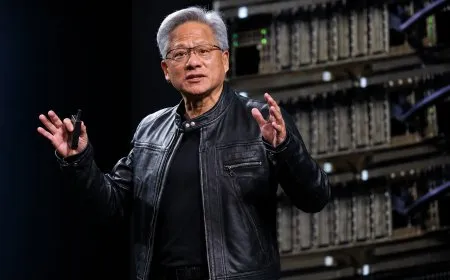
Nvidia Chief Executive Jensen Huang has strengthened the company’s presence in Japan through a series of strategic partnerships spanning artificial intelligence infrastructure, robotics, manufacturing and semiconductor supply chains. During his two-day visit to Tokyo on 15 and 16 July, Huang met with government officials and leaders from some of Japan’s largest technology and industrial companies, reinforcing Nvidia’s vision that factories, robots and intelligent machines will drive the next major phase of AI.
The visit followed similar engagements in Taiwan and South Korea, highlighting Nvidia’s broader strategy to deepen relationships across Asia as demand for AI infrastructure to support industrial automation and next-generation robotics grows.
Japan launches sovereign AI initiative with Nvidia support.
One of the biggest announcements centred on Noetra, Japan’s new sovereign AI initiative designed to develop domestic foundation models for robots, autonomous vehicles and advanced manufacturing. Around 44 Japanese organisations, including SoftBank, Sony, NEC and Honda, are participating in the project as the government seeks to reduce reliance on foreign AI platforms.
Tokyo plans to invest up to one trillion yen (approximately $6.2 billion) over the next five years to accelerate the development of home-grown physical AI technologies. While Japan aims to control the software powering future machines, Nvidia will provide much of the computing infrastructure needed to train these large-scale AI models.
As part of the collaboration, Nvidia will help build what it describes as a Vera Rubin AI factory, expected to become one of the world’s largest national AI computing facilities. Scheduled to launch in 2028, the data centre will feature 13,750 Vera CPUs alongside 27,500 Rubin GPUs, providing approximately 140 megawatts of computing capacity.
Noetra’s roadmap includes a Japanese-language reasoning model planned for fiscal year 2026, followed by multimodal AI systems capable of processing text, images, audio and video by 2028. The final stage aims to introduce “Real-world Native AI” capable of operating robots and intelligent machines by 2030.
Robotics companies embrace Nvidia’s Cosmos platform.
Huang also secured support from many of Japan’s leading robotics and manufacturing companies for Nvidia’s Cosmos platform, an open AI model designed specifically for physical AI applications. Companies including Fanuc, Yaskawa, Kawasaki Heavy Industries, Fujitsu, Hitachi, NEC, Sony, SoftBank, Kubota and robotics association AIRoA announced plans to develop systems using Cosmos technologies.
Nvidia introduced Cosmos 3 Edge during its Tokyo visit, enabling AI models to run directly on Jetson Thor chips installed in robots and industrial machines. Several companies have already begun testing shared robotic control systems, while organisations such as Honda Research & Development and Omron are actively integrating the platform into future automation projects.
Speaking during the visit, Huang said Japan had originally transformed global manufacturing and now has an opportunity to reinvent the industry once again through intelligent factories powered by artificial intelligence.
Toyota expands its AI partnership with Nvidia.
Toyota continues to deepen its long-standing collaboration with Nvidia beyond autonomous driving technology. Earlier agreements committed the automaker’s next-generation vehicles to Nvidia’s Drive platform. At the same time, the latest partnership extends AI into vehicle software development, factory simulation, production-line design, and traffic analysis systems.
The company plans to use Nvidia’s technology to enhance advanced driver-assistance systems that support steering and braking while maintaining human supervision, reflecting Toyota’s more cautious approach compared with fully autonomous vehicle developers.
Japan views physical AI as an economic priority.
Nvidia’s agreements align closely with Japan’s wider industrial strategy. Facing labour shortages caused by an ageing population, the government wants to deploy approximately 10 million AI-enabled robots across 18 industries by 2040. Public and private investment in physical AI is expected to total around $65 billion over that period.
Japan’s AI Robotics Strategy also targets more than 30% of the global AI robotics market by 2040, with officials estimating the sector could be worth roughly ¥20 trillion, or approximately $133 billion. The government believes combining its manufacturing expertise with advanced AI infrastructure could strengthen its position in the rapidly growing robotics industry.
Nvidia strengthens relationships across Japan’s technology ecosystem.
Beyond formal announcements, Huang met with executives from Toyota, Fanuc, Yaskawa, Fujitsu, Kawasaki Heavy Industries, and numerous semiconductor suppliers, continuing Nvidia’s relationship-driven expansion strategy across Asia. Similar visits to Taiwan and South Korea have already resulted in major AI infrastructure agreements, and the Tokyo meetings further reinforce Nvidia’s position at the centre of the region’s rapidly evolving AI ecosystem.
As countries increasingly pursue sovereign AI capabilities while investing heavily in robotics and intelligent manufacturing, Japan has emerged as one of Nvidia’s most important strategic partners. The collaborations announced during Huang’s visit demonstrate how AI development is expanding beyond data centres into factories, industrial automation and the next generation of intelligent machines.