Google DeepMind and Google Research have introduced WeatherNext 3, a new artificial intelligence weather forecasting model designed to deliver more detailed and frequent predictions of changing atmospheric conditions.
The model is the latest development in Google’s AI-based weather forecasting efforts and will begin powering weather information across Google products, including Search, Google Maps, and Gemini. Google also plans to make the model available to users and researchers through its cloud platforms.
WeatherNext 3 has achieved the highest accuracy among leading AI forecasting systems tested on Operational WeatherBench, a benchmark for comparing weather prediction models. The evaluation measures factors including temperature, wind speed, and humidity.
WeatherNext 3 improves AI weather prediction.
Traditional weather forecasting relies on government-operated supercomputers that process complex physical equations to simulate atmospheric behaviour. While these systems have become highly accurate, they require significant computing resources and can take longer to produce forecasts.
Researchers began developing AI weather models after large weather datasets became available for machine learning. These systems learn patterns from historical observations and can generate predictions faster while aiming to maintain comparable accuracy.
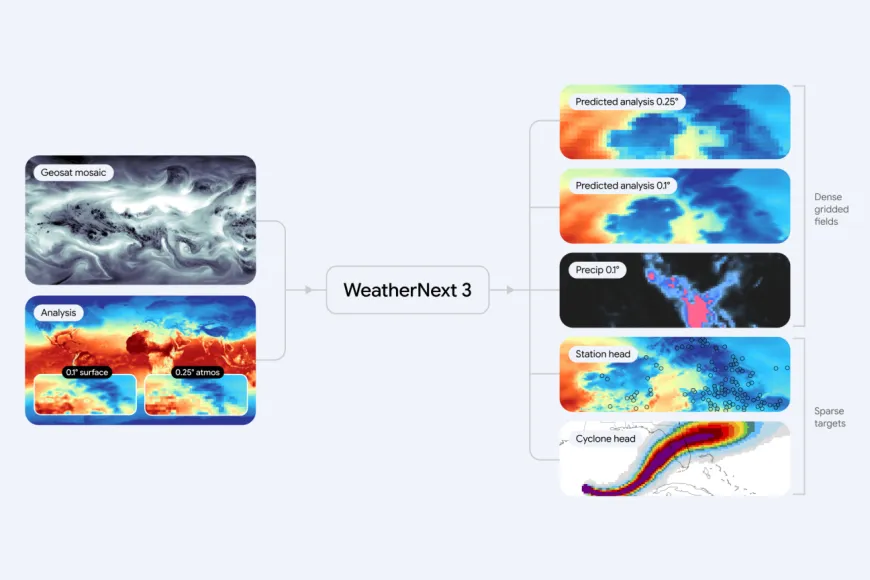
Google said WeatherNext 3 addresses several limitations seen in earlier AI forecasting models. The system can provide predictions at 5-kilometre resolution for key variables, improve rainfall evaluations by 60% compared with WeatherNext 2, and produce hourly forecasts instead of the traditional six-hour intervals.
Google focuses on higher-resolution forecasts.
The improvements come from changes in the model’s design. WeatherNext 3 includes 2.4 times as many parameters as its predecessor and was trained to provide forecasts targeted to specific weather stations, allowing researchers to compare predictions with real-world measurements.
The model can also process real-time weather satellite observations collected hourly. Google said WeatherNext 3 is the first AI model to incorporate raw observations for high-resolution global forecasting directly. However, other weather AI companies have also explored the use of direct observational data.
AI forecasting systems still rely on national weather datasets for parts of their prediction workflows, and researchers continue working on ways to make models better at using unprocessed weather data directly.
AI weather models expand beyond forecasting.
AI-based weather forecasting has gained attention from researchers and government agencies for its speed and lower computational requirements. Weather agencies in Europe and the United States have started using AI models alongside traditional forecasting methods.
Improved forecasts could help industries that depend on weather conditions, including agriculture and renewable energy. Bill Gates has highlighted AI-powered weather forecasting as one potential benefit of the technology, particularly for improving agricultural outcomes in regions where accurate forecasting resources are limited.
Google researchers said more detailed forecasts for factors such as wind, rainfall, and cloud cover could also help improve planning for renewable energy projects.