Robotics startup Gritt has emerged from stealth with $32 million in total funding as it looks to tackle one of the biggest challenges facing the global renewable energy industry: the shortage of skilled labour needed to build large-scale solar projects. The company believes advances in artificial intelligence have finally made it possible for robots to operate reliably in the unpredictable conditions of construction sites, allowing infrastructure projects to be completed faster and more efficiently.
Founded by Carnegie Mellon-trained roboticists Puneet Puri and Vishal Dugar, Gritt announced a $26 million Series A funding round led by Obvious Ventures, with additional participation from Union Square Ventures and Active Impact Investment. The latest investment follows an earlier seed round backed by First Round Capital, Climactic, Congruent Ventures and VSC Ventures, bringing the company’s total funding to $32 million. Gritt says its long-term mission is to build intelligent systems that can accelerate the construction of critical infrastructure around the world.
AI-powered robots designed for demanding outdoor worksites
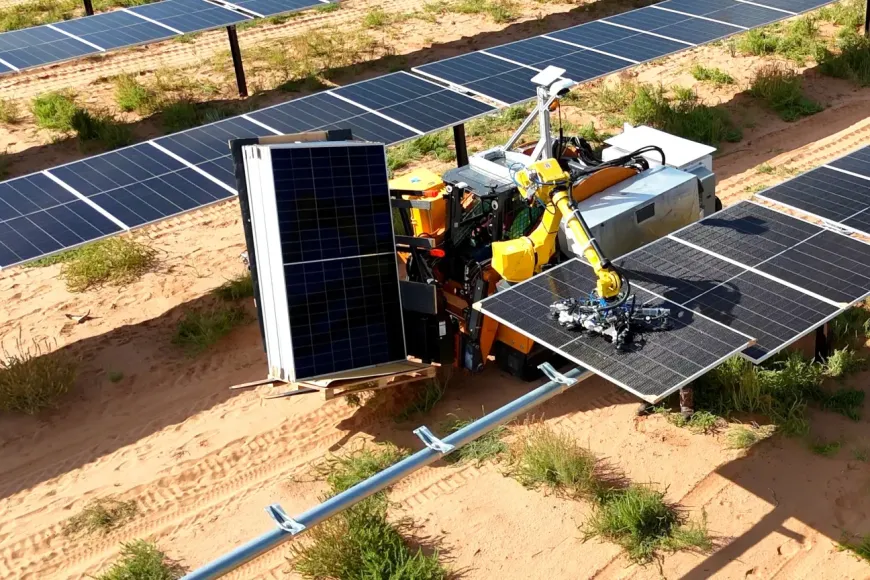
Unlike robotics companies that build proprietary machines from the ground up, Gritt relies on commercially available equipment, including rented skidders and robotic arms from manufacturers such as Kawasaki. The startup equips this hardware with its own AI-powered software, computer vision and control systems, enabling the machines to perform precise tasks in challenging outdoor environments.
The company’s first commercial application focuses on one of the most physically demanding parts of solar farm construction. Its robotic system unloads heavy glass solar panels, transports them across the construction site and accurately positions them onto mounting structures with sub-millimetre precision, allowing human workers to complete the final fastening process. By handling the heaviest lifting, the technology aims to reduce worker fatigue while improving installation speed.
Chief Executive Officer Puneet Puri said the company’s central belief is that meaningful improvements in construction productivity require intelligent systems capable of adapting to highly variable environments rather than operating only inside structured factories. According to the founders, recent advances in AI models have significantly improved robots’ ability to generalise across different tasks and construction conditions.
Boosting installation speed while reducing labour shortages
Gritt says its technology has already demonstrated substantial productivity gains in the field. According to the company, a conventional eight-person installation crew typically installs around 800 solar panels per day. When supported by Gritt’s robotic systems, that same crew can reportedly increase output to between 3,000 and 4,000 panels daily.
The startup currently has two robotic systems operating at customer sites, where they continuously collect operational data to improve the performance of the company’s AI models. Gritt says it has already secured contracts supporting the installation of approximately 2.8 gigawatts of solar capacity over the next 18 months. Its customer base includes three of the ten largest power construction companies in the United States, and the company expects to expand its fleet to 48 systems within the next six months.
Industry supporters believe the technology could become especially valuable for projects located in remote regions where recruiting construction workers remains difficult. The automation also has the potential to improve workplace safety by reducing the need for workers to repeatedly lift and position solar panels weighing roughly 100 pounds above shoulder height throughout the day.
Competition and long-term ambitions
Gritt enters an increasingly competitive market for construction robotics. Companies including Luminous Robotics, Cosmic and China’s Trinabot are also developing automated systems capable of installing solar panels. However, while many competitors focus on designing proprietary robotic hardware, Gritt believes its strategy of combining off-the-shelf equipment with advanced AI software offers lower costs, greater flexibility and faster deployment as customer demand grows.
The company plans to gradually expand the capabilities of its robots beyond transporting solar panels. Future tasks could include fastening panels into place, drilling support posts, assembling solar mounting structures and eventually performing additional labour-intensive construction work such as tying reinforcing steel before concrete is poured.
The founders say recent breakthroughs in artificial intelligence have dramatically accelerated the development process for these new capabilities. Puri explained that training a robotic system to perform a new task once required weeks of development. In contrast, modern AI techniques allow similar functions to be added in a matter of days by reusing the same underlying software architecture.
Building a broader physical AI platform
Beyond robotics, Gritt envisions creating a broader “physical AI” platform capable of monitoring construction sites and assisting with operational decision-making. The company believes its network of sensors and intelligent software could identify potential risks, detect missing equipment, monitor project progress and alert site managers to hazards before they become costly problems. For example, the system could identify an uncovered trench before an approaching storm or notify crews about missing inventory that could delay construction.
As global investment in renewable energy continues to accelerate, demand for technologies that improve construction productivity is expected to grow alongside it. Gritt believes combining artificial intelligence with adaptable robotic systems will help address labour shortages, improve worker safety and significantly increase the speed at which critical infrastructure projects such as solar power plants can be delivered.