Your phone already knows what you are about to type. Your email already knows which messages are spam. Your bank already knows when a charge on your card looks suspicious. Your streaming service already knows what you want to watch next, often better than you do.
None of these systems were programmed with rules for every possible situation. Nobody sat down and wrote "if the user types 'on my' suggest 'way.'" Nobody listed every word that makes an email spam. Nobody described every pattern of credit card fraud. Nobody cataloged every show you might enjoy.
Instead, these systems were shown millions of examples and figured out the patterns on their own. That is machine learning. It is the technology behind almost every AI system you have ever used, and it is the single most important idea in modern computing.
The Simplest Explanation
Traditional software follows instructions a human wrote. A calculator adds two numbers because a programmer told it exactly how to add two numbers. A traffic light changes on a timer because someone set the timer. The software does exactly what it was told, nothing more, nothing less. If you want it to do something new, you write new instructions.
Machine learning flips that. Instead of giving the computer instructions, you give it examples. Instead of telling it the rules, you let it discover the rules by looking at data.
Show it ten thousand photos labeled "cat" and ten thousand photos labeled "not cat," and it figures out what makes a cat a cat. Show it a million emails labeled "spam" and "not spam," and it figures out what spam looks like. Show it years of stock prices, and it finds patterns that might predict what happens tomorrow. Show it billions of sentences, and it learns how language works well enough to write new sentences that sound human.
The machine is learning from data the way a child learns from experience. Not perfectly. Not the way a human understands things. But well enough to be useful, and increasingly, well enough to be remarkable.
Why It Matters Right Now
Machine learning is not new. The core ideas go back to the 1950s. But it spent decades as an academic curiosity because two things were missing: enough data to learn from and enough computing power to process that data.
Both arrived in the past fifteen years. The internet produced more data than anyone knew what to do with. GPUs, originally built for video games, turned out to be spectacularly good at the kind of parallel math machine learning requires. The combination unlocked everything.
The global machine learning market is now valued at over $120 billion and growing at roughly 35% per year. About 60% of organizations have adopted machine learning in some form. 88% of enterprises use AI in at least one business function. It is embedded in healthcare diagnostics, financial fraud detection, retail recommendations, manufacturing quality control, autonomous vehicles, drug discovery, language translation, search engines, and virtually every consumer application on your phone.
ChatGPT, Claude, Gemini, Midjourney, Stable Diffusion, ElevenLabs, Suno, every AI tool that has entered mainstream use in the past few years is built on machine learning. It is not one product or one company. It is the foundational technique that makes all of modern AI possible.
The Three Types of Machine Learning
Machine learning is a broad field, but almost everything falls into one of three categories. Understanding these three categories explains how nearly every ML system you encounter actually works.
Supervised Learning: Learning From Labeled Examples
This is the most common and most intuitive form of machine learning. You give the system a set of examples where both the input and the correct answer are provided, and it learns the relationship between them.
Think of it like a student with an answer key. You show the system a thousand photos of dogs, each labeled "dog," and a thousand photos of cats, each labeled "cat." The system studies the patterns that distinguish one from the other: ear shapes, face proportions, fur textures, body silhouettes. Once it has learned those patterns, you can show it a new photo it has never seen before and it can tell you whether it is a dog or a cat.
The "supervised" part means a human provided the correct labels. The machine's job is to learn the mapping from input to label well enough to make accurate predictions on data it has never seen.
Supervised learning powers email spam filters (input: email text, label: spam or not spam), medical diagnosis tools (input: X-ray image, label: condition present or absent), credit scoring (input: financial history, label: default risk), voice assistants (input: audio waveform, label: what was said), and recommendation engines (input: viewing history, label: next likely choice).
Unsupervised Learning: Finding Patterns Without Labels
In unsupervised learning, the system receives data with no labels at all. No correct answers. No answer key. Its job is to find structure, patterns, and groupings in the data on its own.
Imagine dumping a thousand unlabeled photographs on a table and asking someone to sort them into groups without telling them what the groups should be. They might sort by color, by subject, by mood, by setting. They are finding structure that exists in the data without being told what to look for.
Unsupervised learning does the same thing. Customer segmentation is a common application: given purchase histories for millions of customers, the system identifies natural clusters (frequent buyers, seasonal shoppers, bargain hunters) without anyone defining those categories in advance. Anomaly detection works similarly: the system learns what "normal" looks like and flags anything that deviates significantly, which is how financial institutions catch unusual transactions.
Unsupervised learning is also the foundation of how large language models develop their understanding of language during pre-training. The model is not told what words mean. It observes patterns in how words appear together across billions of examples and builds its own internal representation of meaning. Nobody labeled "bank" as having two meanings. The model discovered that from context.
Reinforcement Learning: Learning by Trial and Error
Reinforcement learning works differently from both supervised and unsupervised approaches. Instead of learning from a dataset, the system learns by interacting with an environment, trying actions, and receiving feedback in the form of rewards or penalties.
Think of it like training a dog. You do not explain the rules of "sit" in English. The dog tries different things. When it sits, it gets a treat. When it does anything else, it does not. Over many repetitions, the dog learns that sitting when it hears "sit" produces a reward. The dog figured out the behavior without being explicitly taught.
Reinforcement learning trained the AI systems that beat human world champions at Go and chess. It is the technique behind self-driving car navigation, where the system learns by simulating millions of driving scenarios. And crucially, it is a core part of how modern language models are fine-tuned.
When ChatGPT or Claude gives you a helpful response instead of a rambling or harmful one, that behavior was shaped by reinforcement learning from human feedback (RLHF). Human reviewers rated model outputs, and those ratings were used as reward signals to adjust the model's behavior. The model learned that helpful, honest, harmless responses get high scores. Over millions of examples, it internalized that pattern.
Reinforcement learning is also at the heart of the "post-training revolution" that has defined AI development this year. Qwen 3.8 27B jumped 14 points on an independent benchmark without any architectural change, purely through post-training that included reinforcement learning on agentic tasks. DeepSeek V4 Flash overtook V4 Pro temporarily through a reinforcement learning refresh alone. The most impactful improvements to AI models are increasingly coming from better reinforcement learning, not bigger architectures.
How the Learning Actually Happens
Regardless of which type of machine learning is being used, the mechanical process of learning is the same at its core. The system has a set of adjustable numbers, called parameters or weights, and learning means finding the values for those numbers that produce the best predictions.
Here is the process, step by step.
The model starts with its parameters set randomly. At this point, it is useless. Its predictions are no better than guessing.
A training example is fed in. The model makes a prediction. That prediction is compared to the correct answer (in supervised learning) or evaluated against a reward signal (in reinforcement learning) or measured against an internal consistency metric (in unsupervised learning).
The difference between the prediction and the desired outcome is calculated. This difference is called the loss. A large loss means the model was very wrong. A small loss means it was close.
An algorithm called backpropagation traces back through the model and calculates, for each parameter, how much that parameter contributed to the error. Then it adjusts each parameter slightly in the direction that would reduce the error.
This process repeats for millions or billions of examples. Each time, every parameter shifts a tiny amount. Over millions of iterations, these tiny shifts accumulate into a model that makes accurate predictions on data it has never seen before.
The key insight is that nobody programs the model's behavior directly. The behavior emerges from the parameters, which emerge from the data. A spam filter's ability to detect spam was not written by a human. It was learned from examples of spam. A language model's ability to write coherent text was not programmed. It was learned from patterns in billions of sentences.
Neural Networks: The Architecture That Made It Work
Machine learning algorithms existed for decades before they produced the results we see today. What changed was the architecture: neural networks, and specifically, deep neural networks.
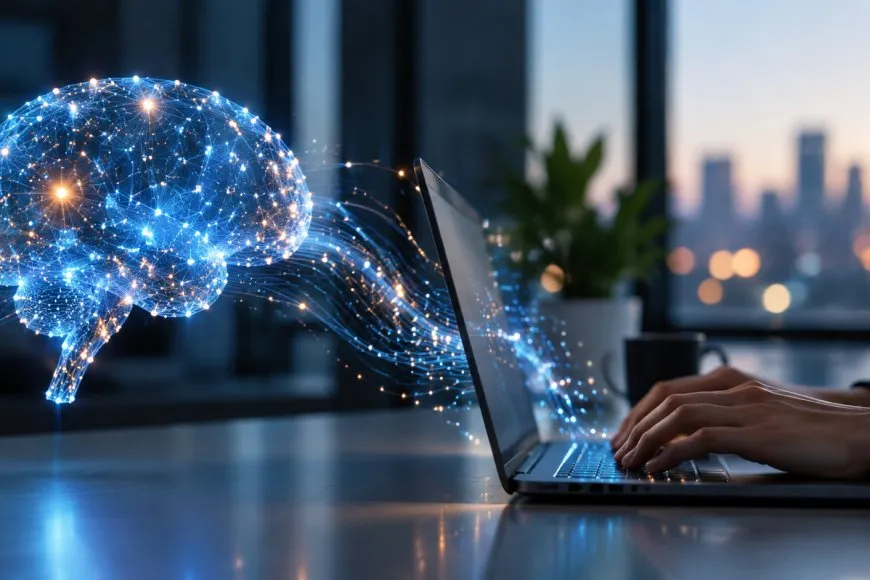
A neural network is loosely inspired by the structure of the human brain. It consists of layers of interconnected nodes, called neurons. Data enters at the first layer, gets transformed as it passes through each subsequent layer, and produces an output at the final layer.
Each connection between neurons has a weight (one of those adjustable parameters). During training, these weights are adjusted to improve the model's predictions. A "deep" neural network simply has many layers between the input and output, sometimes dozens or hundreds.
The depth is what gives deep learning its power. Each layer extracts increasingly abstract features from the data. In an image recognition system, the first layer might detect edges. The second might combine edges into shapes. The third might combine shapes into parts (ears, eyes, noses). The fourth might combine parts into objects (faces, cars, animals). By the time data reaches the final layer, the network has built a rich, hierarchical understanding of what it is looking at.
The same principle applies to language. In a transformer-based language model, early layers capture basic word associations. Middle layers capture grammatical structure and semantic relationships. Deep layers capture complex concepts like tone, intent, irony, and logical structure. The depth of the network is what allows it to represent the full complexity of human language.
The Difference Between Machine Learning, Deep Learning, and AI
These three terms get used interchangeably, but they mean different things, and the relationship between them is simple.
Artificial intelligence is the broadest term. It refers to any system that can perform tasks that typically require human intelligence. This includes everything from a chess-playing program to a self-driving car to a chatbot. Not all AI uses machine learning. A chess program that searches through every possible move using brute force is AI, but it is not learning from data.
Machine learning is a subset of AI. It refers specifically to systems that learn from data rather than following explicitly programmed rules. Most modern AI systems use machine learning, but the terms are not synonyms.
Deep learning is a subset of machine learning. It refers specifically to machine learning using deep neural networks, networks with many layers. Deep learning is what powers large language models, image generators, voice synthesis, and most of the AI applications that have reached mainstream use. Not all machine learning is deep learning (some ML techniques use simpler algorithms like decision trees or linear regression), but the breakthroughs that drove the current AI boom are almost entirely deep learning breakthroughs.
The nesting is: AI contains machine learning, which contains deep learning. Deep learning is the specific technique that made the current generation of AI possible.
What Machine Learning Cannot Do
Understanding the limitations matters as much as understanding the capabilities, because the limitations are where real-world problems come from.
It needs data. Machine learning cannot learn from nothing. If you do not have enough examples, or if the examples are biased, incomplete, or poorly labeled, the model will learn the wrong patterns. This is why roughly 85% of machine learning projects fail, and poor data quality is the primary reason.
It finds correlations, not causes. A model might discover that ice cream sales and drowning deaths both increase in summer. That does not mean ice cream causes drowning. Both are caused by a third factor: hot weather. Machine learning excels at finding patterns in data. It does not understand why those patterns exist, and it cannot distinguish a meaningful relationship from a coincidental one without human guidance.
It can be confidently wrong. A model that has learned strong patterns will apply them even when they do not fit. An image classifier trained mostly on photos of huskies in snow might learn that snow equals dog. Show it a photo of a snowy landscape with no dog in it, and it might still say "dog" with high confidence. The model does not know what it does not know.
It reflects its training data. If the data contains biases, the model will reproduce and sometimes amplify those biases. A hiring model trained on historical hiring data will learn the biases present in those historical decisions. This is not a hypothetical concern. It has happened repeatedly in real deployments, and it is one of the central challenges in responsible AI development.
It is not general intelligence. A model trained to recognize cats cannot play chess. A model trained to predict stock prices cannot write poetry. Each machine learning model is trained for a specific task or set of tasks. The exception is large language models, which are trained on such a vast range of text that they can handle a remarkably wide variety of tasks, but even those have clear boundaries on what they can and cannot do.
Why Machine Learning Changed Everything
The reason machine learning matters is not that it automates individual tasks. It is that it created a fundamentally new way to build software.
Before machine learning, every capability a computer had was one that a human explicitly programmed. If you wanted the computer to recognize faces, you had to write code that described what a face looks like: the distance between eyes, the shape of a nose, the proportions of a jaw. If you wanted it to understand speech, you had to write rules for every phoneme, every accent, every pronunciation variant. The complexity of these rules limited what software could do.
Machine learning eliminated that bottleneck. Instead of writing rules, you provide examples. The computer figures out the rules itself. And it can figure out rules that are too complex, too subtle, or too numerous for any human to write. No human could write the rules for recognizing every breed of dog from every angle in every lighting condition. But a neural network trained on enough photos can learn to do it with accuracy that matches or exceeds a human expert.
That shift from "program the rules" to "learn the rules from data" is why machine learning is transforming every industry it touches. It makes it possible to build capabilities that were previously impossible to program explicitly. And as the amount of data available keeps growing and the cost of computation keeps falling, the range of problems machine learning can tackle keeps expanding.
Every AI assistant you talk to, every recommendation you receive, every fraud alert your bank sends, every autocomplete suggestion your phone offers, and every AI-generated image, video, or piece of music you encounter is a product of machine learning. Understanding what it is and how it works is no longer a technical specialization. It is general knowledge for anyone who wants to understand how the world around them actually functions.