





































Google steps up AI scam protection in India, but gaps remain
Google expands AI-based scam protection in India with on-device call detection and new screen-sharing alerts, but limitations leave significant gaps in coverage.
Google is adding more AI-based protections to help India combat rising digital fraud, introducing on-device scam detection for Pixel 9 devices and new screen-sharing alerts for financial apps.
Digital fraud has surged in India as more citizens come online and increasingly rely on smartphones for payments, shopping, and government services. Fraud tied to digital transactions accounted for over half of all reported bank fraud in 2024 — 13,516 cases resulting in losses of ₹5.2 billion (about $58.61 million), according to the Reserve Bank of India (RBI). Online scams caused an estimated ₹70 billion (roughly $789 million) in losses in the first five months of 2025, the Ministry of Home Affairs reported. Many cases go unreported because victims often don’t know how to file a complaint or prefer to avoid scrutiny.
On Thursday, Google announced the expansion of its real-time scam-detection feature, which uses Gemini Nano to analyse calls locally on the device and identify potential fraud — without recording calls or sending data to Google’s servers. The feature is off by default, works only for calls from unknown numbers, and plays an audio beep during the call to indicate its use. It first debuted as a beta for English-speaking Pixel 9 users in the U.S. in March.
Google confirmed to TechCrunch that on-device scam detection in India will initially work only on Pixel 9 and later models, and only for English-speaking users, with alerts delivered in English. That sharply limits its reach: Android accounts for nearly 96% of India’s smartphones, according to Statcounter, while Pixel devices held less than 1% market share in 2024. The language limitation is also significant in a country where most people use non-English languages, a trend acknowledged by Google and companies like Amazon, which have expanded support for Indian languages across their services.
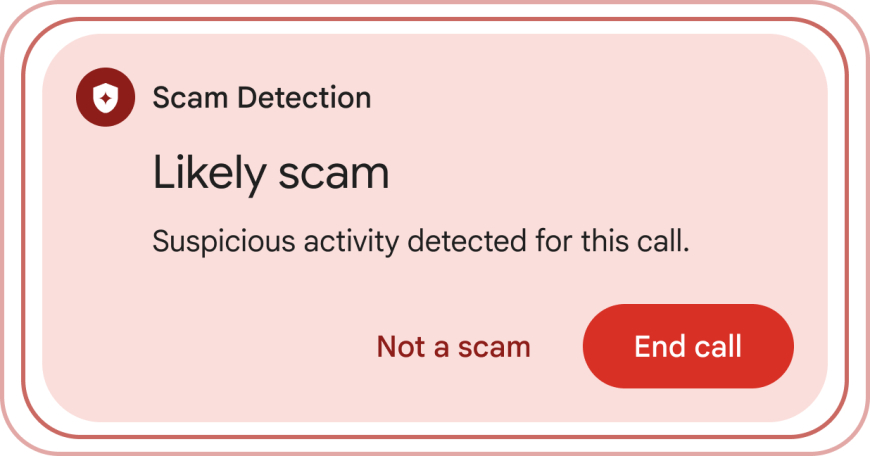
Image Credits: Google
The company said it is working to bring scam detection to non-Pixel Android devices, but did not offer a timeline.
Google also announced a pilot program with Navi, Paytm, and Google Pay to combat screen-sharing scams, which fraudsters use to trick victims into sharing their screens to obtain OTPs, PINs, or other credentials. First announced at Google I/O in May and tested in the U.K., the feature will be available to users on Android 11 or later, with alerts offering one-tap options to end the call and stop sharing. Google confirmed it plans to add more app partners and will provide alerts in Indian languages, though details were not shared.
Google has also been deploying its Play Protect system to restrict predatory loan apps by blocking sideloaded apps that request sensitive permissions, which are commonly abused for fraud. This year, Play Protect blocked over 115 million attempts to install such apps. Google Pay now surfaces more than one million fraud warnings per week, the company added.
Additionally, Google continues to run its DigiKavach digital fraud awareness campaign, which it says has reached over 250 million people. The company worked with the RBI to publish a public list of authorised digital lending apps and their affiliated non-banking financial companies to help curb malicious operations.
Earlier this year, Google launched a Safety Charter in India as part of a broader push to expand AI-driven fraud-detection tools and security infrastructure across the country.
Still, significant gaps remain. Google — like Apple — has faced criticism for allowing fake or misleading apps to slip through its app review process. In multiple cases, police and security researchers identified fraudulent investment and loan apps that remained available on the Play Store until authorities intervened. These incidents highlight the ongoing challenges Google faces in policing an ecosystem that dominates India’s smartphone landscape.
What's Your Reaction?
 Like
0
Like
0
 Dislike
0
Dislike
0
 Love
0
Love
0
 Funny
0
Funny
0
 Angry
0
Angry
0
 Sad
0
Sad
0
 Wow
0
Wow
0