Deciding which plants should stay and which should be removed from a field has traditionally relied on a farmer’s trained eye — and now, increasingly, on a new artificial intelligence model developed by Carbon Robotics.
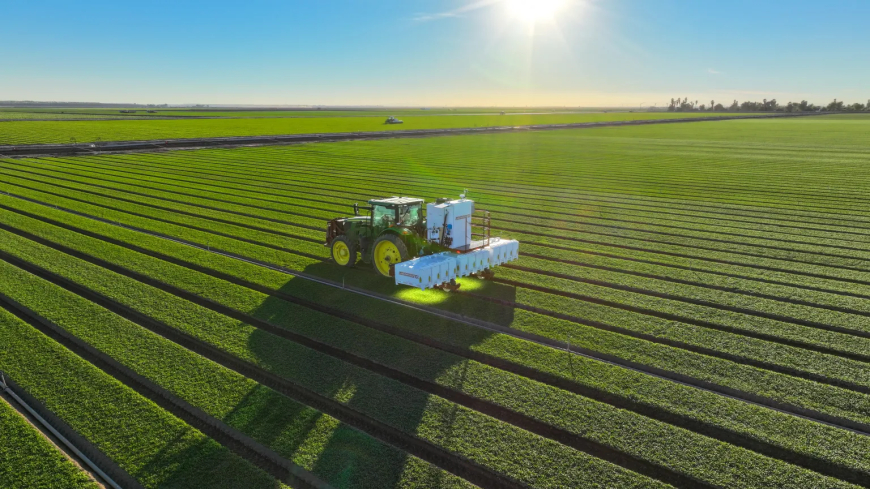
The Seattle-based startup, best known for building the LaserWeeder — an autonomous robot system that uses lasers to eliminate weeds — announced Monday the launch of a new AI system called the Large Plant Model, or LPM. The model is designed to recognise plant species instantly and enables farmers to target unfamiliar weeds without the need to retrain the machines.
LPM has been trained using more than 150 million images and data points collected by Carbon Robotics’ robots as they operate across more than 100 farms in 15 countries. The model now underpins Carbon AI, the intelligence layer that functions as the brain of the company’s autonomous weed-removal robots.
Paul Mikesell, founder and CEO of Carbon Robotics, told TechCrunch that before the introduction of LPM, every new weed type posed a challenge. Even slight variations — such as the same plant grown under different soil conditions or at a different growth stage — required the company to generate new labelled datasets so the robots could correctly identify the plant.
According to Mikesell, the retraining process typically took about 24 hours per session. With the Large Plant Model, however, the system can now recognise and respond to new weeds immediately, even if the model has never encountered that specific plant before.
“A farmer can now operate in real time and say, ‘This is a new weed, and I want you to remove it,’” Mikesell said. “That capability simply didn’t exist before. There’s no additional labelling or retraining required, because the Large Plant Model understands plants at a much deeper level — what it’s seeing and what kind of plant it is.”
Mikesell said Carbon Robotics, founded in 2018, began developing the model shortly after shipping its first commercial machines in 2022. He brings prior experience building large-scale neural networks from his earlier work at Uber and from contributing to virtual reality systems at Meta’s Oculus division.
The new AI model will be delivered to existing customers through a software update. Once deployed, farmers can instruct the robots on what to eliminate and what to preserve by selecting images collected by the machines through the robot’s user interface.
Carbon Robotics has raised more than $185 million in venture funding, backed by investors including Nvidia Ventures, Bond, and Anthos Capital, among others. The company plans to continue refining the model as its machines generate and feed additional data into the system.
“We now have more than 150 million labelled plants in our training dataset,” Mikesell said. “At this scale, we should be able toanalysee virtually any image and determine what type of plant it is — its species, what it’s related to, and how it’s structured — even if the model has never seen that exact plant before. That’s only possible because of the volume of data we’re feeding into the neural network.”








































 Like
0
Like
0
 Dislike
0
Dislike
0
 Love
0
Love
0
 Funny
0
Funny
0
 Angry
0
Angry
0
 Sad
0
Sad
0
 Wow
0
Wow
0