






























Linq raises $20M to enable AI assistants to live within messaging apps
Linq has raised $20 million to embed AI assistants directly into popular messaging apps, aiming to make automated workflows faster and more conversational.

Sometimes, a company can be sitting on a powerful product without realising its full potential until customer demand makes the opportunity impossible to ignore.
Linq, a Birmingham, Alabama–based startup, began as a digital business card that doubles as a lead-capture tool for sales teams. Over time, the company experimented with multiple pivots before identifying a significant opportunity last year: enabling businesses to communicate more naturally with customers by moving beyond traditional SMS to richer messaging formats such as iMessage and RCS.
While Apple already supports business messaging through its Messages for Business offering, and Twilio has built an $18.26 billion enterprise helping companies text their customers, those interactions often feel distinctly transactional. Users can usually tell when they’re messaging a business — the bubbles are grey, branding is prominent, and the experience lacks the familiarity of personal conversations.
Linq’s customers wanted something different. They were looking for a way to send messages that appeared as blue bubbles rather than green or grey, creating a more authentic, human-feeling interaction with customers.
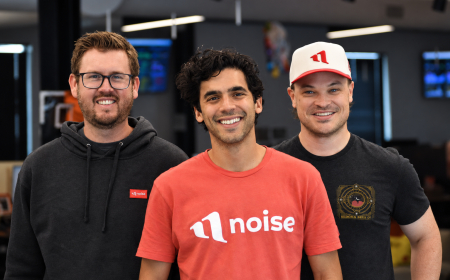
Founded by former Shipt executives Elliott Potter (CEO), Patrick Sullivan (CTO), and Jared Mattsson (president), Linq acted on that feedback. In February 2025, the company launched an API that enables businesses to message customers natively within iMessage, unlocking the full range of features iPhone users expect—including group conversations, emojis, threaded replies, images, and voice notes. Within eight months, Linq doubled the annual recurring revenue it had built over four years, Potter told TechCrunch.
Despite reaching product-market fit, the team wasn’t satisfied with stopping there. The rapid rise of AI agents created an even larger opportunity, positioning Linq as infrastructure rather than just a messaging tool.
That realisation came after the AI assistant Poke emerged. The assistant can manage tasks, answer questions, and schedule calendars — all from within iMessage.
“In the spring of last year, a company called the Interaction Company of California approached us,” Potter said. “They were building an AI assistant called poke.com and told us, ‘We don’t have a CRM, but we really want to use your API.’”
When Poke went viral after launching last September, Linq suddenly found itself flooded with inbound requests. A wave of AI startups wanted to deploy their chatbots and assistants directly through iMessage, RCS, and SMS using Linq’s infrastructure.
At that point, Linq faced a strategic crossroads: continue to focus on its steady B2B revenue stream, or pivot once again to become a foundational layer for AI-powered messaging.
“We still love our sales customers and that use case,” Potter said. “But the real question was whether we stayed a spoke in the wheel or built the hub — becoming the infrastructure layer for all these programmatic messaging applications.”
Potter believes consumers are increasingly overwhelmed by app fatigue. Linq’s approach eliminates the need for yet another app by placing AI assistants where users already spend their time: inside their messaging apps. For developers, this also eliminates the need to build and maintain standalone apps, enabling them to design messaging-native AI experiences from day one.
“Poke.com and others have shown that AI is finally good enough,” Potter said. “You don’t really need a traditional app anymore. You need an interface where you can talk to an intelligent system, connect it to your workflows, and give it instructions and feedback.”
Following the pivot, Linq says its customer base grew 132% quarter over quarter, while existing customer accounts expanded by an average of 34%. AI agents built on the platform now reach 134,000 monthly active users, and Linq claims to process more than 30 million messages each month. The company reports net revenue retention of 295% and zero churn.
To support its growth, Linq announced Monday that it has raised $20 million in a Series A funding round led by TQ Ventures. Mucker Capital and several angel investors also participated. The company plans to use the funding to expand its team, refine its go-to-market strategy, and continue developing its technology. Linq did not disclose its valuation.
Despite the momentum, challenges remain. Linq currently depends heavily on Apple’s ecosystem, and there’s always the risk that Apple could restrict third-party AI chatbots, as Meta has limited access on its platforms. Additionally, while iMessage dominates in the U.S., much of the world relies on other messaging platforms, including WhatsApp, WeChat, Telegram, and Signal.
Still, Potter says Linq’s long-term vision goes far beyond iMessage.
“Our goal is to provide everything needed to build conversational technology,” he said. “That doesn’t stop with a few channels. Today we support programmatic voice, iMessage, RCS, and SMS — but that’s just the beginning. Wherever your customers are, whether it’s Slack, email, Telegram, WhatsApp, Discord, Signal, or anywhere else, you should be able to talk to them and have a conversation.”
“By making AI-to-human communication as effortless as texting a friend, Linq is unlocking an entirely new category of businesses,” said Andrew Marks, co-founding partner at TQ Ventures. “The founding team is exceptional, and we’re confident in their ability to execute on this massive opportunity.”
What's Your Reaction?
 Like
0
Like
0
 Dislike
0
Dislike
0
 Love
0
Love
0
 Funny
0
Funny
0
 Angry
0
Angry
0
 Sad
0
Sad
0
 Wow
0
Wow
0