






































Blue Origin Schedules Third New Glenn Launch for Late February, but Not to the Moon
Blue Origin plans to launch its New Glenn rocket in late February on a commercial mission to low-Earth orbit, delaying its first lunar flight.
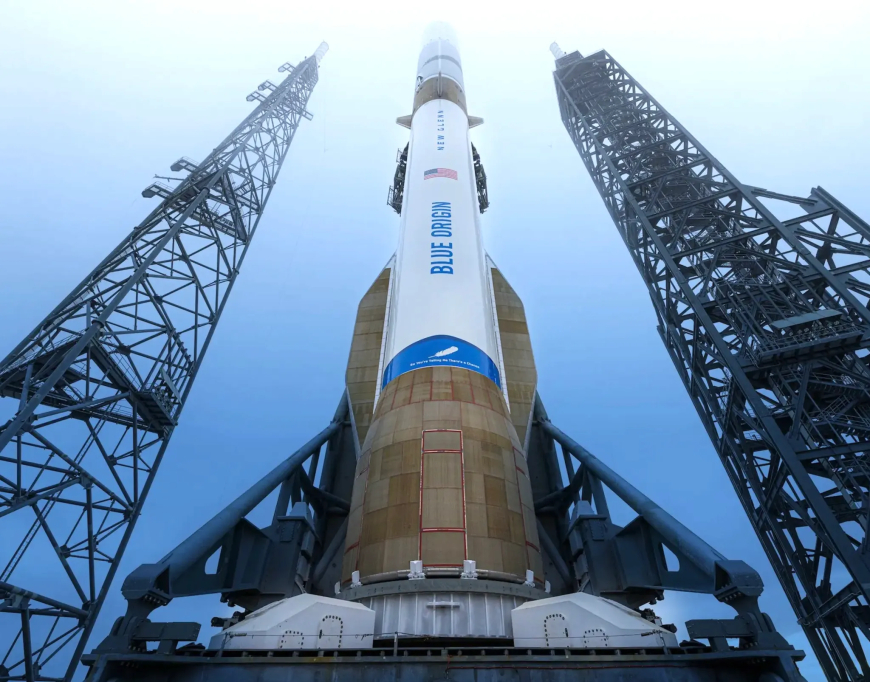
Blue Origin is targeting late February for the third launch of its heavy-lift New Glenn rocket, but the mission will not head to the moon as the company had previously indicated. Instead, the launch will carry a commercial satellite to low-Earth orbit for AST SpaceMobile, marking the second time New Glenn has flown a commercial payload.
The company has not explained why it opted to launch the AST SpaceMobile satellite rather than its own robotic lunar lander. That lander, known as Blue Moon Mark 1 (MK1), is currently being transported to NASA's Johnson Space Centre in Texas for vacuum-chamber testing. A launch date for the lunar mission has not yet been announced.
Our lunar lander is headed to the Lone Star State! ⭐
Blue Moon MK1 departed from Florida today, bound for @NASA_Johnson's Thermal Vacuum Chamber A, where it will undergo testing at the same facility as the Apollo spacecraft. pic.twitter.com/JD2yrqmb5h — Blue Origin (@blueorigin) January 21, 2026
Even so, the upcoming mission represents a significant milestone, as it will be the third New Glenn launch in just over a year following a development period that stretched close to a decade.
The launch is expected to take place during a hectic month for spaceflight. NASA could launch its Artemis II mission — which will send four astronauts on a lunar flyby — as early as February 6. Meanwhile, SpaceX is expected to begin testing the third version of its Starship rocket, and NASA and SpaceX are also scheduled to launch the Crew-12 mission. That flight is intended to help restore the International Space Station to complete staffing levels after the Crew-11 team was medically evacuated earlier this month.
For the late-February launch, Blue Origin plans to reuse the booster from New Glenn's second mission, which flew last November. That booster was successfully recovered by landing it on an ocean-based drone ship — a technique pioneered and refined by SpaceX with its Falcon 9 rockets.
New Glenn is Blue Origin's first orbital-class launch vehicle designed for regular missions to Earth orbit and beyond. It builds on the company's long-running suborbital New Shepard program, which has been operating for more than a decade. Blue Origin has signed an agreement with AST SpaceMobile to launch multiple satellites as the company works to deploy a space-based cellular broadband network.
The rocket is just one element of Blue Origin's broader ambitions. In November, the company revealed plans for a super-heavy version of New Glenn that would stand taller than the Saturn V rocket and rival SpaceX's Starship in scale. More recently, Blue Origin announced TeraWave, a satellite internet constellation it aims to begin deploying in late 2027.
Beyond Earth orbit, Blue Origin also intends to use its Blue Origin landers for future missions to the moon and Mars. The company is also developing Blue Ring, a spacecraft designed to host and deploy payloads for other space companies.
What's Your Reaction?
 Like
0
Like
0
 Dislike
0
Dislike
0
 Love
0
Love
0
 Funny
0
Funny
0
 Angry
0
Angry
0
 Sad
0
Sad
0
 Wow
0
Wow
0