





























Spain’s Xoople secures $130 million in Series B funding to build AI-powered Earth mapping
Spain-based Xoople raises $130M in Series B funding to develop high-resolution Earth mapping technology for AI, boosting geospatial data innovation.
Space data companies have long maintained that their services would find strong demand in the private sector, yet most adoption has historically come from government customers. Now, with artificial intelligence becoming central to business strategy, one Spanish startup is positioning itself as a key provider of high-quality Earth data for enterprise use.
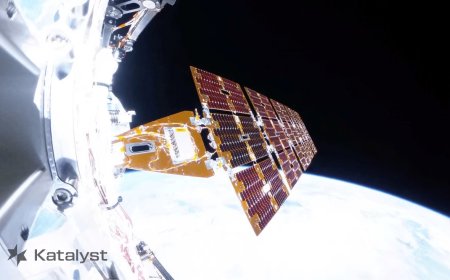
Xoople (pronounced “zoople”) is working on a satellite constellation designed to gather highly precise data tailored for deep learning models. Founded in 2019, the company has spent the past seven years building its technology stack using datasets sourced from government spacecraft while integrating its systems with major cloud providers.
CEO and co-founder Fabrizio Pirondini said that the company has secured $130 million in a Series B funding round led by Nazca Capital. Additional investors include MCH Private Equity, CDTI, Buenavista Equity Partners, and EnEndeavouratalyst.
Alongside the funding announcement, the startup revealed a partnership with L3Harris Technologies to begin developing sensors for its satellites. These sensors are intended to capture optical data at a level that Pirondini described as “two orders of magnitude better than existing monitoring systems.”
L3Harris has a strong track record of building advanced commercial imaging systems already deployed in orbit. However, Pirondini declined to provide detailed specifications about Xoople’s planned satellite constellation, including the number of spacecraft it intends to deploy. He did confirm that the technology will focus on optical data collection. Given the high cost of such systems, the company continues to seek additional funding to support full-scale development.
Pirondini also chose not to disclose the company’s valuation following the round, but noted that it has reached “unicorn territory.” To date, Xoople has raised a total of $225 million.
A key differentiator for the company is its emphasis on data quality. Still, Xoople is entering a competitive market that already includes established players such as Planet Labs, BlackSky, Airbus, and others that operate active satellite constellations and develop AI-focused datasets.
What sets Xoople apart is its focus on enterprise integration.
“Our business model is all about embedding our data and our solutions directly into the ecosystems of those platforms so they can deliver services straight to their customers,” Pirondini explained.
He outlined several potential applications, including government agencies monitoring transportation systems and assessing damage after natural disasters, agricultural companies tracking crop health, and large corporations overseeing infrastructure projects and supply chains.
Aravind Ravichandran, CEO of TerraWatch Space, said that Xoople’s strategy of prioritising distribution before having its own proprietary data is particularly notable. At present, the company relies on publicly available datasets, such as those provided by the European Space Agency’s Sentinel-2 satellites.
“They laid the distribution pipes before having their own data supply — embedding into Microsoft and Esri, the two platforms where enterprise, government, and most GIS users already operate, but neither has proprietary Earth observation data,” Ravichandran said. “Google’s early lead in geospatial AI models will be the benchmark they are compared against.”
It remains unclear how Xoople will balance offering raw data with building its own analytics tools. However, Pirondini said the long-term vision is to create what he calls “Earth’s System of Record,” a platform that could eventually support a comprehensive AI-driven model of the planet developed in collaboration with partners.
What's Your Reaction?
 Like
0
Like
0
 Dislike
0
Dislike
0
 Love
0
Love
0
 Funny
0
Funny
0
 Angry
0
Angry
0
 Sad
0
Sad
0
 Wow
0
Wow
0