






















India Leads the Way on Google’s Nano Banana with a Local Creative Twist
India emerges as the top country for Google’s Nano Banana usage, with users creating retro Bollywood portraits, AI sarees, and cityscape selfies. The Gemini app surges in popularity on App Store and Google Play, showcasing India’s unique and creative engagement with AI image-generation.
Google’s Nano Banana image-generation model, officially known as Gemini 2.5 Flash Image, has fueled global momentum for the Gemini app since launching last month. In India, the model has taken on a creative life of its own, with retro portraits and local trends going viral — even as privacy and safety concerns emerge.
India has emerged as the No. 1 country in Nano Banana usage, according to David Sharon, multimodal generation lead for Gemini Apps at Google DeepMind. The model’s popularity has also propelled the Gemini app to the top of the free app charts on both the App Store and Google Play in India, and the app has climbed to the top of global app store charts, according to Appfigures.
Given India’s scale — the world’s second-largest smartphone market and the second-largest online population after China — it is no surprise that the country is leading the adoption. What stands out to Google is how people are using Nano Banana: millions of Indians are engaging with the AI model in ways that are uniquely local, highly creative, and sometimes unexpected.
Local Creative Trends
- Retro Bollywood Portraits: Indians are recreating 1990s Bollywood-inspired looks, complete with period-specific fashion, hairstyles, and makeup.
- AI Saree Trend: Vintage-style portraits of individuals wearing traditional Indian attire.
- Cityscapes & Iconic Landmarks: Users generate selfies in front of landmarks like Big Ben and U.K. retro telephone booths.
- Transformative AI Creations: Time-travel effects, retro postage stamps, black-and-white portraits, and visualisations of encounters with younger selves.
- Global Trend Amplification: India helped popularise trends like the figurine trend, which originated in Thailand and Indonesia.
Beyond images, Indian users are leveraging Google’s Veo 3 AI video-generation model on the Gemini app to create short videos from old photos of grandparents and great-grandparents.
Gemini App Popularity in India
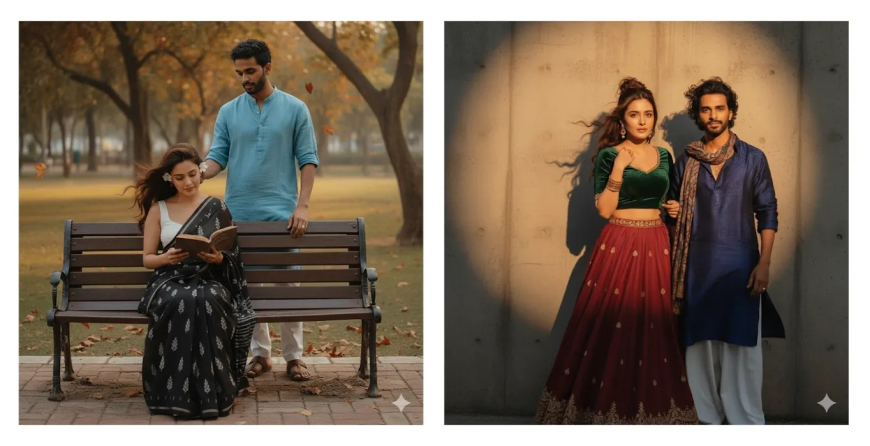
Nano Banana’s Retro trend sample Image Credits:Google
Between January and August, the app saw an average of 1.9 million monthly downloads in India — about 55% higher than in the U.S. — accounting for 16.6% of global monthly downloads, per Appfigures. India downloads have totalled 15.2 million this year until August, while the U.S. has had 9.8 million downloads.
Daily downloads surged following the Nano Banana update on September 1, starting with 55,000 installs and peaking at 414,000 on September 13. Gemini has held the top overall spot on the iOS App Store since September 10 and on Google Play since September 12, including across all categories.
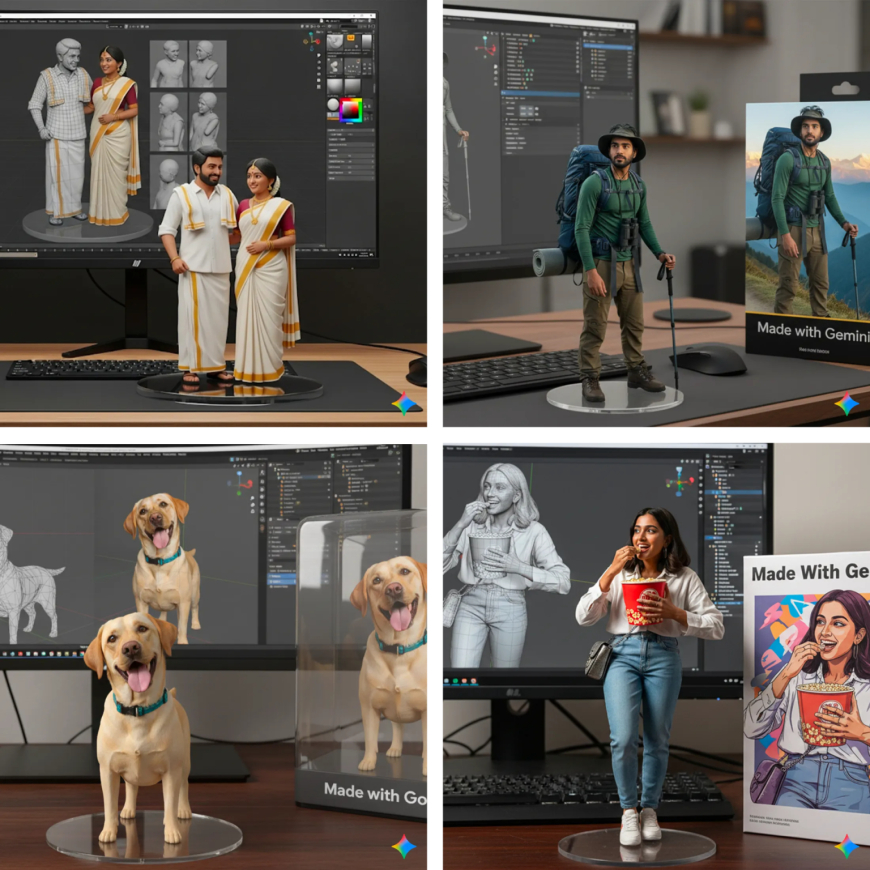
Nano Banana’s Figurine samples Image Credits: Google
Revenue and In-App Spending
India does not top in-app purchases; the Gemini app has generated an estimated $6.4 million globally on iOS since launch. The U.S. accounts for $2.3 million (35%), while India contributes $95,000 (1.5%). However, India posted a record 18% month-over-month growth in spending between September 1–16, compared to an 11% global increase, putting it ahead of the U.S.
Privacy and Safety Measures
Google acknowledges concerns about users uploading personal photos to transform their appearance. Sharon stated:
“When a user asks us to fulfill their query, we do our best to fulfill that query. We don’t try to assume what the user’s intent is. We’ve really tried to improve that, and we have improved that to be bold and fulfill your request.”
Google adds a visible diamond-shaped watermark on images generated by Nano Banana and embeds a hidden marker using SynthID, which allows detection and flagging of AI-generated content. Google is testing a detection platform with trusted testers, researchers, and experts, with plans for a consumer-facing version to check if an image is AI-generated.
“This is still day one, and we’re still learning together. There are things that we might need to improve on, and feedback from users, press, academia, and experts helps us improve,” Sharon said.
What's Your Reaction?
 Like
0
Like
0
 Dislike
0
Dislike
0
 Love
0
Love
0
 Funny
0
Funny
0
 Angry
0
Angry
0
 Sad
0
Sad
0
 Wow
0
Wow
0