



































Google announces a new Universal Commerce Protocol to facilitate AI agent-based shopping
Google introduces the Universal Commerce Protocol at NRF, an open standard for AI agent-based commerce. Developed with partners such as Shopify and Walmart, UCP enables seamless shopping, payments, and customer support through AI-powered search and apps.

Google has announced a new open standard designed to support AI-driven shopping experiences, unveiling the Universal Commerce Protocol (UCP) at the National Retail Federation (NRF) conference.
The protocol has been developed in collaboration with major commerce platforms and retailers, including Shopify, Etsy, Wayfair, Target, and Walmart. UCP is intended to allow AI agents to operate seamlessly across multiple stages of the customer buying journey, from product discovery to post-purchase support. Instead of requiring separate integrations for different agents or services, the protocol aims to provide a unified framework that handles these interactions end-to-end.
Google said the new standard is designed to work alongside other agent-based protocols, including the Agent Payments Protocol (AP2), which it introduced last year, as well as Agent2Agent (A2A) and the Model Context Protocol (MCP). According to the company, both agents and businesses will be able to adopt specific UCP extensions based on their individual requirements selectively.
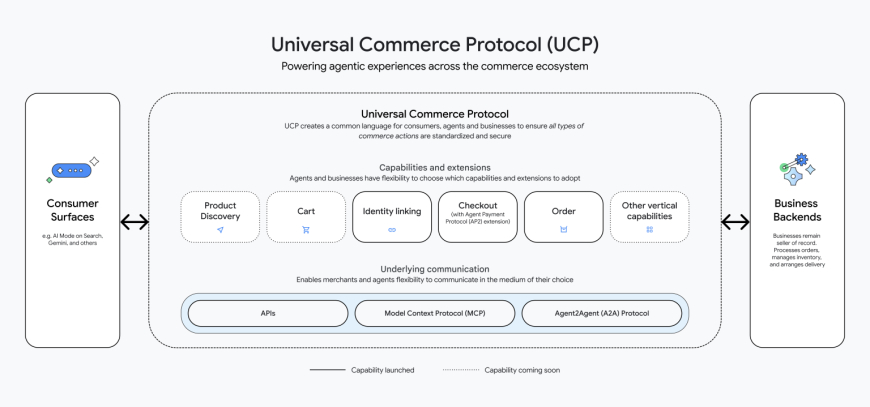
Image Credits: Google
In the near future, Google plans to use UCP for eligible product listings that appear in AI Mode within Search and across the Gemini apps. This will allow U.S. shoppers to complete purchases directly from participating retailers while researching products. Transactions will support Google Pay, with shipping details automatically pulled from users’ Google Wallet profiles. Google also confirmed that PayPal support will be available soon.
“This is one of the really exciting parts about agentic,” said Shopify CEO and founder Tobi Lütke. He noted that AI agents are especially effective at connecting people with products that match specific interests, sometimes surfacing items users would not have thought to search for. According to Lütke, this type of unexpected discovery is often where the strongest commerce experiences emerge.
Shopify also announced a separate but related initiative on the same day, unveiling a shopping integration with Microsoft Copilot that enables customers to complete checkout directly within a conversational interface.
Google is also introducing new consumer-facing advertising options tied to AI Mode in Search. Brands will now be able to offer special discounts to users when they are seeking product recommendations. For example, when a shopper asks for help finding a modern, durable rug suitable for frequent entertaining, a brand can configure a campaign to surface a relevant discount during that recommendation flow.
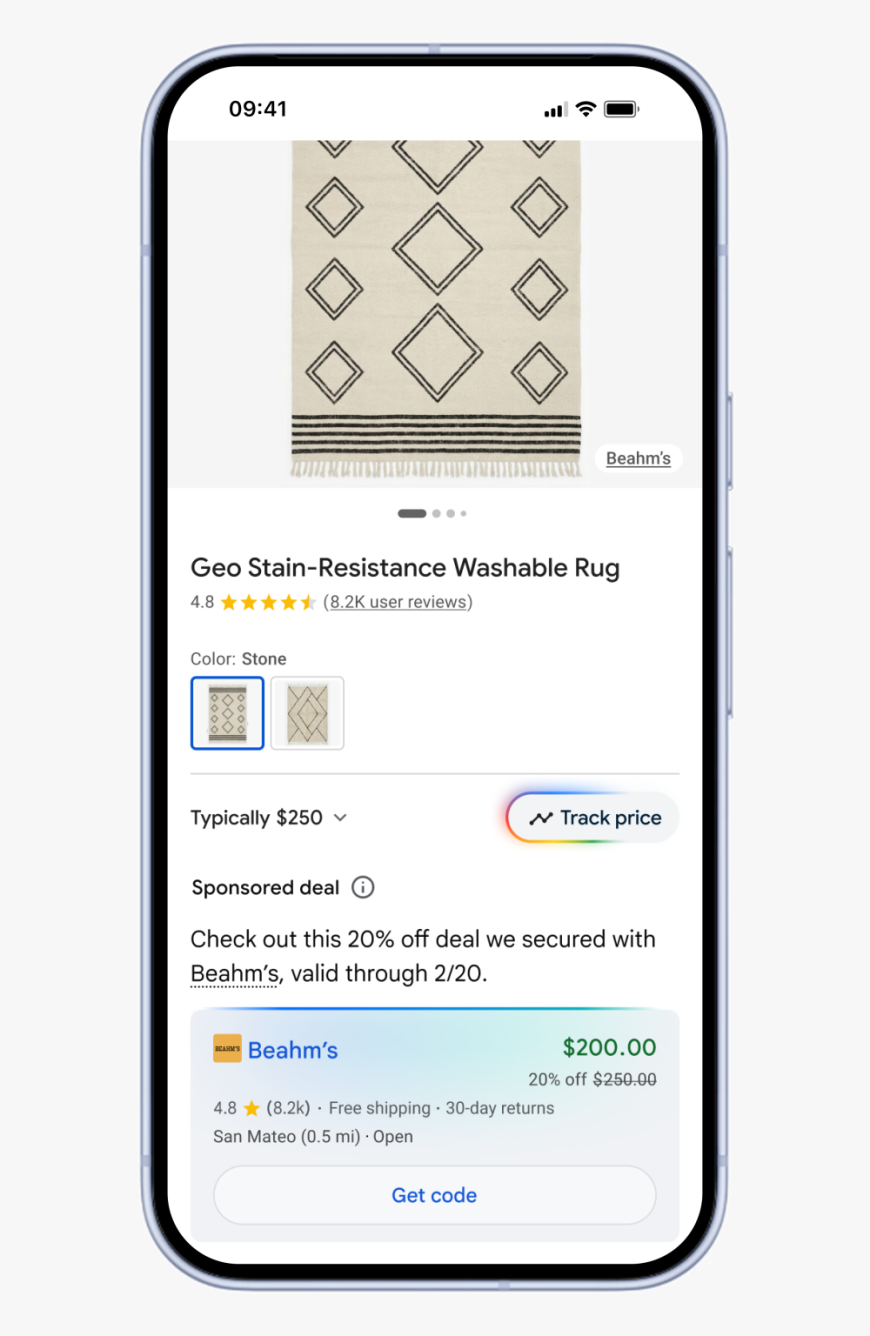
Image Credits: Google
On the merchant side, Google is expanding data attributes within Merchant Centre to help sellers better showcase their products across AI-powered search surfaces. Other companies, including PayPal and OpenAI, are also working to improve merchant discoverability in AI chatbot responses. Several startups focused on prompting and AI optimisation are similarly partnering with merchants to ensure their products appear more prominently in AI-generated answers.
Additionally, Google is now allowing merchants to deploy branded, AI-powered Business Agents directly within Google Search to respond to customer questions. The company said that retailers such as Lowe’s, Michaels, Poshmark, and Reebok are already using this capability. Competing platforms, including Meta and Shopify, have also been developing AI-based tools aimed at customer support and business outreach.
Alongside these updates, Google announced Gemini Enterprise for Customer Experience (CX), a new suite of tools designed to help retailers and restaurants manage shopping interactions and customer service using AI.
Across the broader industry, companies such as Google, Amazon, Walmart, and OpenAI have been steadily rolling out new standards and products to embed AI more deeply into both consumer-facing shopping experiences and merchant operations. Earlier this month, Adobe reported that traffic sent to seller websites from generative AI tools increased by 693.4% during the holiday season. However, the company did not disclose how much of that traffic ultimately converted into purchases.
The story has been updated to clarify that retailers can use AI agents directly within Google Search.
What's Your Reaction?
 Like
0
Like
0
 Dislike
0
Dislike
0
 Love
0
Love
0
 Funny
0
Funny
0
 Angry
0
Angry
0
 Sad
0
Sad
0
 Wow
0
Wow
0