
































Motional puts AI at the center of its robotaxi reboot as it targets 2026 for driverless service
Motional is rebooting its robotaxi strategy with an AI-first approach, aiming to launch a fully driverless commercial service in Las Vegas by the end of 2026.
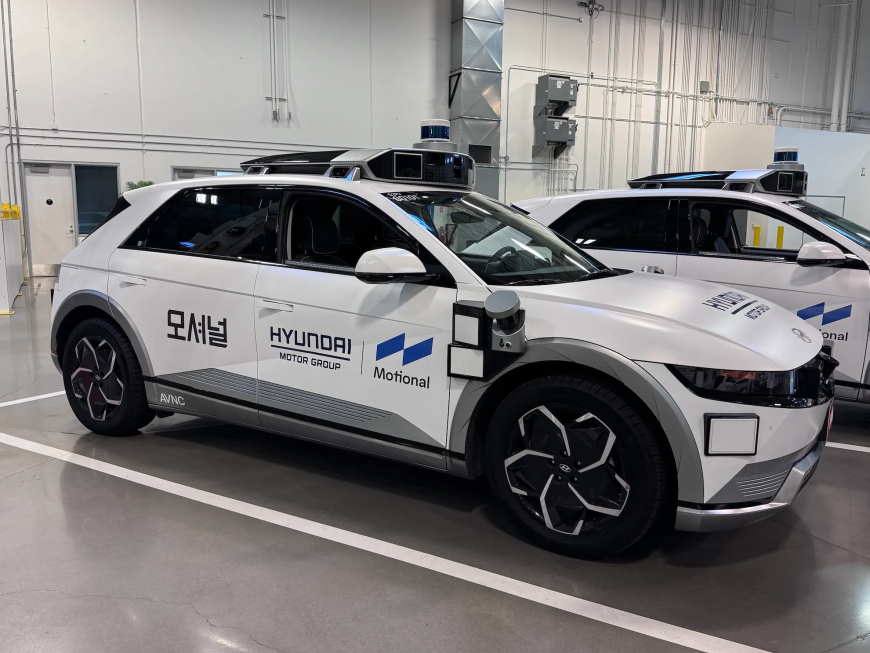
Motional found itself at a critical crossroads nearly two years ago, struggling to advance its robotaxi ambitions.
Created as a $4 billion joint venture between Hyundai Motor Group and Aptiv, Motional had already missed its original deadline to launch a fully driverless robotaxi service with partner Lyft. Aptiv later stepped away as a financial backer, leading Hyundai to inject an additional $1 billion to sustain the company. A series of layoffs followed, including a 40% workforce reduction in May 2024, reducing Motional's headcount from roughly 1,400 to fewer than 600. At the same time, rapid advances in artificial intelligence were reshaping how autonomous driving systems were being built.
Motional was forced to make a fundamental decision: adapt or fade away. The company chose to pause its commercial efforts and rebuild.
Motional has since rebooted its robotaxi program with an AI-first strategy and now plans to launch a commercial, fully driverless service in Las Vegas by the end of 2026. The company has already launched a robotaxi service for its employees, with a human safety operator seated in the driver's seat. Later this year, Motional plans to make that service available to the public through an unnamed ride-hailing partner. The company maintains existing relationships with Lyft and Uber. By the end of the year, Motional expects to remove the human safety operator and begin actual driverless commercial operations.
"We saw that there was tremendous potential with all the advancements that were happening within AI; and we also saw that while we had a safe, driverless system, there was a gap to getting to an affordable solution that could generalize and scale globally," said Motional president and CEO Laura Major during a presentation at the company's Las Vegas facility. "And so we made the very hard decision to pause our commercial activities, to slow down in the near term so that we could speed up."
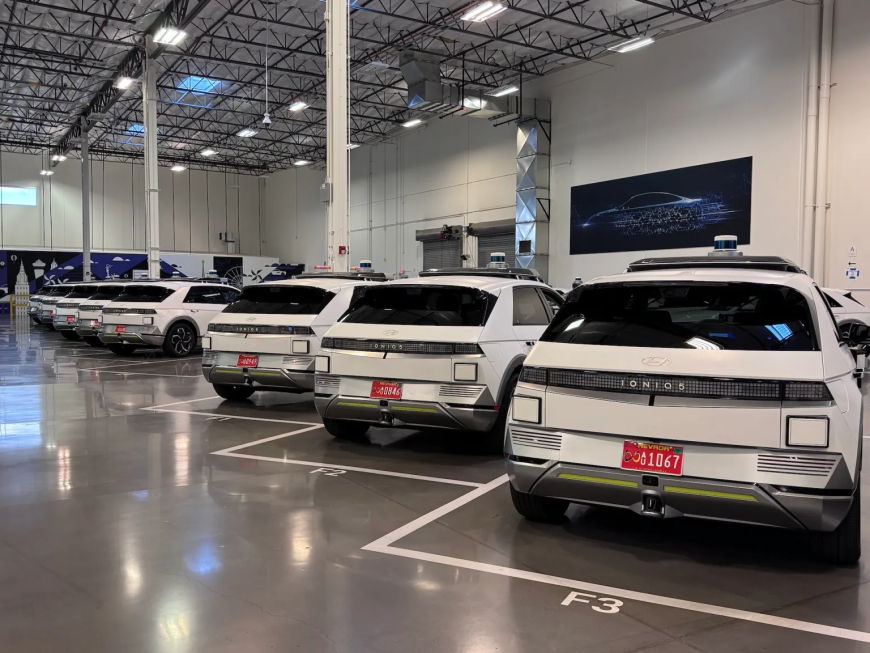
That decision required a significant shift in technical direction. Motional moved away from a traditional robotics-focused architecture to one centred on AI foundation models. While AI had always been part of Motional's system, earlier versions relied on separate machine-learning models for perception, tracking, and semantic reasoning, along with more rules-based software for other functions. According to Major, this resulted in a complex and fragmented software stack.
Meanwhile, transformer-based AI models — initially developed for language tasks — began to prove effective in robotics and autonomous driving. These architectures enabled large, unified models and helped drive the rise of systems such as ChatGPT.
Motional worked to integrate its smaller models into a single end-to-end backbone while retaining specialized models for developers. Major said this approach allows the system to generalize more easily to new cities and environments while keeping costs under control.
"This is really critical for two things," she said. "One is for generalizing more easily to new cities, new environments, new scenarios. And the other is to do this in a cost optimized way."
The company recently demonstrated its updated autonomous system during a 30-minute driverless ride in Las Vegas. While a single demonstration cannot fully evaluate a self-driving platform, it can reveal progress and highlight remaining challenges.
During the ride, a Hyundai Ioniq 5 autonomously navigated off Las Vegas Boulevard and into the busy pickup and drop-off area at the Aria Hotel — an environment Motional previously avoided. The vehicle carefully manoeuvred around stopped taxis, unloading passengers, pedestrians, large planters, and other vehicles.
In earlier Lyft deployments, Motional's vehicles handled only portions of trips autonomously, with human safety operators taking control in parking lots and crowded hotel pickup zones. In the recent demonstration, the car managed those areas without human intervention.
Some aspects remain under development. In-vehicle graphics for riders are still being refined, and the vehicle occasionally moves cautiously, such as when navigating around a double-parked delivery van. There were no disengagements during the demonstration, meaning the safety operator did not take control at any point.
Major said Hyundai remains committed to Motional's long-term vision.
"I think the real long-term vision for all of this is putting Level 4 on people's personal cars," she said, referring to a level of automation that requires no human intervention. "Robotaxis are stop number one and have huge impact. But ultimately, any OEM would want to integrate that capability into their vehicles."
What's Your Reaction?
 Like
0
Like
0
 Dislike
0
Dislike
0
 Love
0
Love
0
 Funny
0
Funny
0
 Angry
0
Angry
0
 Sad
0
Sad
0
 Wow
0
Wow
0