



























Nvidia Wants to Be the Android of Generalist Robotics
Nvidia unveiled a new robotics AI stack at CES 2026, signalling its goal to become the Android platform for generalist robots.

Nvidia unveiled a broad new stack of robot foundation models, simulation tools, and edge hardware at CES 2026, signalling its ambition to become the default platform for generalist robotics, much like Android became the operating system of choice for smartphones.
The move reflects a broader shift across the technology industry as artificial intelligence moves out of the cloud and into physical machines. Enabled by lower-cost sensors, advanced simulation tools, and AI models that increasingly generalise across tasks, robotics is entering a phase in which systems can learn to reason and operate in the real world.
On Monday, Nvidia detailed its full-stack ecosystem for what it calls physical AI, introducing new open foundation models designed to help robots reason, plan, and adapt across many environments and tasks. These models are available on Hugging Face and are intended to move robotics beyond narrow, task-specific applications.
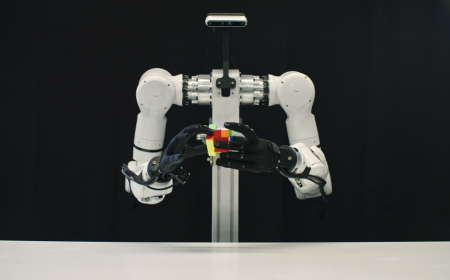
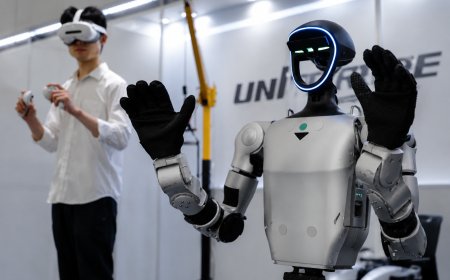
The newly released models include Cosmos Transfer 2.5 and Cosmos Predict 2.5, which function as world models for synthetic data generation and robot policy evaluation in simulation. Nvidia also introduced Cosmos Reason 2, a reasoning vision-language model that allows AI systems to perceive, understand, and act in physical environments. In addition, the company unveiled Isaac GR00T N1.6, its next-generation vision-language-action model designed for humanoid robots. GR00T uses Cosmos Reason as its core reasoning engine and enables whole-body control, allowing humanoid robots to move and manipulate objects simultaneously.
Alongside the models, Nvidia announced Isaac Lab-Arena, an open-source simulation framework hosted on GitHub. The platform enables safe, large-scale virtual testing of robotic capabilities and serves as a key component of Nvidia’s physical AI ecosystem.
The company says Isaac Lab-Arena addresses a significant challenge in robotics development: validating increasingly complex robotic behaviours in the real world is expensive, slow, and risky. The framework brings together training tools, task scenarios, and standardised benchmarks such as Libero, RoboCasa, and RoboTwin, helping to create a unified testing standard in an industry that has historically lacked one.
Supporting the broader ecosystem is Nvidia OSMO, an open-source command centre designed to connect the entire robotics workflow, from data generation through model training, across both desktop and cloud environments.
To power these systems at the edge, Nvidia introduced the Blackwell-powered Jetson T4000, the newest member of its Thor family of chips. The company describes the Jetson T4000 as a cost-effective on-device compute option that delivers 1,200 teraflops of AI performance and 64 gigabytes of memory, while operating within a 40- to 70-watt power envelope.
Nvidia is also expanding its collaboration with Hugging Face to make robotics development more accessible. The partnership integrates Nvidia’s Isaac and GR00T technologies into Hugging Face’s LeRobot framework, connecting Nvidia’s roughly 2 million robotics developers with Hugging Face’s 13 million AI builders. As part of this effort, the open-source Reachy 2 humanoid robot platform now works directly with Nvidia’s Jetson Thor chip, allowing developers to experiment with different AI models without being locked into proprietary systems.
Taken together, Nvidia’s strategy aims to lower barriers to robotics development while positioning the company as the underlying hardware and software provider powering the ecosystem—much like Android’s role in the smartphone market.
There are early indications that the approach is gaining traction. Robotics is now the fastest-growing category on Hugging Face, with Nvidia’s models among the most downloaded. At the same time, robotics companies, including Boston Dynamics, Caterpillar, Franka Robots, and NEURA Robotics, are already using Nvidia’s technology.
With its expanding suite of models, tools, and hardware, Nvidia is positioning itself to become a foundational layer for the next generation of general-purpose robots.
What's Your Reaction?
 Like
0
Like
0
 Dislike
0
Dislike
0
 Love
0
Love
0
 Funny
0
Funny
0
 Angry
0
Angry
0
 Sad
0
Sad
0
 Wow
0
Wow
0