




































Zoom brings its AI assistant to the web with access for free users
Zoom has launched its AI Companion 3.0 on the web and is extending limited access to free users. Basic plan users can summarise meetings, capture action items, ask questions, and use AI note-taking in up to three meetings per month. The update also adds third-party integrations, daily reflection reports, task creation, email drafting, and new document creation tools compatible with Zoom Docs, Google Drive, and OneDrive.

Zoom has expanded access to its AI assistant, bringing it to the web as part of the company’s AI Companion 3.0 rollout. For the first time, free-tier users will be able to use the assistant’s capabilities — including meeting summaries, action item lists, and insights — though with certain limitations.
Zoom says that basic plan users can access the AI Companion in three meetings each month, each offering meeting summaries, in-meeting questions, and AI-powered note-taking. Free users can also ask up to 20 questions through the side panel and the new web-based interface. Those who want unrestricted access can purchase a $10 add-on plan.
The new web interface also introduces conversation starter prompts to help users better understand the assistant’s capabilities.
Zoom added that the AI Companion can now retrieve information from third-party platforms such as Google Drive and Microsoft OneDrive, in addition to data stored within Zoom. Support for Gmail and Microsoft Outlook will be added soon.
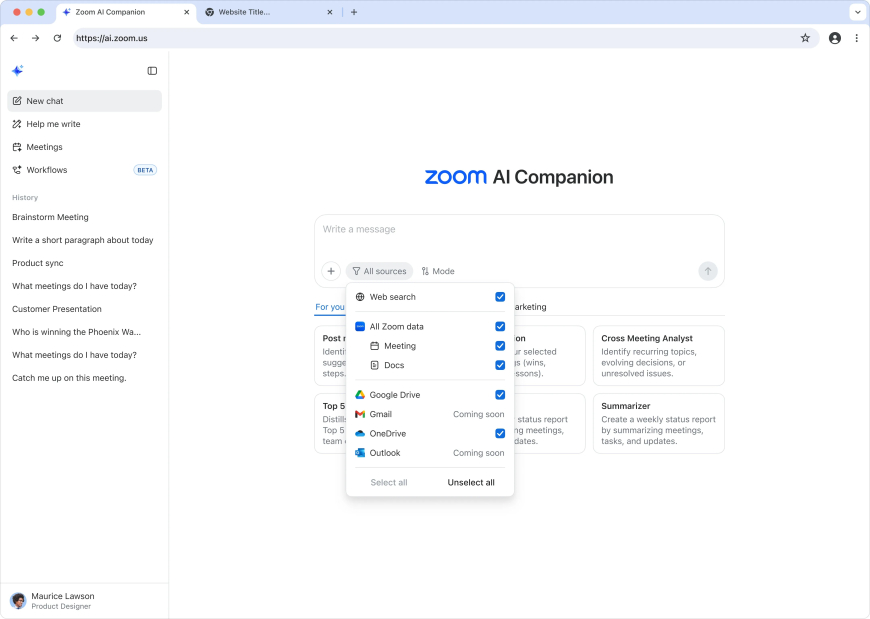
Image Credits: Zoom
The assistant also generates a daily reflection report that summarises meetings, tasks, and updates for the user. It can also create follow-up tasks and draft emails.
Zoom is expanding the assistant’s document-related features as well. With the latest update, users can draft and edit documents based on meeting content directly within the companion interface. These documents can then be moved into Zoom Docs for collaboration. Users can also export their documents as Markdown (MD), PDF, Microsoft Word, or Zoom Docs files.
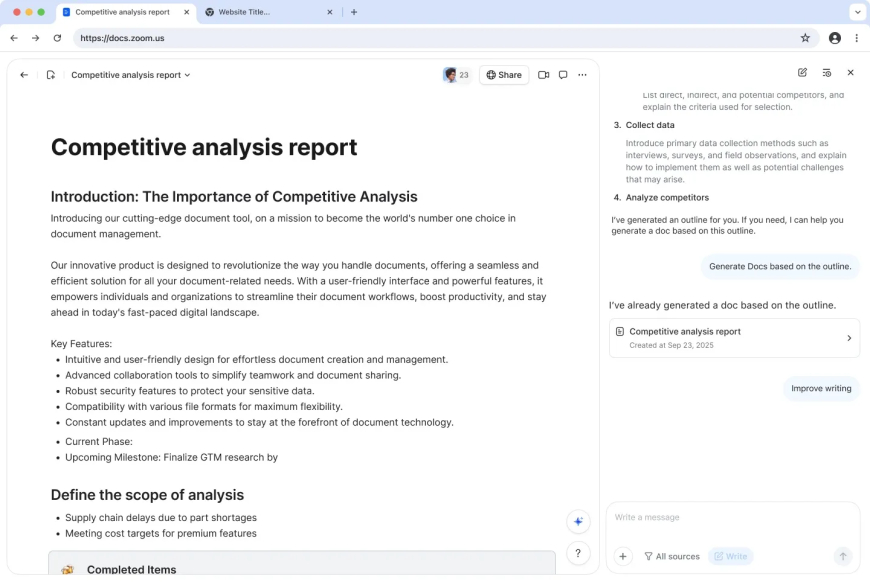
Image Credits: Zoom
Lijuan Qin, Zoom’s head of AI product, emphasised that Zoom’s independent platform gives it access to rich contextual meeting data, providing an advantage over competitors in the productivity market. The company uses a combination of its own AI models along with models from OpenAI and Anthropic.
Zoom, led by founder and CEO Eric Yuan, became widely used during the pandemic and has since expanded into a broader productivity suite. Its tools now compete with offerings from Google, Microsoft, ClickUp, and Notion, all of which aim to integrate more deeply with user workflows.
Earlier this year, Zoom introduced a cross-app notetaker designed to work with various meeting applications and even in offline meetings, further positioning the company in the productivity software landscape.
What's Your Reaction?
 Like
0
Like
0
 Dislike
0
Dislike
0
 Love
0
Love
0
 Funny
0
Funny
0
 Angry
0
Angry
0
 Sad
0
Sad
0
 Wow
0
Wow
0