Cities like New York City are home to ageing buildings that are structurally sound but often uncomfortable to live in. Constructed at a time when large, centralised boilers represented the height of heating technology, many of these buildings swing between being too hot and too cold, rarely settling into a comfortable middle ground.
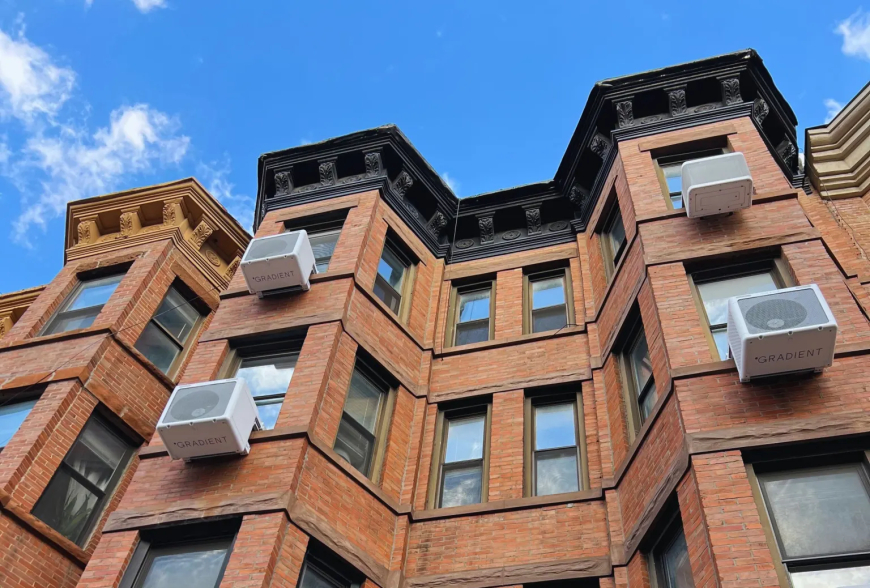
Several companies are attempting to solve this problem with cleverly designed horseshoe-shaped heat pumps. At a glance, they resemble traditional window air conditioners, but they don’t block the window view and are capable of both heating and cooling.
Gradient produces one of these heat pumps, and it’s now introducing a significant new capability. In multifamily buildings, Gradient can connect all of its window units into a single, coordinated system. The startup shared exclusive details with TechCrunch about its new Nexus software platform and accompanying service.
“Multifamily buildings are an ignored sector,” said Vince Romanin, Gradient’s chief technology officer. “It’s a place where we can do better for the user.”
Gradient primarily focuses on older buildings that require HVAC upgrades. The company has partnered with the New York City Housing Authority to install its heat pumps in public housing developments. It has also run a pilot project in Tracy, at a newer, two-story affordable housing complex. In addition, Gradient is in discussions with colleges and universities, many of which operate dormitories that were not designed to handle increasingly hot autumn weather.
Many older buildings are served by a single electric meter, which can encourage residents to overuse heating or air conditioning without directly bearing the cost. Nexus is designed to give building managers greater control. Using the system, managers can set boundaries that prevent excessive heating or cooling—whether intentional or accidental—while maintaining occupant comfort. In one case, a building manager capped the heating setpoint at 78°F, and energy consumption dropped by 25% the following day.
Romanin said Gradient’s heat pumps represent the “lowest-cost option” for ageing buildings with boilers nearing the end of their usable life, a common situation across New York City. An added benefit is that apartments that previously relied solely on steam radiators gain access to air conditioning, helping to future-proof units against more frequent and intense heat waves.
Because Gradient installs window units rather than minisplit systems, retrofits can often be completed in a matter of hours. They also avoid the need for major electrical upgrades, Romanin said. In buildings with outdated wiring that cannot support a full 12-amp load on a single outlet, Nexus can dynamically reduce power draw, according to Mansi Shah, senior vice president of product and software at Gradient.
The strategy extends beyond individual buildings to the broader electric grid. During peak-demand periods of peak demand —such as hot summer days—Gradient is developing methods to scale back its heat pumps while preserving indoor comfort temporarily. By combining building-level data with real-time sensor feedback from each unit, the company aims to predict which heat pumps can safely reduce cooling demand, such as those on the shaded side of a building. This type of demand-response capability could allow utilities to support more electrified heating and cooling systems without costly grid upgrades.
“There are a lot of people who said when we electrify everything, the grid won’t handle it,” Romanin said. “I think that it is very possible to electrify everything and make the grid better, make the grid’s job easier, and make electrons cheaper.”








































 Like
0
Like
0
 Dislike
0
Dislike
0
 Love
0
Love
0
 Funny
0
Funny
0
 Angry
0
Angry
0
 Sad
0
Sad
0
 Wow
0
Wow
0