Industry has delivered one of its strongest and most relevant storylines yet in season four: an aggressive pursuit to expose a fraudulent fintech company known as Tender.
The series follows Harper Stern as she leads her newly launched investment firm and searches for a company to short—essentially betting that its stock price will collapse. After receiving a tip from a journalist suggesting something is deeply wrong at Tender, Harper dispatches her associates, Sweetpea and Kwabena, to Ghana to investigate the company’s operations.
What they uncover is devastating. “Fake users drive fake revenue drives fake cash,” Sweetpea explains to Harper. The findings suggest that fabricated metrics underpin the entire business. “The thing is nothing,” she adds.
What makes this season of IndustryIndustrylarly compelling is how precisely it reflects the current moment in tech and finance. Tender begins as a payment processor for adult-content platforms. The show references the fundamental and still contentious Online Safety Bill introduced in the U.K., which imposed stricter age-verification requirements and other regulatory measures for online adult content. Because of its association with that industry, it is facing new government regulations and must either pivot or perish.
Its CFO-turned-leader, Whitney, pushes for a dramatic transformation: turning Tender into a bank. He outlines an ambitious plan to make that happen, including positioning the company’s CEO, Henry, as the public face of the pivot. Whitney embodies nearly every tech-baron cliché — move fast, break things, and win at any cost. He lobbies politicians for a banking license while actively scouting merger opportunities.
Harper, meanwhile, is steering her new firm after feeling undermined at her previous job and being dismissed as a DEI hire by the very man who brought her in — a pointed nod to the recent retreat from diversity initiatives across corporate America. Now aligned with a mix of new allies and old rivals, Harper is hunting for a company on the brink of collapse. To her, Tender is the perfect target.
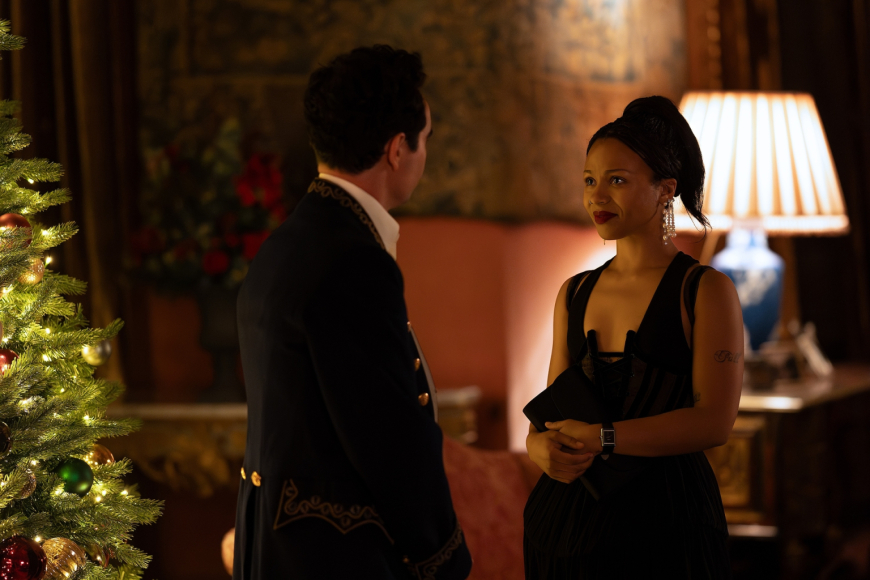
This pursuit puts her directly at odds with her friend Yasmin, who is married to Henry and is responsible for crafting Tender’s messaging and lobbying strategy. It’s a clash fueled by ego, loyalty, and ambition — the tension that keeps the series humming.
Industry captures the tech world with such sharp precision that reality itself begins to feel like satire.
The season also weaves in commentary on rising authoritarianism through the character Moritz, who rails against Western liberalism and hesitates to sell his family’s bank to Whitney, whose Jewish-sounding surname, Halberstram, becomes part of the tension. The subplot appears to echo real-world critiques of “technofascism,” which are increasingly levelled at some tech elites.
Harper remains, as ever, a calculating sociopath. “My real passion lies with finding dead men walking,” she declares during an investor breakfast — a moment that ultimately helps her raise millions for her new venture.
She is also the character whose rise most strains believability. From a personality standpoint, her ruthlessness makes sense: unlike Yasmin or Henry, she has no inherited wealth or safety net to fall back on. Still, it raises a thorny question — would the famously insular, exclusionary, and overwhelmingly white U.K. establishment truly allow a Black American woman to rise through its ranks andoutmanoeuvrer them at their own game?
“Who needs realism when she’s such a great character,” one Black British founder told me.
He added that the show nails how detached the U.K.’s upper class is from consequences and stands out as one of the few series that “accurately portrays the ruthlessness of the British elite, especially how they manipulate media and governments to serve their own interests.”
Another European investor echoed the sentiment, noting that “nepotism and a lack of professional boundaries — people sleeping together for trade secrets — is unfortunately very realistic and quite common.”
Meanwhile, Yasmin spirals toward an increasingly dark trajectory. Earlier in the season, she orchestrates a ménage à trois involving her husband, Henry and Whitney’s assistant, Hayley. As the episodes progress, her hedonism intensifies to the point that one reviewer has already compared her to Ghislaine Maxwell, an unsettling symbol of what festers at the intersection of wealth, power, and moral decay.
An Icarus-style downfall may be looming, at least for Whitney.
By now, viewers are well-versed in how real-world founders have inflated success through deception — from Charlie Javice’s Frank scandal to the catastrophic collapse of FTX. The show references several such cases, but perhaps the most striking parallel to Tender is the implosion of the German fintech Wirecard.
Wirecard eventually admitted that the billions of dollars it claimed to hold likely never existed, despite previous assertions that the funds were secured in Philippine banks. The scandal involved opaque accounting practices and regulatory blind spots — eerily similar to Tender’s fictional fraud. Short sellers targeted Wirecard as well, and one blog famously described them as “alternative whistleblowers” — those who act when “the market, and the regulator, refuse to see what is right in front of them.”
It’s a philosophy Harper could easily adopt, especially after Eric tells her that “short-only work is ugly, hard, investigative,” and inherently “anti-status quo, anti-establishment, anti-power.”
In the Wirecard case, multiple executives were arrested, the CEO among them, while the COO fled and was later accused of being a Russian spy. Tender’s ultimate fate remains unknown as the season nears its final episodes.
One of the industry’s strengths is its speed and breakneck pace. It is unmistakably rooted in the present and unapologetically audacious, forcing viewers to choose their preferred anti-hero and follow them wherever the chaos leads.
It’s exhilarating — a visual manifestation of a world without ethical capitalists. And just like in real life, we can’t look away.






































 Like
0
Like
0
 Dislike
0
Dislike
0
 Love
0
Love
0
 Funny
0
Funny
0
 Angry
0
Angry
0
 Sad
0
Sad
0
 Wow
0
Wow
0