People in the European Union can now download apps from third-party marketplaces on iPhone thanks to the Digital Markets Act (DMA), a regulation aimed at opening up competition in the mobile app economy. These alternative stores work a lot like Apple’s App Store in the sense that they offer a marketplace-style way to browse and install apps on Apple devices. The key difference is that the apps distributed through these third-party stores don’t pass through Apple’s standard App Review. Instead, Apple requires a “notarization” step that, according to the company, verifies compliance with certain “baseline platform integrity standards,” such as ensuring the software is free of malware. From there, each marketplace can apply its own additional review rules and approval policies.
Another major distinction: support and refunds aren’t handled by Apple. In third-party marketplaces, the store operator is responsible for customer service, refunds, and related support.
To operate an alternative iOS app marketplace in the EU, developers have to accept Apple’s DMA-related “alternative business terms.” One of the most debated parts of that structure is the Core Technology Fee (CTF). Under these terms, a marketplace operator must pay €0.50 for each first annual install of the marketplace app. Notably, for marketplace apps, that fee applies even before reaching 1 million installs — a threshold that differs from that for other EU apps distributed under Apple’s DMA business terms.
Even with these new requirements — and the complexity they entail — several companies and developers have moved quickly to take advantage of the ability to distribute iOS apps outside Apple’s storefront.
And this isn’t only an EU story. Other regions are moving in a similar direction. Japan, for example, has been exploring alternative app distribution models too. In December 2025, Apple said it would comply with Japan’s Mobile Software Competition Act (MSCA), which expands developers’ options to distribute apps and handle payments outside the App Store.
In Japan, the alternative distribution approach also comes with its own set of business terms. Those include an App Store commission ranging from 10% to 21%, an Apple payment processing fee of 5% for in-app purchases made through Apple’s system, a 5% core technology fee, and a 15% “store services” commission on web-based sales made through a link inside the app.
Here are the alternative app stores that iPhone users in these markets can try right now.
AltStore PAL (EU)
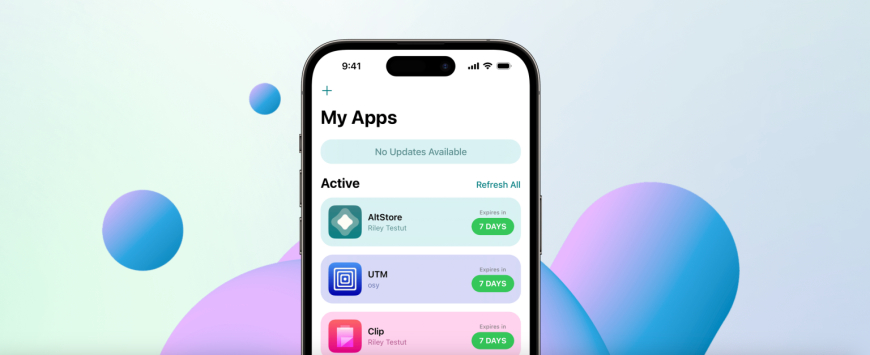
AltStore PAL is an officially approved alternative marketplace for EU users, co-created by developer Riley Testut — best known for building Delta, the Nintendo game emulator app. The store is open source, and it’s designed to help independent developers distribute apps alongside software published by AltStore’s own team, including Delta and an iOS clipboard manager called Clip.
AltStore PAL differs sharply from Apple’s App Store in how it handles distribution. Apps in AltStore are self-hosted by developers rather than uploaded and stored in a centralized marketplace catalogue. To publish, developers download an Alternative Distribution Packet (ADP), host it on their own server, and then create a “source” link that users add inside AltStore to access those apps. In practical terms, that means users don’t see one giant universal storefront by default — they see the apps that correspond to the sources they personally add.
Some widely shared apps that users have been adding include UTM (a virtual machine app that can run Windows and other software on iOS and iPadOS), OldOS (a SwiftUI-based recreation of iOS 4), Kotoba (a standalone iOS dictionary), iTorrent (a torrenting app), qBitControl (a remote client for qBittorrent on iOS devices), and PeopleDrop (a social discovery platform).
Setapp Mobile (EU — closed February 2026)
MacPaw’s Setapp was among the earliest companies to accept Apple’s DMA business terms to launch an alternative iOS app store for EU users. But the project was short-lived. MacPaw announced it would shut down Setapp Mobile on February 16, 2026, while clarifying that Setapp Desktop applications would not be affected.
MacPaw explained that “still-evolving and complex business terms that don’t fit Setapp’s current business model” led to the decision to sunset the service.
Before it closed, Setapp was known for its subscription model, bundling curated apps at a singlerecurring monthly price across iOS and Mac. After the DMA came into force, the company introduced a dedicated alternative marketplace for iOS users in the EU. Like Setapp’s broader offering, the mobile store packaged dozens of curated apps under a single subscription fee, and the catalogue expanded over time.
The apps in Setapp Mobile were typically ad-free and didn’t rely on in-app purchases, and the selection was generally considered high quality. However, the bundle did not include major mainstream apps such as Facebook, Uber, Netflix, and others.
Epic Games Store (EU)
Epic Games — the company behind Fortnite — launched its own iOS app store alternative in the EU in August 2024. The store gives users a place to download games, including Epic’s Fortnite, Rocket League Sideswipe, and Fall Guys, with additional releases promised over time.
Epic has also said it plans to expand distribution beyond its own store by bringing its games to other alternative marketplaces. That includes AltStore PAL, which Epic is supporting through a grant, as well as Aptoide’s iOS store in the EU and ONE Store on Android.
Epic’s return to iOS distribution through alternative marketplaces comes more than four years after Apple removed Fortnite from the App Store due to policy violations, a move that sparked Epic’s high-profile legal fight over what it described as an App Store monopoly. While U.S. courts ultimately concluded that Apple was not engaged in antitrust behaviour, the case still helped drive changes that allowed developers to link users to external websites under certain conditions, sometimes in exchange for a reduced commission.
Aptoide (EU)
Lisbon-based Aptoide is another option for iPhone users looking for an alternative app distribution platform, particularly focused on games. The company is known for operating a Google Play alternative, and it describes its system as open source. Aptoide says it scans apps to help ensure they are safe to download and install.
On iOS, Aptoide first launched via an invite-only beta in June 2024 and later expanded availability across the European Union. The store is free for consumers to use. To cover the Core Technology Fee that Aptoide pays Apple, the company does not charge users directly; instead, it takes a 10% to 20% commission on iOS in-app purchases, depending on whether the marketplace itself generated those purchases.
Across its broader ecosystem — including Android, the web, in-car platforms, and TV — Aptoide says it offers around 1 million apps to a user base of more than 430 million people.
Mobivention marketplace (EU)
Mobivention’s marketplace is positioned more as a business-to-business solution than a consumer-focused app store. It gives EU companies a way to distribute internal apps to employees — particularly apps that either can’t be published in Apple’s App Store or shouldn’t be made public for operational, compliance, or security reasons.
Mobivention also offers custom marketplace development for organizations that want to provide a private internal app store dedicated to corporate apps. For larger enterprises, the company says its underlying marketplace technology can be licensed, enabling deeper customization to match specific company requirements and workflows.
Skich (EU)
Skich has taken a different approach to app discovery. Last March, the company announced an alternative iOS app store for EU users built around a Tinder-style interface: users swipe right to “match” with apps they might like. Skich also plans features such as playlists and visibility into what friends are playing.
The alternative marketplace is intended to replace Skich’s existing app experience, and the company has said it will take a 15% commission on purchases made through the store. Rather than launching with a massive catalogue on day one, Skich promoted the store to developers — including outreach at the Game Developers Conference (GDC) — as part of its strategy to build inventory and partnerships over time.
Onside (EU and Japan)
Onside is an alternative iOS app store that operates in the EU and, more recently, Japan. The company expanded to Japan on February 17, 2026, following the rollout of new regulatory options that allow alternative distribution models in that market.
Onside says it plans to charge developers lower rates while maintaining strong security protections, including measures designed to keep payment information private. Today, the store supports bank card payments and Apple Pay. The company has also said it will later add additional payment methods, including iDeal, Klarna, and others.
For users, Onside is positioning itself as a more traditional “App Store-like” experience, highlighting a familiar interface with editorial collections, ratings and reviews, and automatic updates. The company also promotes access to popular apps and certain exclusives that aren’t available in the same way across other marketplaces.
































 Like
0
Like
0
 Dislike
0
Dislike
0
 Love
0
Love
0
 Funny
0
Funny
0
 Angry
0
Angry
0
 Sad
0
Sad
0
 Wow
0
Wow
0