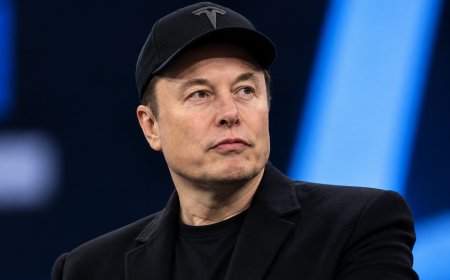
“Join xAI if the idea of mass drivers on the Moon appeals to you,” Elon Musk declared following a recent restructuring at xAI that saw several executives depart the AI lab.
The recruitment pitch arrived shortly after xAI’s merger with SpaceX and ahead of the combined company’s anticipated IPO. Observers might assume that xAI’s workforce would be primarily focused on building artificial general intelligence, competing with traditional software companies using deep learning, or refining internal projects such as “Macrohard.” Instead, Musk is once again directing attention skyward — this time to the Moon.
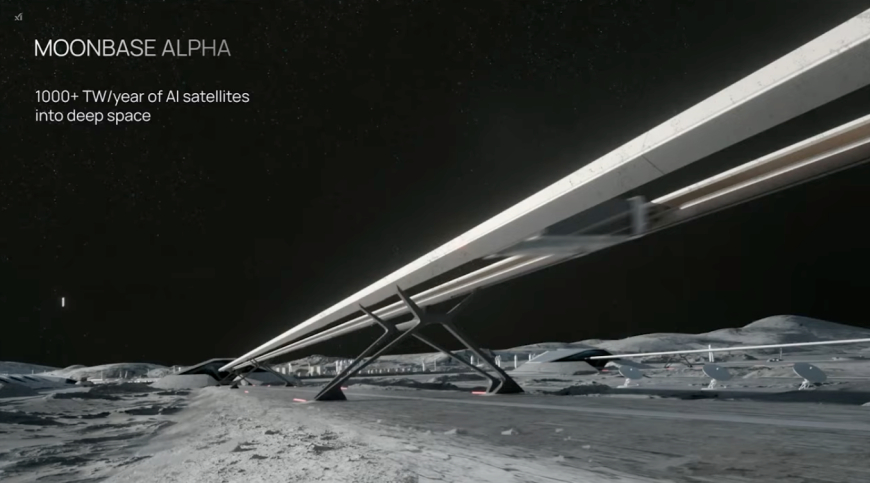
After previously outlining ambitions to construct AI data centres in orbit — a strategy positioned as a core synergy between SpaceX and xAI — Musk expanded on the idea. “What if you want to go beyond a mere terawatt per year?” he asked. “To do that, you have to go to the Moon…I really want to see a mass driver on the Moon that is shooting AI satellites into deep space.”
In Musk’s framing, orbiting data centres around Earth would be just the beginning. The next step, he suggested, would involve building even larger computing systems in deep space. To make that possible, he proposed establishing a lunar city capable of manufacturing space-based computers and launching them throughout the solar system using an electromagnetic mass driver, similar in concept to a large-scale maglev system.
For long-time Musk observers, the placement of the moon base concept within a publicly shared xAI all-hands presentation offered a familiar signal. The slide describing the lunar plan appeared at the end of the deck — a position historically reserved during SpaceX briefings for dramatic visions of rockets landing on Mars and discussions about the future of multi-planetary life.
The pivot to the Moon follows SpaceX’s recent public shift away from its longstanding goal of colonising Mars. With xAI now integrated into the broader corporate structure, Musk appears to be advancing a new, science-fiction-inspired narrative. This time, the reference point is the Kardashev Scale, a theoretical framework proposed in the 1960s by Soviet astronomer Nikolai Kardashev to classify civilisations by their energy consumption. The scale imagines civilisations progressing from harnessing planetary energy sources to eventually capturing the power of their star.
According to Musk, a lunar manufacturing base could allow the company to capture “maybe even a few per cent of the sun’s energy” to train and operate AI systems. “It’s difficult to imagine what an intelligence of that scale would think about,” he told employees, “but it’s going to be incredibly exciting to see it happen.”
Since unveiling plans for Marscolonisationn nearly a decade ago, Musk’s long-term vision has served as a powerful recruiting and branding tool for SpaceX. The company’s narrative of becoming a multi-planetary species helped align engineering efforts and distinguish SpaceX from traditional aerospace contractors focused on incremental government contracts. “Occupy Mars” became a recognisable symbol of that ambition.
The proposed moon base fits within that broader pattern — an evolution of Musk’s storytelling that now centres on AI as the defining technological frontier. The shift away from Mars became clearer in May 2025, when a Starship update presentation concluded with a now-abandoned vision of Tesla Optimus robots walking across the Red Planet.
One challenge with the Mars strategy was financial: there was limited commercial demand to fund such missions. Plans introduced in 2016 to adapt the company’s Dragon spacecraft as a Mars lander were shelved the following year due to escalating technical costs. Since first unveiling the vehicle that became Starship in 2016, SpaceX has recalibrated its priorities toward more immediate revenue sources — including launching satellites for its Starlink network and fulfilling approximately $4 billion in contracts to transport astronauts to the Moon for NASA.
By contrast, deploying AI infrastructure in Earth orbit could make economic sense if computing demand and terrestrial energy constraints continue to grow. Some analysts believe such scenarios might become feasible in the 2030s.
Establishing a manufacturing hub on the Moon, however, would require breakthroughs. While researchers and startups are exploring chip fabrication and precision manufacturing in space, producing large volumes of advanced computing hardware on the lunar surface would depend on dramatically reducing launch costs and building extensive supporting infrastructure. That includes transporting raw materials and constructing what Musk described as a “self-sustaining city.”
The ambitious proposal may serve as a long-term aspiration—a stretch objective designed to energise investors and engineers alike. For retail investors drawn to bold technological narratives, such a vision could bolster enthusiasm for SpaceX’s future public offering. For engineers, whether in AI or aerospace, the pivot may feel abrupt. Still, the narrative offers a distinct framing for xAI’s broader purpose beyond developing large language models.
As one departing executive reportedly remarked, many AI labs appear to be pursuing similar objectives. A solar system-scale supercomputer manufactured on the Moon would certainly stand apart. Whatever its feasibility, it is neither conventional nor dull — and it reinforces Musk’s ongoing reliance on expansive, future-focused storytelling to define his companies’ trajectories.



































 Like
0
Like
0
 Dislike
0
Dislike
0
 Love
0
Love
0
 Funny
0
Funny
0
 Angry
0
Angry
0
 Sad
0
Sad
0
 Wow
0
Wow
0