





































Rivian was saved by software in 2025
Rivian’s turnaround in 2025 was driven by software upgrades, cost controls, and improved vehicle margins, helping the EV maker stabilise operations and regain investor confidence.
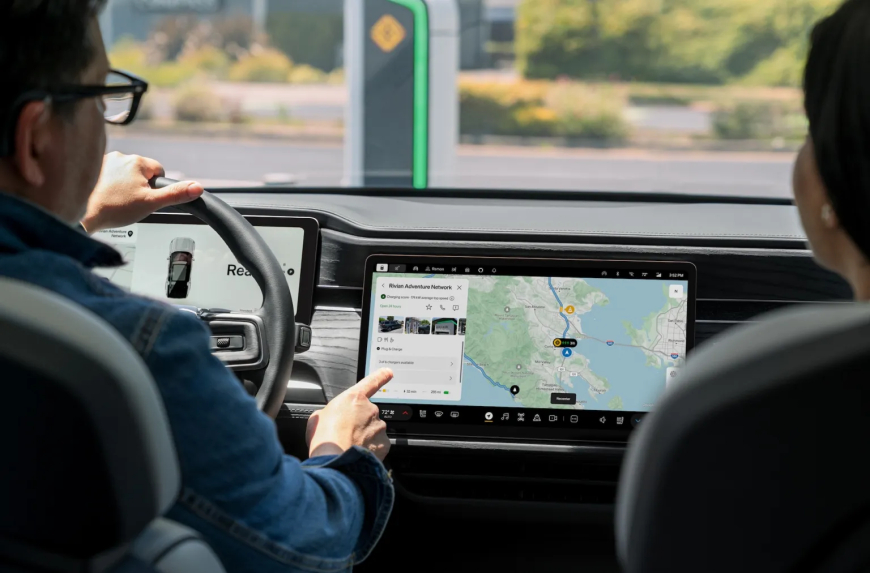
Rivian is, by every practical measure, an EV manufacturer that builds and sells electric vehicles. But in 2025, the company’s software and services business was the key driver of its 8% annual revenue growth.
Rivian reported on Thursday that it generated $5.38 billion in total revenue in 2025, rising from $4.97 billion a year earlier. That headline growth looks less bright when focusing only on automotive revenue, which slid 15% to $3.8 billion in 2025. Rivian said the decline was driven by a $134 million reduction in regulatory credit sales and weaker vehicle deliveries, though higher average selling prices partly balanced those headwinds.
By contrast, software and services revenue surged to $1.55 billion for the year, growing more than threefold. Rivian said most of that jump was tied to its joint venture with Volkswagen Group. The “services” portion of that segment, which Rivian does not separate, covers a mix of items including vehicle repairs, trade-ins, and maintenance-related services. The remainder — and the majority of the segment’s revenue — is tied to software, largely connected to the Volkswagen joint venture.
Volkswagen and Rivian created a technology joint venture in 2024 valued at up to $5.8 billion. The deal is structured around milestones, and in 2025 Rivian met one of those targets, triggering a $1 billion payout through a share sale. Under the joint venture agreement, Rivian will provide Volkswagen Group with its existing electrical architecture and software technology stack.
Rivian received an initial $1 billion convertible note in 2024, followed by another $1 billion payment in July 2025.
The company is expected to keep receiving additional payments from Volkswagen through 2027. On Thursday’s earnings call, CFO Claire McDonough said Rivian anticipates another $2 billion of capital from the joint venture in 2026.Approximately$11 billion of that depends on completing winter testing, which is currently underway. The other $1 billion is structured as nonrecourse debt and is expected to arrive in October.
Even with that funding acting as a meaningful cushion, Rivian’s financial performance in 2026 will depend heavily on the launch of its next EV, the R2.
In its earnings report on Thursday, Rivian reiterated that the R2 SUV — designed to be both cheaper to manufacture and more affordable for buyers — is expected to reach the market by June 2026. That lower-cost manufacturing goal is especially important for Rivian, which has historically lost money on each vehicle it produces.
For years, Rivian has worked to bring down its cost of goods sold. The company has made progress, including through the rollout of its second-generation flagship vehicles: the R1T pickup and the R1S SUV. McDonough said that in the fourth quarter, the company delivered “$92,000 of cogs per unit,” representing about a $4,000 per-unit improvement from the third quarter. Rivian’s cogs per unit stood at $99,000 in the fourth quarter of 2024.
Rivian also reported that its total automotive cost of revenue declined year over year, falling from $1.4 billion in the fourth quarter of 2024 to $898 million in the same quarter of 2025. At the same time, the company noted that the cost of revenue tied to software gradually increased as 2025 progressed.
The R2 SUV — initially launching as a dual-motor, all-wheel-drive model — gives Rivian another chance to push costs down further. The company expects to share more details on the R2, including final specifications, on March 12.
Rivian’s 2026 outlook suggests the company is counting on strong interest in the R2 and on its ability to scale production. On Thursday, Rivian said it expects to deliver 62,000 to 67,000 vehicles in 2026, representing as much as a 59% increase from last year. Rivian delivered 42,247 vehicles in 2025 across its two consumer R1 models and its electric delivery van (EDV).
CEO RJ Scaringe added that Rivian expects some growth in EDV sales in 2026. The company plans to build an all-wheel-drive version of the EDV and a variant with a larger battery pack, with Amazon remaining the primary customer.
“Both of those are to help unlock specific use cases within the Amazon network,” Scaringe said. “We’re working really closely with Amazon in defining the requirements of those and are excited to get those launched.”
Rivian is not projecting profitability — even on an adjusted basis — just yet. Still, it indicates a sizable improvement. The company posted a $3.6 billion net loss in 2025 and expects an adjusted net loss of $1.8-$2.1 billion in 2026. Rivian also forecast capital expenditures of $1.95 billion to $2.05 billion this year.
What's Your Reaction?
 Like
0
Like
0
 Dislike
0
Dislike
0
 Love
0
Love
0
 Funny
0
Funny
0
 Angry
0
Angry
0
 Sad
0
Sad
0
 Wow
0
Wow
0