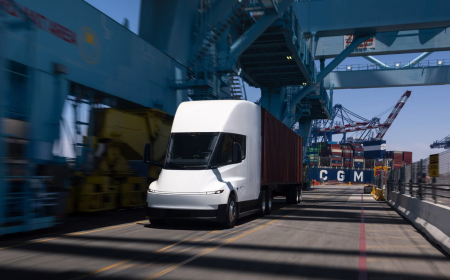
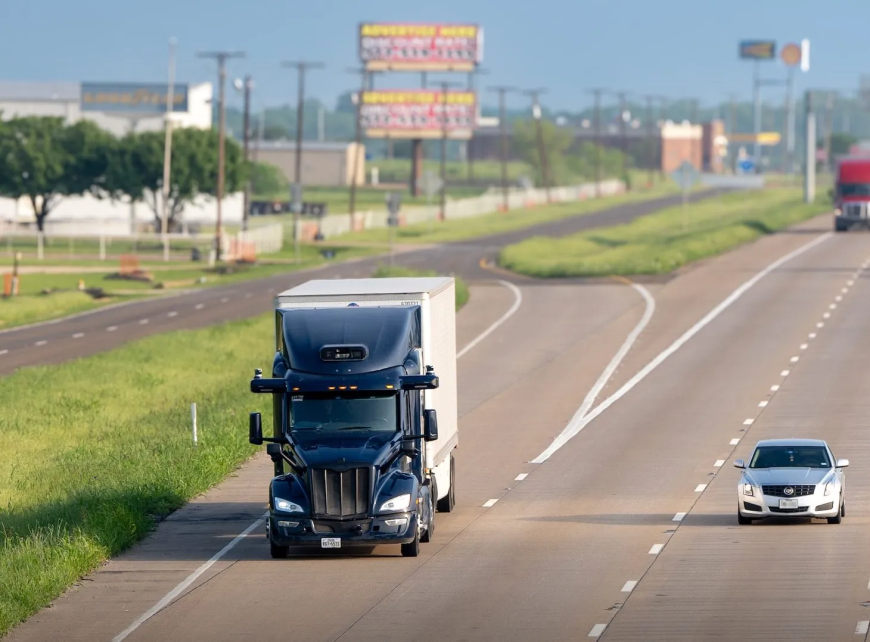
Aurora Innovation says its self-driving trucks are now capable of completing a continuous 1,000-mile freight route between Fort Worth, Texas, and Phoenix, Arizona. This journey surpasses what a human driver can legally accomplish in a single stretch.
The milestone has important financial implications for Aurora and other companies seeking to commercialise autonomous semitruck technology. According to Aurora, its driverless trucks can complete the 1,000-mile haul in roughly 15 hours. Human drivers, by contrast, are restricted by federal hours-of-service regulations that limit driving time.
Under federal rules, truck drivers must take a 30-minute break after eight hours of driving and are limited to a maximum of 11 hours behind the wheel within a shift. Once they reach that threshold, they are required to remain off duty for 10 hours before resuming operations. Those constraints extend the total time needed to cover long-haul routes.
“This represents more than a technological achievement,” Aurora co-founder and CEO Chris Urmson said during the company’s earnings call on Wednesday. “It is the dawn of a superhuman future for freight.”
Aurora argues that the ability to operate nearly nonstop offers compelling economics for customers such as Uber Freight, Werner Enterprises, FedEx, and Schneider. The company believes it can eventually reduce transit times by nearly half. This factor has drawn support from customers, such as Hirschbach, an early adopter on the Fort Worth-to-Phoenix corridor.
In a letter to shareholders, Aurora said it is preparing to expand operations throughout the Sun Belt region of the United States. The company currently runs driverless routes — some still including a human observer in the cab — between Dallas and Houston; Fort Worth and El Paso; El Paso and Phoenix; Fort Worth and Phoenix; and Laredo and Dallas.
The network expansion has marked Aurora’s evolution from a technology developer into a commercial operator generating revenue from autonomous freight services.
Aurora began reporting revenue in April 2025, when it deployed heavy-duty driverless trucks for commercial service on public highways. According to a filing with the U.S. Securities and Exchange Commission, the company generated $1 million in revenue during the fourth quarter and $3 million for the full year. Chief Financial Officer David Maday said adjusted revenue, including proceeds from pilot programs earlier in the year, totalled $4 million.
While those figures remain modest relative to overall expenses, they represent progress over 2024, when the company recorded no revenue. Aurora posted a net loss of $816 million in 2025, a 9% increase from the previous year, as it invests in scaling operations.
The company expects revenue growth as it expands both its fleet and the number of fully autonomous routes. Aurora currently operates 30 trucks, 10 of which are unmanned. By the end of the year, it expects to grow its fleet to more than 200 vehicles. Urmson said Aurora’s trucks have accumulated 250,000 fully driverless miles as of January 2026 without a safety incident.
In the second quarter, Aurora plans to introduce a fleet of driverless International Motors LT trucks that will operate without a human observer in the cab. At present, Aurora’s autonomous routes using Paccar trucks include a safety observer at the request of the manufacturer.
Urmson expressed optimism about the company’s trajectory, citing advances in its autonomous driving software, a forthcoming second-generation hardware system designed to lower costs, and continued geographic expansion. The latest progress is supported by Aurora’s fourth software release since launching commercial operations in April 2025.
According to the company, its first release validated driverless operations between Dallas and Houston: the second confirmed nighttime operations, and the third extended service to El Paso. The newest release equips the system to handle the varied geography and climate conditions across the southern United States.
“Just as the last two years brought robotaxis into the mainstream, we expect 2026 to mark the inflexion point where the market recognises that self-driving trucks have arrived and are quickly becoming a permanent fixture in our transportation landscape,” Urmson said on the earnings call. “If you’re in the Sun Belt in 2026, you won’t just read about the Aurora driver. You’ll see it every day.”
Aurora currently operates autonomous freight routes in Texas, New Mexico, and Arizona. The company has outlined plans to expand driverless operations into Nevada, Oklahoma, Arkansas, Louisiana, Kentucky, Mississippi, Alabama, North Carolina, South Carolina, Georgia, and Florida as part of its broader rollout strategy.






































 Like
0
Like
0
 Dislike
0
Dislike
0
 Love
0
Love
0
 Funny
0
Funny
0
 Angry
0
Angry
0
 Sad
0
Sad
0
 Wow
0
Wow
0