Meeting notetaker Read AI on Thursday launched a new AI-powered email-based assistant called Ada, which can help users manage scheduling, answer questions using a company’s knowledge base, and respond to out-of-office emails.
Read AI describes Ada as a “digital twin” that can handle tasks on a user’s behalf around the clock. The company said Ada will be available to all users, and people can begin setting it up by emailing “ada@read.ai” with the words “Get me started.”
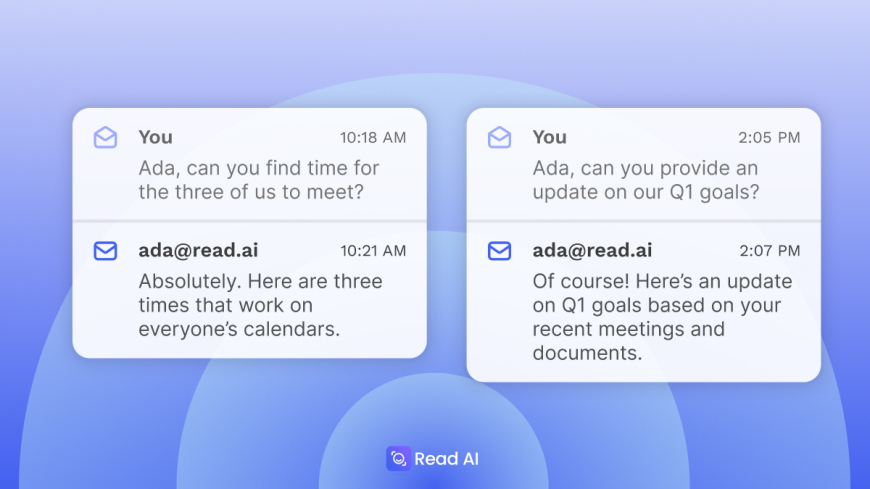
When a user asks Ada to find time for a meeting, the assistant responds directly to the other person within the email thread with the user’s available time slots. If the recipient replies that they can’t make those times and requests alternatives, Ada follows up with new options. Read AI said that while Ada can access a user’s calendar through the Read AI platform, it does not share details about what those calendar events are with others.
Ada can also respond to questions using a company’s internal knowledge base, topics discussed in a user’s past meetings, and public internet searches. For example, users can ask “Ada, can you provide an update on how we are tracking for Q1 goals?” and receive a response based on available information.
If someone else in an email thread asks a question, Ada will draft a reply for the user and help refine it before sending the message. The company stated that Ada does not disclose sensitive information without explicit user permission.
Read AI’s VP of Product, Justin Farris, said the feature does not rely on MCPs (model context protocols, a technical standard that connects AI tools to external services). Instead, he said Ada builds a knowledge graph using meeting data and connected services to generate more contextual answers. He added that over time, Ada is expected to take more proactive actions. For instance, if a follow-up action item is mentioned during a meeting, Ada may prompt the user to set it up after the meeting using contextual data.
“The way I describe our solution is that when you are bringing on a new employee, you train them. When you add Ada to your workflow and connect more services to give more context, it starts to ramp up and handle more tasks for you,” CEO David Shim said.
Read AI said Ada currently operates through email, but it plans to bring the assistant to Slack and Microsoft Teams soon.
Speaking on the sidelines of Web Summit Qatar earlier this month, Shim said the company now has more than 5 million monthly active users and is targeting growth to 10 million. He added that Read AI sees about 50,000 sign-ups per day and also has a broader base of around 100,000 people who view Read AI content — such as meeting summaries — without registering for an account.
For Read AI, the U.S. remains its biggest market, though international growth is strong. The company said 60% of users are outside the U.S., while revenue is split roughly evenly.
Read AI, which has raised more than $81 million in funding, continues to add AI-driven tools to its product suite. Last year, it introduced Search Copilot for knowledge discovery. Last month, it added features that allow users to update customer-relationship software, send customised emails from within a meeting report, and stay current on topics using internal sources and web-based information.
Other meeting notetakers are also expanding their feature sets to pull more insights and actions from meeting data. Last September, Granola introduced “recipes” — repeatable prompts designed to surface knowledge from meeting information. Quill, which emerged from stealth this week with a $6.5 million funding round, integrates with tools like Linear, Notion, and CRMs and is built for task automation.






































 Like
0
Like
0
 Dislike
0
Dislike
0
 Love
0
Love
0
 Funny
0
Funny
0
 Angry
0
Angry
0
 Sad
0
Sad
0
 Wow
0
Wow
0