

































Simulation startup aims to become the “Cursor” for physical AI
A simulation startup is building tools to accelerate the development of physical AI, aiming to become the “Cursor” for robotics, automation, and real-world systems.
The idea behind physical AI is that engineers will eventually be able to program machines in the real world as easily as they build software today. That vision is still some distance away, largely because robotics remains limited by a shortage of high-quality data from real-world environments.
To train robots effectively, companies often rely on expensive physical testing setups, such as building mock warehouses or capturing large volumes of sensor data from real-world operations. Entire industries have emerged around the collection and labelling of this data, including monitoring factory lines and gig workers to improve machine learning models.
Simulation offers an alternative approach. By creating highly detailed virtual environments that replicate real-world conditions, developers can generate the data and testing scenarios needed to train robots at scale. This is where Antioch is positioning itself, aiming to bridge what is commonly referred to as the “sim-to-real” gap — the challenge of ensuring that systems trained in virtual environments behave reliably once deployed in the physical world.
Co-founder Harry Mellsop explained that the goal is to make simulated environments indistinguishable from reality from the perspective of an autonomous system. To support that mission, the New York-based startup has raised $8.5 million in seed funding, valuing the company at $60 million. The round was led by A* and Category Ventures, with participation from MaC Venture Capital, Abstract, Box Group, and Icehouse Ventures.
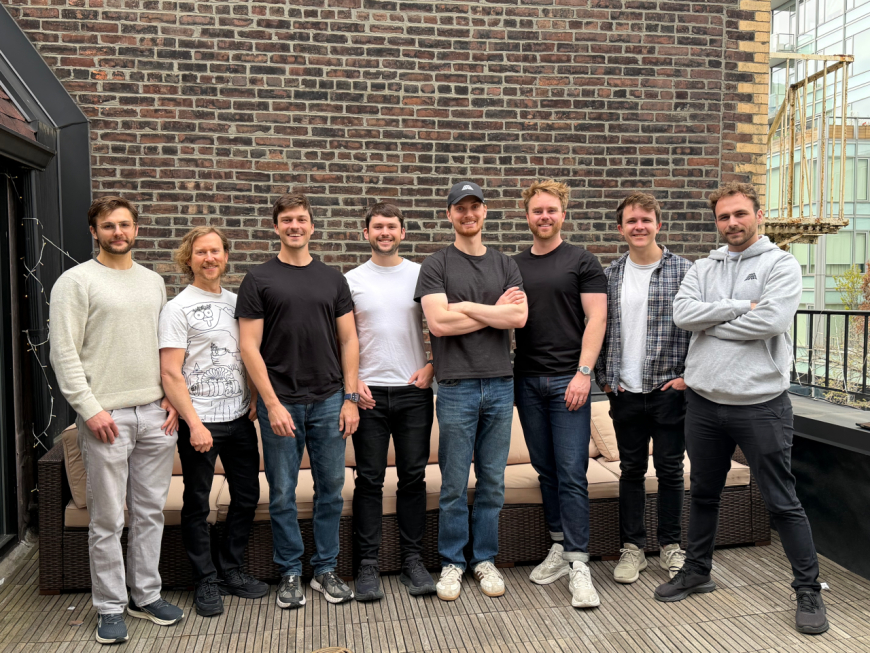
Mellsop founded the company in May last year alongside four co-founders. Two of them, Alex Langshur and Michael Calvey, previously co-founded Transpose, a startup that Chainalysis later acquired. The remaining co-founders, Collin Schlager and Colton Swingle, bring experience from Meta Reality Labs and Google DeepMind.
The importance of simulation is already evident across the autonomy sector. For example, Waymo uses world models developed by Google DeepMind to test and validate its autonomous driving systems. These tools help reduce the need for costly real-world data collection when expanding into new environments.
Antioch aims to make similar capabilities accessible to smaller robotics companies that lack the resources to build their own large-scale testing infrastructure. The platform allows developers to create multiple digital versions of their hardware systems and connect them to simulated sensors that replicate real-world inputs. This enables testing of edge cases, reinforcement learning, and the generation of new training datasets.
The company compares its approach to tools like Cursor, which transformed software development workflows. Antioch’s goal is to offer a comparable layer for physical AI, where developers can iterate on robotic systems primarily in software before deploying them in the real world.
Achieving this requires extremely high-fidelity simulations. The physics within these virtual environments must closely match reality to ensure safe and reliable performance when systems are deployed. Antioch builds on foundational models from companies such as Nvidia and World Labs, adding domain-specific tools that simplify their use for developers.
Investor interest reflects the growing importance of this space. Çağla Kaymaz, a partner at Category Ventures, noted that while software development tools have rapidly evolved with large language models, the stakes are higher in physical AI, where failures can have real-world consequences.
Antioch is currently focusing on sensor and perception systems, which are critical for applications like autonomous vehicles, industrial machinery, and drones. While broader ambitions for general-purpose robots remain further out, the company has already begun working with both startups and large multinational organisations investing in robotics.
Adrian Macneil, an angel investor and former executive at Cruise, emphasised the importance of simulation in building reliable autonomous systems. He pointed out that real-world testing alone cannot provide sufficient data for safety validation at scale.
Macneil also highlighted the need for a broader ecosystem of tools, similar to platforms like GitHub, Stripe, and Twilio in the software world, to support the development of physical AI systems.
Researchers are already exploring these possibilities. At MIT Computer Science and Artificial Intelligence Laboratory, experiments are underway using Antioch’s platform to evaluate AI models by having them design and test robots within simulated environments. These experiments include competitive scenarios in which models can be tested against one another under controlled conditions.
Despite the progress, significant work remains to close the gap between digital simulations and real-world performance. If successful, however, developers could create powerful feedback loops that accelerate innovation, similar to those seen at leading autonomy companies.
For Antioch, the vision is clear: as physical AI evolves, the tools used to build it may increasingly resemble those used in software development — with simulation at the centre of that transformation.
What's Your Reaction?
 Like
0
Like
0
 Dislike
0
Dislike
0
 Love
0
Love
0
 Funny
0
Funny
0
 Angry
0
Angry
0
 Sad
0
Sad
0
 Wow
0
Wow
0