The AI-powered note-taking app Granola, which has reached a $1.5 billion valuation, has gained traction among founders and venture capitalists in the tech world. However, one developer saw an opportunity to build a more privacy-focused alternative — one that runs entirely on-device, avoids subscriptions, and is available for a one-time payment. That idea led to the development of a new Mac application called Talat.
Nick Payne, a developer based in Yorkshire, England, describes himself as a computer enthusiast and explains that the inspiration for Talat emerged from a series of unexpected discoveries.
“I think Granola is awesome; it’s a shining example of what you can do with an Electron app [a framework for building desktop applications] given enough love and care,” he said. “When I first tried it, I was fascinated that it managed to record system audio on my Mac without recording video, which was the standard workaround at the time. That led to a ton of research, discovering a relatively new and poorly documented Apple API.”
To better understand and work with the Core Audio Taps API — which allows developers to access audio streams on a Mac — Payne built an open-source audio library called AudioTee.
“During that time, I was slowly piecing together a toolkit, but I never found anything that felt like it could stand on its own as a product rather than just a cool tech demo,” Payne explained. “The state-of-the-art hosted transcription models — the same providers folks like Granola use — are incredible, and it’s viscerally cool to see your speech unfurled onscreen in near real time. But it always nagged me that the trade-off required providing not just my data, but my audio data; my actual voice,” he added.
The turning point came when Payne discovered FluidAudio, a Swift-based framework that enables fast, fully local audio processing on Apple devices. This tool allows transcription models to run directly on a Mac’s Neural Engine — Apple’s dedicated AI hardware — without sending any data to external servers.
That discovery made it possible to build a product in which all processing happens locally, ensuring that users’ audio and transcripts remain entirely on their devices.
Talat, developed in collaboration with Payne’s longtime friend and former colleague Mike Franklin, is the result of this work. The app is lightweight, at around 20 MB, and is offered as a one-time purchase. It doesn’t require users to create an account or share analytics data, and it avoids ongoing subscription fees.
While some AI meeting tools offer a wide range of advanced features, Talat focuses on simplicity and efficiency. It records audio from the Mac’s microphone during meetings on platforms such as Zoom, Microsoft Teams, and Google Meet, and transcribes conversations in real time. The app attempts to identify speakers automatically, though users can manually adjust them if needed. It also allows note-taking alongside transcripts, with options to edit, delete, or split sections.
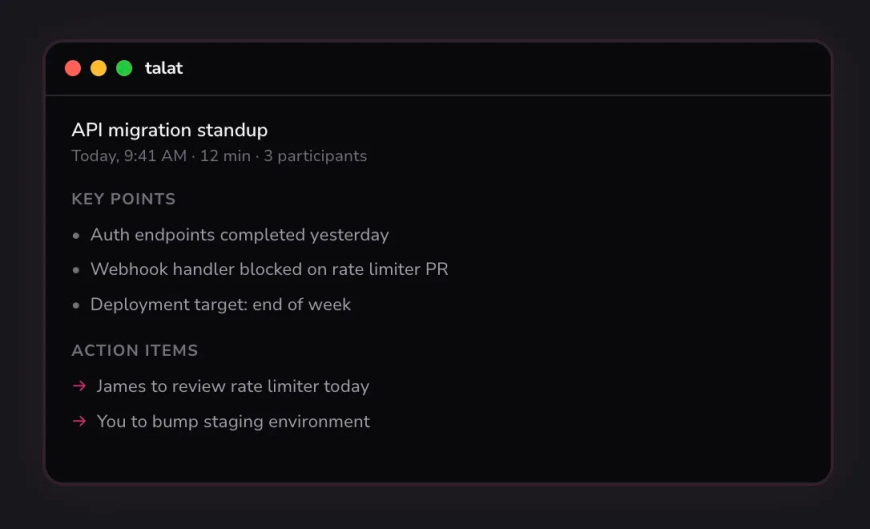
Once a meeting ends, a local large language model generates a summary that includes key points, decisions, and action items. All notes, transcripts, and summaries remain searchable within the app.
Beyond privacy, Payne says flexibility is another core goal of the product.
“We’re leaning into configurability and letting users control where their data goes: pick your own LLM, auto-export to Obsidian, webhooks that push data out when a meeting finishes, an MCP server — a standardised way for AI tools to connect to outside data sources — to pull it on demand,” he explained.
Under the hood, Talat uses a mix of AI components, largely built around FluidAudio. For summarisation, it defaults to a model called Qwen3-4B-4bit, which is optimised to run efficiently even on less powerful hardware.
Users also have the option to switch to cloud-based AI providers or use alternative models, including Nvidia’s Parakeet speech-recognition models or local setups via Ollama, giving them greater control over how the app operates.
Future updates are expected to introduce additional integrations, including support for tools like Google Calendar and Notion.
At launch, Talat is available to users with Apple’s M-series Macs, starting from the M1 chip. New users can try the app with up to 10 hours of recordings before deciding whether to purchase.
The app is currently priced at $49 during its pre-release phase, with plans to increase the price to $99 once it reaches version 1.0.
Payne and Franklin are bootstrapping the project and intend to keep Talat’s core offering as a one-time purchase, maintaining its focus on privacy, simplicity, and user control.



























 Like
0
Like
0
 Dislike
0
Dislike
0
 Love
0
Love
0
 Funny
0
Funny
0
 Angry
0
Angry
0
 Sad
0
Sad
0
 Wow
0
Wow
0