






































Apple Maps to introduce ads as the company expands business services
Apple is set to bring ads to Apple Maps, signalling a shift toward monetisation and expanded business offerings within its growing services ecosystem.
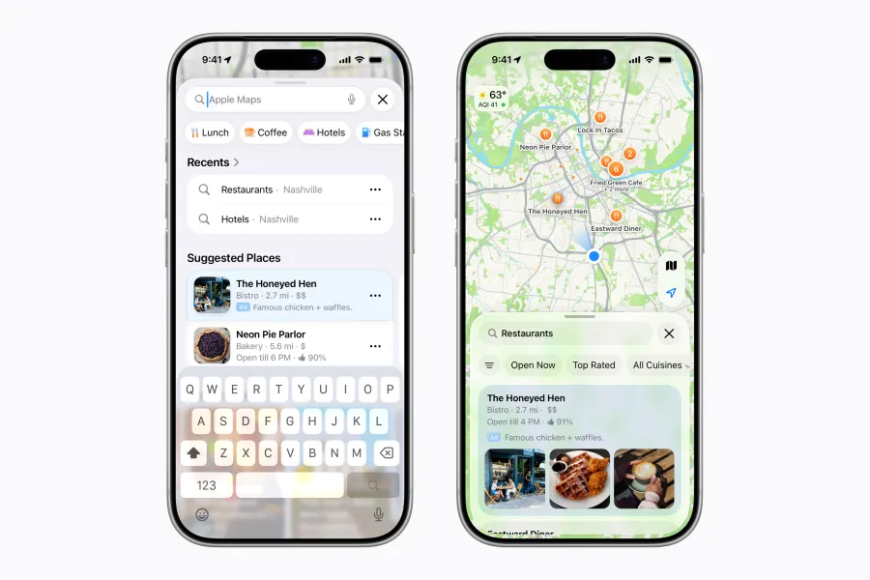
Apple on Tuesday announced that it will start allowing advertisers to reach customers through Apple Maps, with the rollout beginning in the U.S. and Canada later this summer. The advertising feature will be open to businesses of all sizes that operate physical locations and already have a business listing on Apple Maps. Users will begin to see these ads appear alongside relevant search results within the app.
The introduction of ads is part of a broader initiative called Apple Business, a revamped suite of services that combines multiple tools into a unified platform. This offering includes integrated email, calendar, and directory services, as well as tools designed to help companies manage employee devices more efficiently.
Apple stated that Maps users will see only a single ad in search results at any given time. These ads will be visually distinct, marked with a small blue halo around the map pin and clearly labelled as advertisements within the Suggested Places list, similar to how ads are presented on the App Store.
Adding advertising to Apple Maps provides the company with an opportunity to generate a new revenue stream without significantly altering the user experience or the app's core functionality. Consumers are already familiar with ads in navigation services, particularly through years of exposure to Google Maps, where advertising has become a standard feature. This move could contribute significantly to Apple's growing global advertising business.
The company emphasised that user privacy will remain protected. Apple noted that interactions with ads will not be tied to a user's Apple account. Personal data will remain on the device, will not be collected or stored by Apple, and will not be shared with third parties.
Businesses interested in advertising will need to have an Apple Maps listing first. They can then create campaigns by uploading photos, adding promotional messages, and setting budgets. Apple's system uses automated matching to display ads to users who are actively searching for similar businesses. Advertisers will also have the flexibility to start or stop campaigns at any time.
For larger advertisers, more advanced options will be available, including scheduling when ads appear and targeting specific geographic areas.
Earlier reports from Bloomberg suggested that Apple would use a bidding system for ad placements. Apple has now confirmed that its advertising model will follow an auction-based pricing structure, which is common in the industry. Advertisers will only pay when they achieve specific outcomes, such as a user viewing or tapping on their ad.
The launch of ads in Maps comes alongside the broader introduction of Apple Business, which consolidates several existing tools and services into one platform. Previously, businesses needed to navigate separate services such as Apple Business Connect, Apple Business Essentials, and Apple Business Manager. These will now be unified under the Apple Business umbrella, available in 200 countries and regions starting April 14, 2026.
As part of this update, businesses will gain access to new features, including an employee directory and productivity tools like business email and calendar services tied to their domain. Each employee account will include 5 GB of free iCloud storage, with paid plans in the U.S. starting at $0.99 per user per month for up to 2 TB of storage. Additional support options will also be available through AppleCare+ for Business, with pricing starting at $6.99 per user or device per month.
The updated offering also includes several free tools aimed at businesses of all sizes. These include a mobile device management (MDM) solution for distributing apps to employees, which has been enhanced with new features and is now available at no cost, whereas it was previously a paid service.
Small businesses can use preconfigured "Blueprints" to simplify device setup for employees without requiring advanced technical expertise. Administrators can select the apps they want their staff to use, and the system will automatically configure the necessary settings. Larger organisations will have the option to manage app deployments through an API, giving them greater control and flexibility.
With these updates, Apple is expanding both its advertising capabilities and its enterprise services, positioning itself more strongly in the business tools and digital advertising space while maintaining a focus on privacy and user experience.
What's Your Reaction?
 Like
0
Like
0
 Dislike
0
Dislike
0
 Love
0
Love
0
 Funny
0
Funny
0
 Angry
0
Angry
0
 Sad
0
Sad
0
 Wow
0
Wow
0