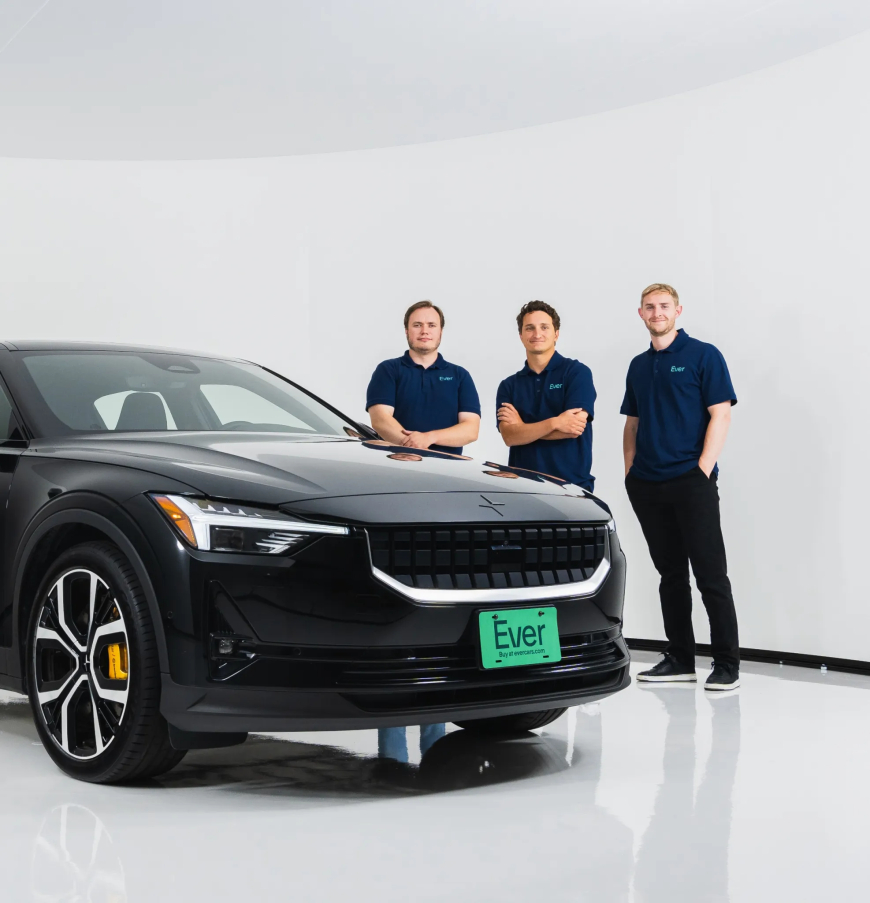
If someone wants to purchase or sell a used electric vehicle today, where do they begin? A startup named Ever aims to position itself as the go-to platform for that very decision. The company describes itself as the first “AI-native, full-stack auto retail business” dedicated entirely to EVs, and says it already serves thousands of customers who buy and sell electric vehicles through its marketplace.
To expand further, Ever has secured $31 million in Series A financing led by Eclipse. Additional investors participating in the round include Ibex Investors, Lifeline Ventures, and JIMCO, the investment arm of the Saudi Arabian Jameel family, known as an early backer of Rivian.
Over the past decade, companies such as Carvana and CarMax helped bring car buying into the digital era. More recently, a wave of startups has sought to layer artificial intelligence into the process, offering tools such as voice-based agents and advanced scheduling software. However, Eclipse partner Jiten Behl believes incremental AI additions do not fundamentally modernise automotive retail.
“These bolt-on AI tools are band-aids,” Behl said, comparing them to early electric vehicles that were essentially traditional combustion models retrofitted with electric drivetrains. That strategy, he argued, involved significant compromises compared to designing a purpose-built EV from scratch, as companies like Tesla and Rivian did.
“Auto retail is a perfect candidate for disrupting with AI,” Behl added. “It’s a lot of process, a lot of labour, [very] rules-based.”
Ever co-founder and CEO Lasse-Mathias Nyberg explained that completing a car transaction often requires “hundreds or thousands of different actions” on the retailer’s side. He described the buying and selling journey as filled with friction for both parties.
In 2022, Nyberg and his team began exploring ways to reduce or eliminate that friction. After roughly a year of research, they developed a digital-first auto retail model powered by a core orchestration layer—effectively an operating system that manages the workflows of a vehicle transaction. That includes processing information from buyers and sellers, handling pricing and appraisals, and coordinating inventory management.
“When you do appraisals, or pricing, or titling, it’s very deterministic in terms of what steps need to be taken,” Nyberg said. He noted that many retailers rely on isolated point solutions that are stitched together inefficiently. While these businesses may view themselves as digitised, he argued that a clean-sheet approach using agentic AI can unify the experience and remove small but cumulative inefficiencies.
According to Nyberg, this structure has allowed Ever’s sales team to be two to three times more productive than under conventional systems. He believes that increased efficiency improves margins, which can either strengthen profitability or enable the company to offer more competitive pricing to customers.
Ever’s strategy extends beyond its online marketplace to include physical locations. Nyberg emphasised that a hybrid approach remains important because many customers still want to see and test-drive a vehicle in person, particularly if they are considering an EV for the first time.
Feedback from early users has been mixed. In one Reddit discussion from last year, some participants praised Ever for simplifying the EV purchasing process, while others described challenges reaching customer support. Nyberg attributed those issues to the company’s early-stage operations, when it was functioning largely in stealth mode, and said the team is working to ensure its systems remain flexible and responsive.
A broader obstacle may be the cooling demand for EVs in the United States. While Nyberg has not ruled out expanding into used combustion vehicles down the line, he intends to maintain a near-term focus on EVs, noting the absence of a retailer singularly dedicated to that segment.
Behl, who spent eight years on Rivian’s leadership team, acknowledged his enthusiasm for electric vehicles, describing himself as a “hopeless romantic” about the sector. He remains confident that the long-term trajectory favours electrification, given its inherent advantages. When evaluating Ever, he said his immediate reaction was, “I wish Rivianweres were doing this.”
Looking at the broader market, companies like Carvana still account for only a single-digit share of the automobile retail market. For him, that leaves significant room for a digitally driven model to expand.
“Customers are going to continue to gravitate towards better experience when it comes to buying cars,” he said, adding that the future of car retail will increasingly revolve around a digitally led experience that reduces the friction traditionally associated with buying and selling vehicles.






































 Like
0
Like
0
 Dislike
0
Dislike
0
 Love
0
Love
0
 Funny
0
Funny
0
 Angry
0
Angry
0
 Sad
0
Sad
0
 Wow
0
Wow
0