

































Ex-AirPods engineer shifts focus to building next-generation heat pumps
A former AirPods engineer is now developing advanced heat pumps to improve energy efficiency and accelerate the adoption of clean home heating solutions.
In 2022, the state of California set an ambitious target to install 6 million heat pumps by 2030. So far, only around 2.3 million units have been deployed. To meet that goal, installations would need to average about 2,000 units per day over the next five years — a pace that may be difficult to sustain. A typical mini-split system can take roughly a full day to install and usually costs between $4,000 and $6,000 per zone, according to EnergySage.
Mary-Ann Rau, co-founder and CEO of Merino Energy, believes a different approach is necessary.
Merino Energy, which has been operating quietly until now, aims to simplify both the cost and installation process of heat pumps. The company has unveiled its new product, the Merino Mono, priced at $3,800, which includes installation that takes approximately one hour.
Rau previously worked at Apple, where she was involved in product launches such as AirPods, and later joined Quilt, another company in the heat pump space. While working at Apple, she began electrifying her home in San Francisco, installing solar panels, an induction stove, and an electric vehicle charger. However, when it came time to install heat pumps, she encountered unexpectedly high costs.
She noted that if the expense felt prohibitive even in her situation, it would likely be out of reach for many others.
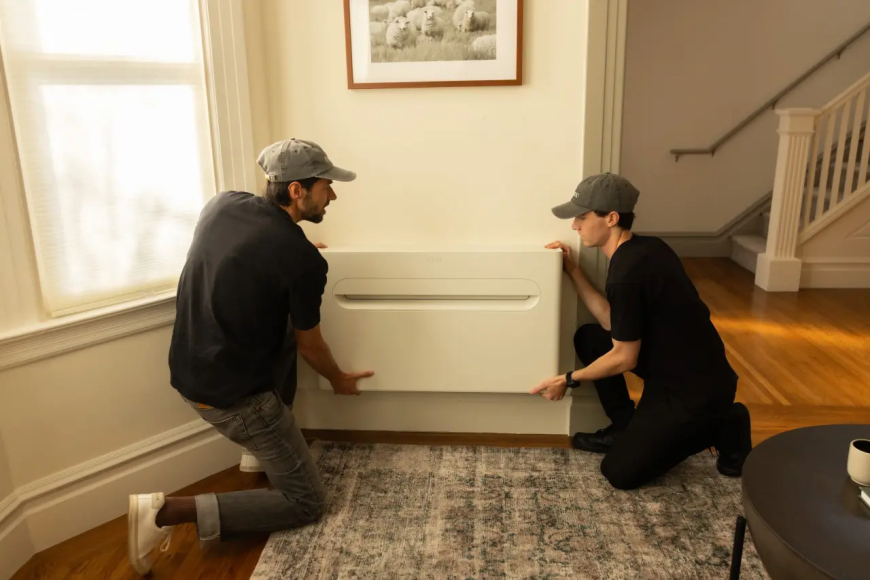
Traditional heat pump systems typically consist of two components: an indoor heat exchanger and an outdoor condenser. Merino’s design combines both into a single unit, roughly the size of a standard radiator placed beneath a window. The system operates using a standard 120-volt outlet, reducing the likelihood that homeowners will need to upgrade their electrical systems.
According to Rau, if an outlet can power a household appliance like a microwave, it should be sufficient for the Merino Mono.
The device includes features commonly found in modern heat pump systems. It connects to Wi-Fi, detects room occupancy, and allows multiple units within a home to coordinate for improved efficiency and comfort. The company is also working on integration with Oura Rings, enabling the system to automatically adjust room temperature during specific sleep phases, such as REM sleep.
Installation involves cutting two openings in a wall — one for air intake and another for exhaust. Air circulates through the condenser coils, transferring heat to the heat exchanger. A separate airflow loop inside the unit manages heating or cooling within the room. From the outside, only small intake and exhaust vents and a condensate pipe are visible.
By integrating all components into a single indoor unit, Merino has reduced installation complexity. Unlike conventional systems, there is no need to connect indoor and outdoor units using copper lines or perform refrigerant charging, processes that typically increase labour costs.
However, this simplified design comes with some trade-offs. The compact system is slightly less efficient compared to larger, traditional setups. The Merino Mono has a SEER2 rating of 15.2, while Quilt systems can reach 25. Larger outdoor condensers generally deliver higher efficiency, but Merino believes its design is better suited to smaller spaces, such as apartments and urban housing, where simplicity and cost are more critical.
The company is currently installing 48 units at the CiviCentreer Apartments, a low-income housing development in Richmond. For now, Merino is focusing on California as its primary market, with plans to expand into other states, including Hawaii, Oregon, and Washington.
So far, six installation partners have signed on across the Bay Area and Los Angeles. The company has also begun accepting preorders, with deliveries expected later this year. Rau expressed confidence that simplifying installation and reducing costs could help accelerate the adoption of heat pumps, making them more accessible to a wider range of households.
What's Your Reaction?
 Like
0
Like
0
 Dislike
0
Dislike
0
 Love
0
Love
0
 Funny
0
Funny
0
 Angry
0
Angry
0
 Sad
0
Sad
0
 Wow
0
Wow
0