
































Hybrid cement plants emerge as the next innovation in sustainable construction
Hybrid cement plants combine traditional and green technologies to reduce emissions, energy use, and environmental impact in construction.
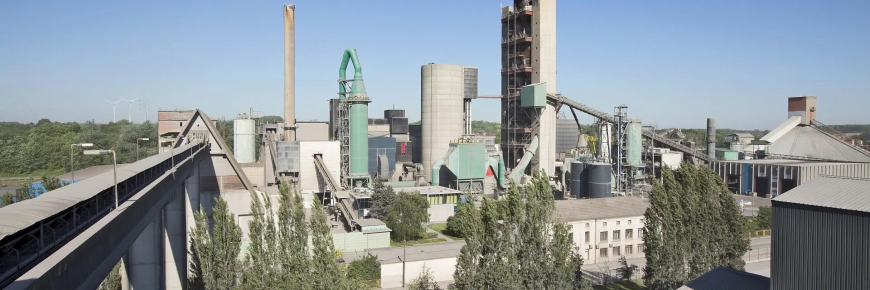
You've likely heard of hybrid vehicles, but the idea of a hybrid cement or glass plant is far less familiar. That's because nearly all industrial facilities of this kind still depend heavily on fossil fuels to generate the extreme heat required for production. However, that could soon shift as a new startup has introduced a method to integrate electric heating into existing plants. Much like hybrid cars, this approach allows operators to reduce fuel use while maintaining flexibility and controlling costs.
Carlos Ceballos, co-founder and CEO of NOC Energy, explained that the company's goal is to modernise heavy industry without forcing an immediate, complete departure from fossil fuels. "We hybridise industrial processes," he said. "Most companies are willing to electrify, but they don't want to get rid of fossil fuels yet. In the energy transition, they want to have the opportunity to choose the lowest cost."
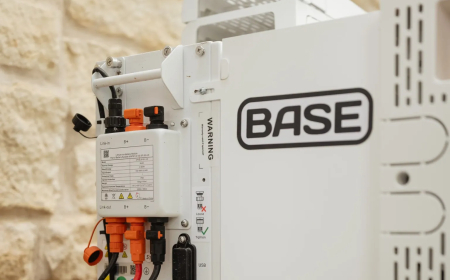
NOC Energy has developed an electric heating system that can be attached to traditional fossil-fuel-powered facilities. The system can deliver heat directly to equipment such as glass kilns and various stages of cement manufacturing. Operators retain full control — if electricity becomes expensive, they can shut down the electrical system and revert entirely to fossil fuels.
One of the most notable aspects of the technology is its ability to generate extremely high temperatures. The system can already reach around 1,200 degrees Celsius, and the company is working toward pushing that limit to 1,500 degrees Celsius. Achieving such temperatures with clean energy alternatives has been a longstanding challenge, as fossil fuels and hydrogen have traditionally been the only viable options — with green hydrogen still too costly for widespread industrial use. The space remains relatively underdeveloped, though companies like Electrified Thermal Solutions are emerging as potential competitors.
The startup recently secured $2.7 million in seed funding, led by 360 Capital, with participation from SOSV and Desai VC. This funding will support further development and deployment of its hybrid heating systems.
While hybrid setups are expected to be the most common choice for early customers, the system can also operate independently of fossil fuels if needed. A key advantage lies in its ability to store heat for extended periods. This enables companies to take advantage of cheaper electricity when renewable energy supply is high — such as during periods of strong wind or peak sunlight — and to use stored heat later when electricity prices increase.
At the core of NOC's system is induction heating technology, which operates on principles similar to those of induction cooktops. Instead of directly generating heat through combustion or resistance, induction uses electromagnetic fields. When electric current passes through copper coils, it generates a magnetic field that causes nearby metal objects to vibrate at the microscopic level, producing heat.
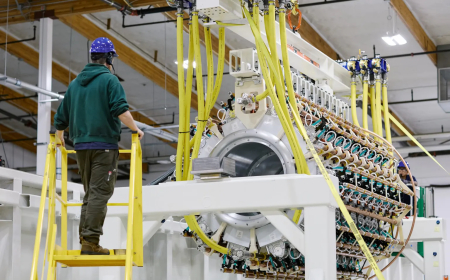
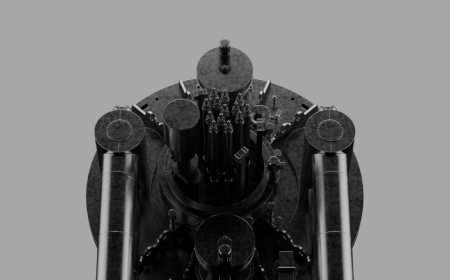
In this case, the system uses steel spheres packed inside large ceramic containers measuring about 2.5 meters in diameter. Copper coils wrapped around these containers generate the magnetic fields, while insulation helps retain the heat. When energy is needed, air is pushed through the heated steel spheres, capturing and transporting heat to industrial processes such as cement production and glass manufacturing.
This approach offers a significant durability advantage over traditional electric heating methods. Resistive heating systems — similar to those found in household appliances — can reach high temperatures, but their components degrade quickly. At around 1,000 degrees Celsius, such systems may last about a year, while at 1,200 degrees Celsius their lifespan can shrink to just a few months.
NOC's design avoids this issue entirely because the copper coils never come into direct contact with the heat. Instead, they remain insulated and operate at near-room temperature, generating heat indirectly via electromagnetic induction. This separation dramatically improves the system's longevity.
The thick insulation surrounding the containers also allows the system to store thermal energy for hours. Depending on customer needs, the storage capacity can be scaled by stacking multiple modules and increasing the number of steel spheres, enabling longer-duration heat retention.
So far, the company has operated a pilot-scale system roughly the size of a refrigerator for more than 15,000 hours. It has also built two larger demonstration units — one for a glass manufacturer and another for a cement producer — both located in France. These systems are expected to begin operation in May.
Ceballos noted that the hybrid model offers companies a way to manage uncertainty as the global energy landscape evolves. "Being hybrid allows them to derisk the future," he said. "Given the geopolitical problems today, it's very attractive."
What's Your Reaction?
 Like
0
Like
0
 Dislike
0
Dislike
0
 Love
0
Love
0
 Funny
0
Funny
0
 Angry
0
Angry
0
 Sad
0
Sad
0
 Wow
0
Wow
0