

































Startup aims to identify which AI-discovered drug candidates truly matter
AI is generating more drug candidates than ever, but one startup is working to identify which ones have real clinical value and market potential.
Google DeepMind’s breakthrough use of deep learning to predict complex protein structures has already reshaped how scientists understand biology. But as AI systems continue generating large volumes of potential drug candidates, a new challenge has emerged: determining which of those candidates are actually viable for real-world testing and production.
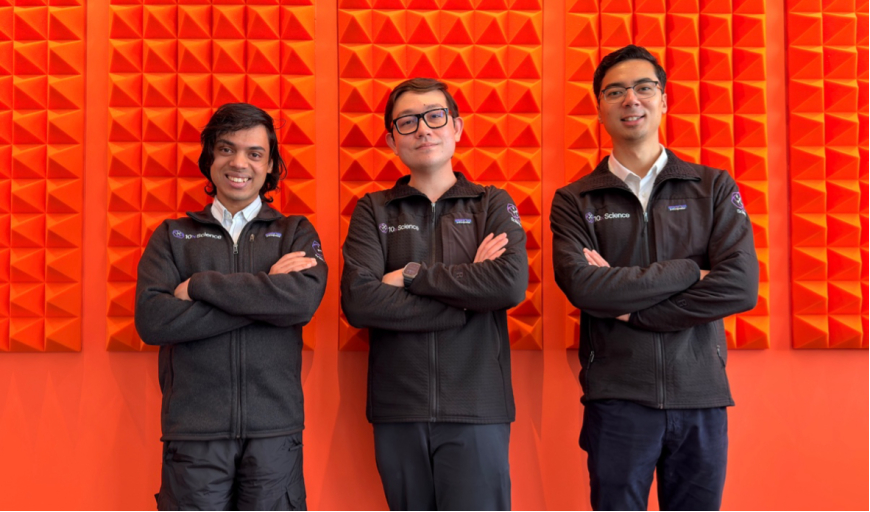
A new startup called 10x Science is trying to solve that bottleneck. Founded in December 2025, the company announced today that it has raised a $4.8 million seed round led by Initialised Capital, with participation from Y Combinator, Civilisation Ventures, and Founder Factor.
The company was co-founded by chemical biologist David Roberts, biologist Andrew Reiter, and serial entrepreneur Vishnu Tejus, who brings experience in computer science and AI systems.
“When biopharma tries to create a drug candidate, they have all of these really nice prediction tools,” Roberts said. “You can add as many candidates as you want to the top of the funnel, but they all have to pass through this characterisation process. Everything needs to be measured.”
At the core of modern drug discovery is protein structure analysis, especially for biologic drugs developed in living cells. These drugs are designed to target specific diseases with high precision. One example is Keytruda, a widely used cancer therapy developed by Merck that helps the immune system identify and attack cancer cells.
The founders of 10x Science previously worked together in the Stanford laboratory of Nobel laureate Dr Carolyn Bertozzi, where they studied how cancer cells interact with the immune system. During their research, they encountered persistent limitations in understanding molecular-level biological processes.
A major part of their work focuses on mass spectrometry, a technique used to measure the mass and charge of molecules to determine their structure and composition. While powerful, the method generates extremely complex datasets that require significant expertise and time to interpret.
The 10x Science platform combines deterministic algorithms grounded in chemistry and biology with AI agents designed to interpret mass spectrometry outputs. The company says it invested heavily in training its models on spectrometry datasets while ensuring that its outputs remain traceable — a critical requirement in pharmaceutical regulatory environments.
Matthew Crawford, a scientist at Rilas Technologies, which provides outsourced chemical analysis services for biotech firms, has been using the platform for several weeks. He says it has significantly improved the speed of his workflows.
Crawford noted that the system could explain its reasoning, automatically locate relevant data sources, and adapt to different molecular structures. In one case, he said the model identified a protein based solely on a file name and then independently retrieved its sequence from online databases, eliminating the need for manual input.
“I ran a particular protein through it, and it just kind of figured out, from what I named the file, what the protein probably was,” Crawford said. “It then searched databases online for the sequence for that protein, so I didn’t have to program in the sequence.”
The company says it is already collaborating with multiple large pharmaceutical firms as well as academic research institutions. The newly raised capital will be used to expand engineering teams, refine the platform, and onboard additional customers.
Looking ahead, Roberts said that if the company succeeds in scaling protein characterisation, it could eventually expand into broader biological modelling by combining protein data with other cellular insights.
“The deeper thing behind what we’re building is actually a new way to define molecular intelligence,” Roberts said.
For investors, the appeal of 10x Science lies in its potential to become a foundational tool in drug discovery without being tied to the success of any single drug candidate. Instead of betting on regulatory approvals, the company positions itself as essential infrastructure for pharmaceutical research.
“This is a SaaS platform that pharma has to pay for, every single month, to go through all of these potential candidates,” said Zoe Perret, partner at Initialised Capital. She added that the founders’ deep domain expertise could provide a strong moat in a field where few people fully understand both the data and the underlying chemistry.
According to Crawford, the real value of the platform lies in its ability to simplify complex scientific workflows for researchers who lack the time or resources to analyse mass spectrometry data manually.
“Groups here are trying to make a new drug,” he told. “They just want to get a quick, simple answer out of mass spec, and then it opens up a whole can of worms. This software is going to help keep that can of worms closed and get them the answer they actually need to do the next thing in their research, then.”
What's Your Reaction?
 Like
0
Like
0
 Dislike
0
Dislike
0
 Love
0
Love
0
 Funny
0
Funny
0
 Angry
0
Angry
0
 Sad
0
Sad
0
 Wow
0
Wow
0