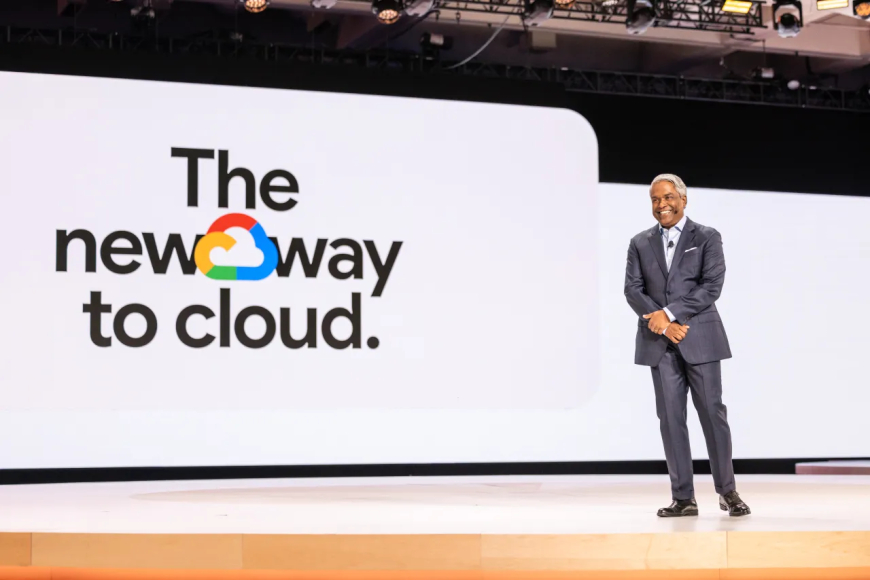
Google Cloud Next is underway this week in Las Vegas, and one message has come through clearly: Google is actively positioning itself as the cloud of choice for AI startups. As part of this push, the company announced several new initiatives and highlighted a wide range of startups building on its infrastructure.
The biggest announcement from the event is a new $750 million fund allocated to help Google Cloud partners accelerate enterprise adoption of AI agents. The funding is open to a broad ecosystem, including early-stage startups and large consulting firms. It can be used for multiple purposes, such as building Gemini proof-of-concept projects, deploying Google-forward-engineered support teams, and receiving cloud credit and enterprise deployment incentives.
Alongside the funding announcement, Google also showcased a large group of startups either newly joining or significantly expanding their usage of Google Cloud services. Several companies stood out due to their scale, valuation, or technical integration with Google’s AI stack.
Lovable is expanding its partnership with Google Cloud by launching a new AI coding agent through Google’s enterprise application marketplace. The fast-growing “vibe-coding” startup reportedly reached $400 million in annual recurring revenue as of February.
Notion, the widely used AI-powered productivity platform valued at around $11 billion, is leveraging Google’s Gemini models to power its text and image generation features across its workspace tools.
Gamma, an AI-driven alternative to traditional presentation software, recently valued at $2.1 billion, is using Google’s latest image-generation model, Nano Banana, along with other Google Cloud capabilities to enhance its design and content-creation tools.
Inferact, a startup founded by the creators of the open-source vLLM project, is using Nvidia GPU infrastructure on Google Cloud, along with access to Google’s broader AI ecosystem, to scale inference workloads.
ComfyUI, a popular open-source platform for generating AI images and multimedia content, is also integrating Google Cloud services, including access to Nano Banana 2 for advanced visual generation workflows.
Beyond these leading names, Google highlighted a wide range of additional startups building across sectors such as healthcare, logistics, enterprise software, and AI tooling.
Chorus is developing AI-powered smart tagging systems to track real-time movement and condition of goods across supply chains.
Emergent AI is building a vibe-coding platform to simplify software development with generative AI.
ExaCare AI focuses on AI solutions for post-acute healthcare facilities, helping improve patient management workflows.
Insilica generates AI-driven, regulatory-compliant chemical safety reports for industrial applications.
Parallel provides web search and research APIs designed specifically for AI agents.
Proximal Health develops AI systems that automate insurance claims adjudication processes.
Reducto specialises in AI-powered document parsing tools.
Stord manages e-commerce fulfilment and parcel logistics operations at scale.
Stylitics builds AI-based image-generation tools for retailers, including outfit styling and product bundling.
Temporal offers a developer-focused cloud environment designed to prevent workflow failures in distributed systems.
Vapi provides developer tools for building conversational AI voice agents.
Vurvey Labs enables synthetic market research using AI-driven agent simulations.
Wand builds in-game AI assistants for single-player PC gaming experiences.
Watershed delivers enterprise software for sustainability reporting and environmental program management.
ZenBusiness provides an all-in-one back-office platform for small businesses, including an integrated AI chat assistant.
Overall, Google Cloud Next 2026 reinforced the company’s strategy of deeply embedding itself in the AI startup ecosystem, positioning its cloud infrastructure as a foundational layer for the next generation of AI-powered products and services.



































 Like
0
Like
0
 Dislike
0
Dislike
0
 Love
0
Love
0
 Funny
0
Funny
0
 Angry
0
Angry
0
 Sad
0
Sad
0
 Wow
0
Wow
0