David Ashton was raised outside Sacramento, California, and later attended college in San Luis Obispo during the severe drought that marked the late 2000s.
Over the years, he regularly travelled the 300-mile route between Sacramento and San Luis Obispo, fascinated by the endless stretches of lettuce fields — vast expanses of leafy green crops standing out against a harsh, dry landscape. The contrast left a lasting impression on him. Seeing water-intensive crops grown in drought conditions only to be transported across the country eventually helped inspire Canopii, his robotic farming startup focused on shortening produce supply chains.
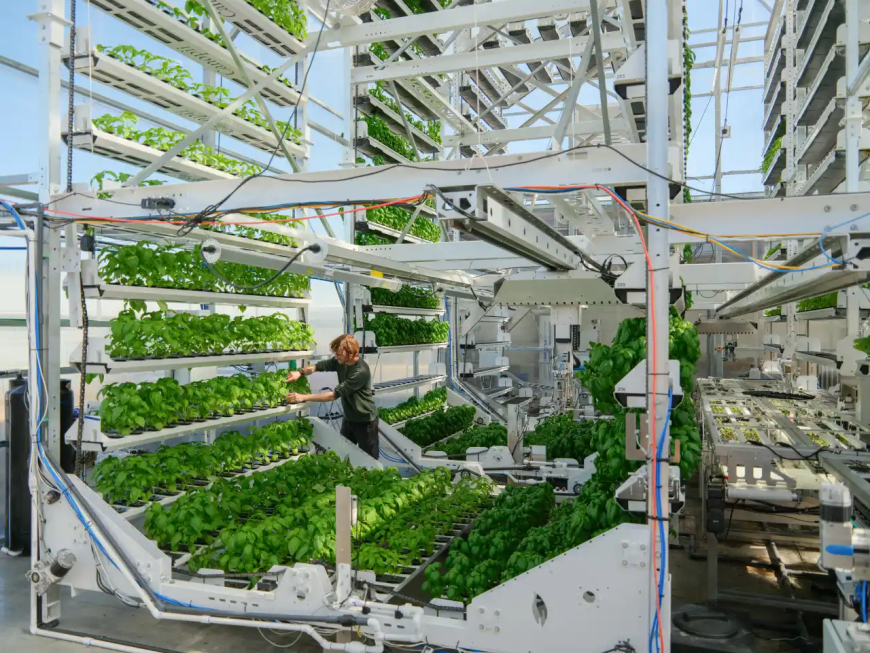
Based in Portland, Oregon, Canopii develops robotic greenhouses that manage the full crop production cycle autonomously, from seeding through harvest, without human intervention. Each greenhouse can produce up to 40,000 pounds of produce annually while using only a single spigot of water and occupying about the same amount of space as a basketball court.
GK Designs manufacture the farms and is currently building them to cultivate herbs and speciality greens, including baby bok choy and gai lan, also known as Chinese broccoli.
Ashton said the early foundations for Canopii were laid after the Portland agtech company he had planned to join went bankrupt while he was driving up the coast to relocate there. While his wife was attending medical school, he spent his nights working on the concept and plans for the business.
After three years of development, he applied for a $250,000 grant from the National Science Foundation to create an initial prototype of his idea. Once that proved successful, he applied for a $1 million grant to build a full-scale prototype.
“Now, five years later, we have hit a major milestone [for] the farm,” Ashton said. “We have an autonomous farm that grows everything from seed to harvest without any human intervention, and we did so with a very small team and very little capital, which I think is very different from what the rest of the industry had experienced.”
So far, the company has raised about $3.6 million, including roughly $2.3 million in grants, with the remainder from strategic backers.
Ashton knows well how many investors and venture capital firms view the indoor farming sector. What was once a highly popular category saw companies such as Bowery Farming and Plenty raise hundreds of millions of dollars, only to later go bankrupt before reaching the level of success many had expected.
He argues that Canopii’s product is fundamentally different from vertical farming operations and says the company’s deliberate choice to avoid venture capital in its early stages has helped it avoid many of the challenges that have hurt others in the industry.
“The capital stack has to be diversified beyond VC,” Ashton said. “We’re five now, and we’re still just iterating on one farm, which has allowed us to learn so much. I think if we got VC right away, and we try to scale after year one or two, that’s not possible with food infrastructure.”
The company has already received inbound interest from schools, restaurants, casinos, and other potential customers. With its automation milestone now reached, Canopii is aiming to develop its first commercial farm in downtown Portland. Further ahead, the company plans to franchise these farms — and, when the timing is right, raise venture capital as well.
“We can mass produce it like a car,” Ashton said. “I think a big achievement on this farm is that the whole thing runs off of 100 AMPs and 240 volts. That’s house power. You can literally put this in a backyard. And that speaks to the level of resource management that we’ve achieved in this farm.”






































 Like
0
Like
0
 Dislike
0
Dislike
0
 Love
0
Love
0
 Funny
0
Funny
0
 Angry
0
Angry
0
 Sad
0
Sad
0
 Wow
0
Wow
0