





































Here’s the Technology Powering ICE’s Deportation Crackdown
ICE is using a range of surveillance and data technologies — from cell-site simulators to facial recognition and Palantir analytics — to support expanded deportation efforts under the Trump administration.

President Donald Trump pledged to make immigration enforcement a defining pillar of his second term, vowing to carry out deportations on an unprecedented scale. One year into that term, available data shows that Immigration and Customs Enforcement (ICE) and Customs and Border Protection have deported more than 350,000 people.
ICE has become the central force behind the administration’s mass removal strategy, conducting raids in homes, workplaces, and public spaces in search of undocumented individuals. These operations have sparked widespread protests and resistance from communities across the United States.
To carry out this campaign, ICE relies on a wide range of surveillance and data-driven technologies. At the same time, the Department of Homeland Security has used the momentum of Trump’s deportation push to challenge long-standing legal boundaries, including forcibly entering homes without judicial warrants — actions that legal experts say violate Fourth Amendment protections against unreasonable searches and seizures.
Below are some of the key technologies ICE is using.
Cell-site simulators
ICE employs cell-site simulators to monitor mobile phones. These systems masquerade as legitimate cell towers, tricking nearby phones into connecting to them. Once connected, law enforcement can identify and locate the phones in the area and, in some cases, intercept calls, text messages, and internet traffic.
Cell-site simulators are often referred to as “stingrays,” named after one of the earliest commercial versions developed by defence contractor Harris, now part of L3Harris. They are also known as IMSI catchers, which capture a phone’s unique subscriber identity module (SIM) identifier, which can be used to link the device to its owner.
Over the past two years, ICE has signed contracts totalling more than $1.5 million with TechOps Speciality Vehicles (TOSV), a company that builds customised surveillance vans for law enforcement agencies. One contract, dated May 8, 2025, and valued at over $800,000, states that TOSV will provide “Cell Site Simulator (CSS) Vehicles to support the Homeland Security Technical Operations program.”
TOSV president Jon Brianas told TechCrunch that the company does not manufacture the surveillance equipment itself, but instead integrates the technology into its vehicles as part of a broader design.
The use of cell-site simulators has long drawn criticism. Because the devices force all nearby phones to connect, they inevitably collect data from individuals who are not targets of investigations. Authorities have also been accused of deploying the technology without warrants. In some cases, prosecutors have gone to great lengths to conceal the technology’s use in court, including withholding information, accepting plea deals, or dropping charges entirely to avoid disclosure.
In a 2019 Baltimore case, court records revealed that prosecutors were instructed to abandon cases rather than violate a non-disclosure agreement with the manufacturer of the devices.
Facial recognition
Clearview AI is among the most prominent facial-recognition companies in operation today. The firm built its reputation by claiming it could identify nearly anyone using a vast database of images scraped from across the internet.
On Monday, 404 Media reported that ICE signed a contract with Clearview AI to support its investigative arm, Homeland Security Investigations (HSI), with tools designed to identify suspects and victims in cases involving child sexual exploitation and assaults on law enforcement officers. Government procurement records show the contract, signed last week, is worth $3.75 million.
ICE has maintained multiple agreements with Clearview over the past few years. In September 2024, the agency purchased $1.1 million worth of “forensic software” from the company. The year prior, ICE paid nearly $800,000 for enterprise facial recognition licenses.
Clearview AI did not respond to requests for comment.
ICE also uses a facial-recognition application called Mobile Fortify, which agents deploy in the field to identify individuals. The app compares scanned driver’s license photos against a database of roughly 200 million images, much of which originates from state driver’s license records.
Paragon phone spyware
In September 2024, ICE signed a $2 million contract with Israeli spyware firm Paragon Solutions. Soon after, the Biden administration issued a stop-work order, placing the agreement under review to determine whether it complied with an executive order governing the federal government’s use of commercial spyware.
The contract remained suspended for nearly a year. Last week, however, the Trump administration lifted the stop-work order, effectively reinstating the agreement.
The current operational status of Paragon’s technology within ICE remains unclear. Contract records state that the deal includes “a fully configured proprietary solution,” along with licenses, hardware, maintenance, warranty coverage, and training. If installation and training were not completed before the suspension, it may take time for the system to become operational.
It is also uncertain whether the spyware will be used directly by ICE or by Homeland Security Investigations, whose mandate extends beyond immigration enforcement to include investigations into child exploitation, human trafficking, financial crimes, and other offences.
Paragon has long positioned itself as an ethical spyware provider, a stance now complicated by its relationship with ICE under Trump. In December, U.S. private equity firm AE Industrial acquired Paragon and announced plans to merge it with cybersecurity company RedLattice, according to Israeli outlet Calcalist.
When TechCrunch sought comment from Paragon about the revived ICE contract, the inquiry was redirected to RedLattice’s vice president of marketing and communications, Jennifer Iras. Iras did not respond to requests for comment for this story or a previous one.
Paragon has also faced scrutiny in Italy, where the government has been accused of using spyware to surveil journalists and immigration activists. In response, Paragon severed ties with Italy’s intelligence agencies.
Phone hacking and unlocking tools
In mid-September, Homeland Security Investigations signed a $3 million contract with Magnet Forensics. The agreement covers software licenses that allow agents to extract digital evidence, process multiple devices simultaneously, and generate forensic reports.
Magnet Forensics produces GrayKey, a phone unlocking system that allows law enforcement to connect locked smartphones, bypass security protections, and access stored data. Magnet merged with GrayKey developer Grayshift in 2023.
Magnet Forensics did not respond to a request for comment.
Cellphone location data
In late September, 404 Media reported that ICE purchased access to a comprehensive surveillance platform capable of searching historical cellphone location data alongside social media information. The system appears to combine two products, Tangles and Webloc, developed by data analytics firm Penlink.
One of the tools advertises its ability to process billions of daily location signals from hundreds of millions of mobile devices, offering both forensic and predictive analysis, according to a redacted contract reviewed by 404 Media. While the document does not specify which product provides that capability, previous reporting suggests Webloc is responsible.
Forbes previously cited a Penlink case study describing Webloc’s ability to track mobile device patterns at specific locations over time.
Such location data is typically collected through software development kits embedded in smartphone apps or via real-time bidding systems used in digital advertising. These mechanisms generate detailed location data as a byproduct, which is later sold by data brokers to government agencies — often without the need for warrants.
Tangles, the second Penlink product, is described as an AI-powered open-source intelligence tool that automates the collection and analysis of data from the open, deep, and dark web.
Forbes reported that ICE spent $5 million on Penlink’s tools. Penlink did not respond to requests for comment.
License plate readers
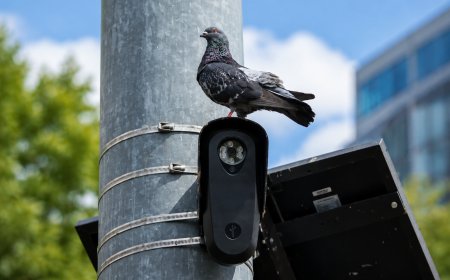
ICE also relies heavily on automated license plate reader systems to track vehicle movements across large portions of the country. In addition to its own resources, ICE frequently accesses data through partnerships with local police departments that contract with ALPR providers.
One of the most prominent vendors in this space is Flock Safety, which operates more than 40,000 license plate scanners nationwide and continues to expand through partnerships with companies like Ring.
Some local law enforcement agencies have cut off federal access to their data after learning ICE was obtaining information through informal requests. Border Patrol operates its own network of license plate readers, according to reporting from the Associated Press.
LexisNexis databases
ICE has relied on LexisNexis for years to support its investigative work. In 2022, documents obtained through Freedom of Information Act requests revealed that ICE conducted more than 1.2 million searches over seven months using LexisNexis’ Accurint Virtual Crime Centre to gather background information on migrants.
In 2023, The Intercept reported that ICE was using LexisNexis tools to flag individuals for investigation before any crime had occurred, a practice critics described as mass surveillance.
Public records show that ICE currently pays for access to LexisNexis’ Law Enforcement Investigative Database Subscription, which includes public records and commercial data. This year alone, ICE has spent $4.7 million on the service.
LexisNexis spokesperson Jennifer Richman told TechCrunch that the agency has used the company’s data and analytics products for decades across multiple administrations.
“Our commitment is to support the responsible and ethical use of data, in compliance with all applicable laws and regulations,” Richman said, adding that LexisNexis works with more than 7,500 government agencies nationwide to support public safety.
Palantir
Data analytics firm Palantir has signed multiple contracts with ICE over the past year. The largest, worth $18.5 million and signed in September 2024, covers a database system known as Investigative Case Management, or ICM.
Palantir’s relationship with ICE dates back to the early 2010s. In 2022, the company signed a $95.9 million agreement to provide the ICM system.
Earlier this year, 404 Media reported on the inner workings of the database after reviewing a recent version. The system allows ICE to filter individuals based on immigration status, physical traits, criminal associations, location data, and numerous other attributes.
According to 404 Media, a source familiar with the database described it as consisting of “tables upon tables” of information capable of generating reports on individuals based on hundreds of criteria, such as visa type, port of entry, country of origin, and even hair colour.
The relationship has proven controversial within Palantir itself. Internal documents justifying the company’s work with ICE were leaked to 404 Media by sources inside the firm.
Palantir is also developing a separate platform called ImmigrationOS. Business Insider revealed a $30 million contract describing the tool as a system designed to streamline apprehension operations, track visa overstays, provide real-time visibility into self-deportations, and support enforcement activities. Wired later reported additional details from internal documents.
First published on September 13, 2025, and updated on September 18, 2025, to include Magnet Forensics’ contract; October 8, 2025, to include cell-site simulators and location data; and January 26, 2026, to include license plate readers.
What's Your Reaction?
 Like
0
Like
0
 Dislike
0
Dislike
0
 Love
0
Love
0
 Funny
0
Funny
0
 Angry
0
Angry
0
 Sad
0
Sad
0
 Wow
0
Wow
0