
































Tesla raises spending plan to $25B — where the investment is headed
Tesla has increased its spending plan to $25B, focusing on AI, manufacturing expansion, and energy solutions to support future growth.
Tesla CEO Elon Musk opened the company’s first-quarter earnings call with a significant update on spending plans — one that could be interpreted as either a strategic push or a cautionary signal for investors. According to Tesla’s latest earnings report, the company now expects capital expenditures to rise to $25 billion in 2026 as it accelerates its shift toward artificial intelligence and robotics.
The figure represents spending on physical assets such as factories, infrastructure, and long-term production capacity, excluding day-to-day operating costs. At this level, Tesla’s planned capex is roughly three times higher than its annual spending in recent years. The company reported capital expenditures of $8.5 billion in 2025, $11.3 billion in 2024, and $8.9 billion in 2023.
Earlier in January, Tesla projected that capex would exceed $20 billion in 2026, reflecting its growing investment in AI systems, compute infrastructure, data centres, and manufacturing expansion. The revised $25 billion estimate suggests these ambitions are becoming even more capital-intensive than initially expected. For context, Tesla’s most recent quarterly capital expenditure was $2.5 billion, consistent with prior quarters.
Musk framed the increased spending as a long-term investment in the company’s future direction.
“With 2026, we’re going to be substantially increasing our investments in the future,” Musk said during Wednesday’s earnings call. “So you should expect to see a very significant increase in capital expenditures, but I think it is well justified for a substantially increased future revenue stream.”
He also pointed out that Tesla is not alone in scaling up spending. Other major tech companies are also increasing capital investment to support AI and infrastructure growth. Amazon has projected around $200 billion in capital expenditures in 2026 across AI, chips, robotics, and satellite systems, while Google is expected to spend between $175 billion and $185 billion, up from $91.4 billion the previous year.
Tesla’s expanded spending plan is closely tied to Musk’s long-term vision of transforming the company beyond electric vehicles, energy storage, and solar products. A portion of the capital will go toward AI development, chip design, robotics, and manufacturing expansion, including Tesla’s growing robotaxi program and a new semiconductor research facility in Austin.
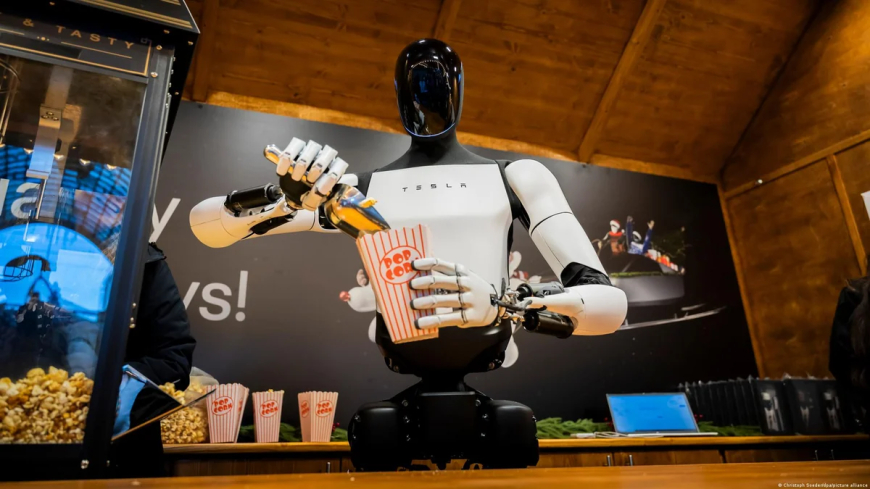
The company also plans major investments in its manufacturing footprint. The Fremont, California, facility is expected to transition away from Model S and Model X production and begin large-scale manufacturing of the Optimus humanoid robot. Tesla has also begun preparing land near its Austin factory for a dedicated Optimus production facility.
Musk said the company aims to ramp up internal production of Optimus for testing, to make the robot useful outside Tesla “sometime next year.”
Additional spending will also target supply chain expansion across batteries, energy systems, and AI silicon development.
Tesla CFO Vaibhav Taneja noted that the elevated spending cycle will continue for “a couple of years” and acknowledged its financial impact. Despite a brief boost in investor sentiment — driven in part by $1.4 billion in free cash flow — the company expects to enter negative free cash flow territory later this year.
Tesla shares initially rose after the announcement, but later erased gains during after-hours trading as executives outlined the scale of future spending. Even so, the company remains in a strong cash position, reporting $44.7 billion in cash, cash equivalents, and short-term investments at the end of the first quarter.
“While this may seem like a lot, and we will have the impact of negative free cash flow for the rest of the year, we believe this is the right strategy to position the company for the next era,” Taneja said.
What's Your Reaction?
 Like
0
Like
0
 Dislike
0
Dislike
0
 Love
0
Love
0
 Funny
0
Funny
0
 Angry
0
Angry
0
 Sad
0
Sad
0
 Wow
0
Wow
0