





























Jensen Huang Says Nvidia Revenue Could Grow 70% Next Year
Nvidia CEO Jensen Huang says revenue could grow 70% next year, citing surging demand for AI infrastructure and broad visibility across customers and partners.
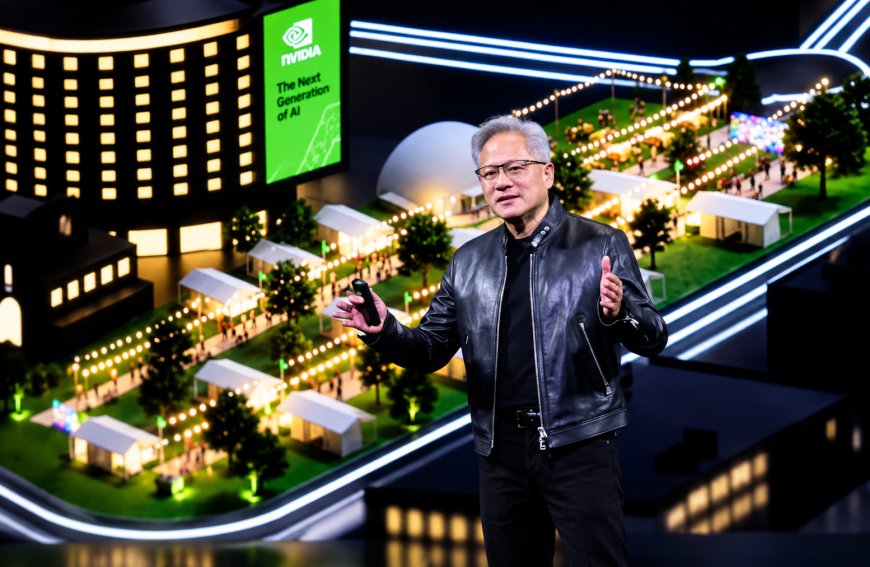
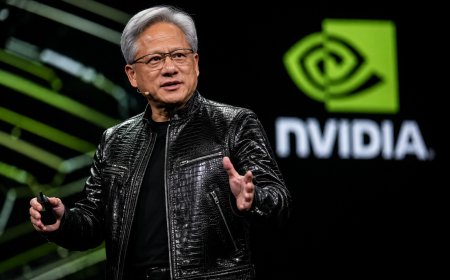
Nvidia CEO Jensen Huang says the company could grow revenue by roughly 70% next year, arguing that its position across the AI infrastructure market gives it unusual visibility into future demand.
Speaking Thursday at the Goldman Sachs Communacopia + Technology Conference, Huang said Nvidia’s business can no longer be seen as simply selling individual graphics processors. Its latest AI systems combine GPUs, CPUs, networking, and other components into large-scale computing platforms used by cloud providers, AI labs, and data centre operators.
Grace Blackwell demand continues to accelerate
Huang pointed to demand for Nvidia systems that combine Grace CPUs with Blackwell GPUs. The company’s GB200 NVL72 platform, for example, integrates 36 Grace CPUs and 72 Blackwell GPUs into a rack-scale system connected through NVLink.
Huang said orders for that class of system are currently growing about 27% month over month, illustrating the scale of demand Nvidia continues to see as companies expand AI infrastructure.
The CEO reiterated an outlook first discussed around Nvidia’s latest earnings results, saying he believes revenue could increase about 70% next year. Analysts expect Nvidia to finish its current fiscal year with roughly $400 billion in revenue, which would put a 70% increase at approximately $680 billion.
Nvidia’s recent earnings discussion has similarly emphasised strong demand for accelerated computing and AI infrastructure.
Nvidia says broad market visibility supports its forecast
Huang said Nvidia’s confidence comes partly from working across nearly every layer of the AI ecosystem. Its hardware supports models from companies including OpenAI, Anthropic and Google, as well as open-weight models and a growing range of AI startups.
Nvidia also works closely with cloud providers, server manufacturers, so-called neoclouds, component suppliers and data centre developers. Huang said those relationships give the company visibility into planned power capacity, facilities and computing deployments around the world.
That strategy has also raised questions about investments Nvidia makes in companies that later purchase its hardware. Such arrangements are sometimes described as circular financing because a supplier’s investment can help finance demand for its own products.
Huang rejected the suggestion that Nvidia is artificially creating demand. He said the company evaluates whether businesses have genuine customer contracts before investing and claimed Nvidia has seen about $100 billion in contracts supporting companies it has backed.
Competition is nevertheless increasing as Amazon, Google, Microsoft, OpenAI and other companies develop their own AI chips, while specialised semiconductor companies pursue alternatives to Nvidia hardware. Huang’s 7
What's Your Reaction?
 Like
0
Like
0
 Dislike
0
Dislike
0
 Love
0
Love
0
 Funny
0
Funny
0
 Angry
0
Angry
0
 Sad
0
Sad
0
 Wow
0
Wow
0