






































Amazon Wants Prime Air Drone Delivery to Reach 500 U.S. Communities
Amazon plans a major Prime Air expansion that could bring drone delivery to about 500 U.S. communities as it pushes toward faster package delivery.
Amazon is preparing its biggest Prime Air expansion yet, with plans that could bring drone delivery to hundreds of U.S. communities before the end of 2026.
The company has publicly framed the expansion in terms of customer reach rather than a specific city count. Amazon CEO Andy Jassy said Prime Air plans to serve communities covering 30 million customers by the end of the year. At the same time, the company continues working toward a longer-term goal of delivering 500 million packages by drone by the end of the decade.
Amazon’s official Prime Air expansion statement
The expansion is already visible in Federal Aviation Administration records. The FAA has reviewed or is reviewing Prime Air operations across several major U.S. markets, including Texas, Florida, Detroit, Kansas City, Chicago, Omaha and Baton Rouge.
FAA Prime Air environmental reviews and decisions
Together, the filings show how Amazon intends to move Prime Air from a limited experiment into a much larger part of its delivery network.
Prime Air Is Moving Beyond a Small Pilot Program
Amazon has spent years developing drone delivery, but its commercial footprint has remained small compared with its traditional delivery network.
As recently as May 2026, Amazon said Prime Air was providing under-60-minute drone delivery in nine U.S. locations, with tens of thousands of eligible products available for delivery using autonomous aircraft.
Amazon’s official U.S. delivery update
The new expansion is considerably more ambitious.
Instead of building drone operations as isolated facilities separate from Amazon’s broader logistics network, the company is increasingly placing Prime Air Drone Delivery Centres next to existing Amazon warehouses and fulfilment facilities.
That arrangement allows eligible packages already moving through Amazon’s network to be transferred to drones for the final part of the journey.
If Amazon reaches communities representing 30 million customers, Prime Air would move much closer to becoming a mainstream delivery option rather than a technology demonstration available in only a handful of areas.
The MK30 Drone Is Central to Amazon’s Expansion
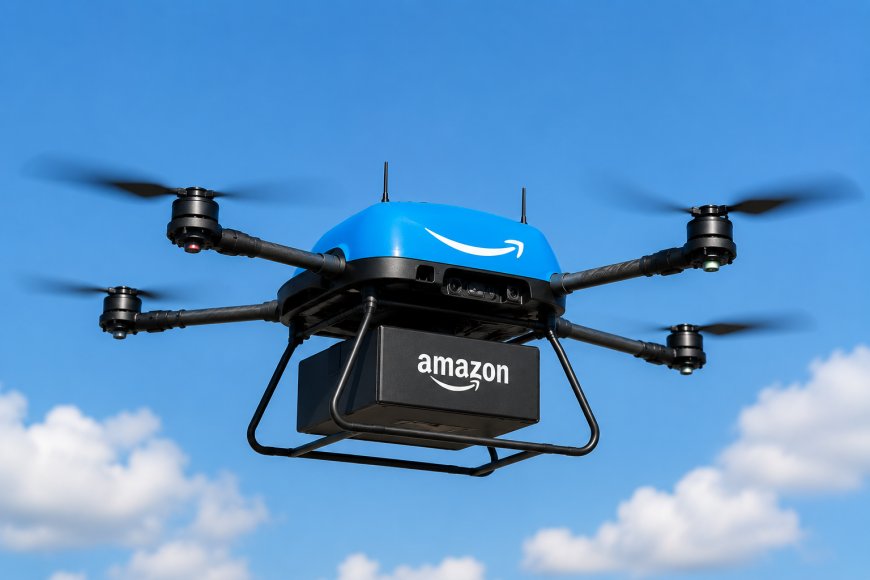
The expansion relies on Amazon’s latest delivery aircraft, the MK30.
The MK30 is an electric aircraft capable of taking off and landing vertically before transitioning into forward flight. FAA documents describe it as a hybrid multicopter fixed-wing aircraft with six propulsors.
The FAA lists the MK30 with a maximum operating range of 7.5 miles from a Prime Air Drone Delivery Centre. That creates a potential operating area of approximately 174 square miles around each facility.
The aircraft has a maximum takeoff weight of about 83 pounds and can carry packages weighing up to 5 pounds. FAA documentation also lists a maximum forward-flight speed of roughly 67 mph.
FAA official Prime Air operating details
Amazon says the MK30 is smaller, lighter and quieter than its earlier delivery drones.
The aircraft also includes onboard detect-and-avoid technology designed to identify obstacles and other aircraft during flight.
Amazon says the MK30 has received approval for operations beyond the operator’s visual line of sight, an important capability if the company wants to operate large numbers of delivery flights without employees physically watching each drone throughout its journey.
Amazon’s official MK30 drone overview
Some Prime Air Sites Could Handle 1,000 Flights a Day
The scale proposed in FAA filings gives a clearer picture of where Amazon wants the program to go.
For several proposed and approved operating areas, Prime Air has outlined plans for up to 1,000 MK30 delivery flights per operating day from each delivery centre.
At that maximum level, the FAA estimates that an individual centre could handle roughly 365,000 annual delivery operations if it operated every day of the year.
Actual flight volumes would depend on customer demand, weather and the gradual rollout of the service.
FAA records for Chicago, Baton Rouge, and Omaha describe the same general model: Prime Air Drone Delivery Centres would be located alongside existing Amazon warehouse properties, with drones delivering packages to eligible homes and communities within the surrounding operating area.
View current FAA drone-operation reviews for Amazon Prime Air.
The FAA has also completed environmental decisions covering larger Prime Air expansion plans in markets including Florida, Kansas City, Detroit and Texas.
Those environmental findings are an important regulatory step, but they should not be mistaken for a guarantee that every planned delivery centre will immediately begin full commercial operations.
Texas Shows How Large Prime Air Could Become
Texas provides one of the clearest examples of Amazon’s intended scale.
FAA records describe a proposed Prime Air network in Texas that would involve 22 Drone Delivery Centres across the State, each using the MK30.
Each location could eventually support up to 1,000 delivery flights per operating day under the analysed operating scenario.
The FAA signed its environmental Finding of No Significant Impact and Record of Decision for the Texas action in February 2026.
FAA official Prime Air environmental review page
Amazon already has experience operating drones in College Station, Texas. The company has used that market to test its delivery technology and later introduced the MK30 there.
College Station’s expanded MK30 operating radius is 7.5 miles, compared with the 3.7-mile radius used by Amazon’s earlier MK27-2 aircraft.
That additional range greatly increases the geographic area a delivery centre can potentially cover.
Amazon Is Building Drone Delivery Into Its Existing Network
One of the most important changes in Prime Air has little to do with the drone itself.
Amazon originally operated drone delivery through specialised sites. Its newer strategy integrates Prime Air more closely with existing fulfilment operations.
Amazon has said Prime Air deployments can operate from its existing Same-Day Delivery network.
Amazon’s official Prime Air network expansion announcement
That could make expansion considerably easier.
Amazon already has warehouses, inventory systems, delivery infrastructure, and a large customer base across the country. Adding drone facilities to existing properties means the company does not necessarily need to build an entirely separate logistics network for aerial delivery.
The model also helps explain why FAA documents repeatedly describe new Prime Air Drone Delivery Centres as located on the same property as or adjacent to existing Amazon warehouses.
The Goal Is Faster Delivery
Amazon’s long-term objective is not simply to replace vans with drones.
The company is trying to reduce the time from order placement to the package reaching the customer.
Prime Air currently focuses on relatively small products that fit within the MK30’s payload limit. For eligible items close to a delivery centre, a drone can avoid much of the road network used in conventional last-mile delivery.
Amazon has said its long-term ambition is to deliver Prime Air orders in under 30 minutes.
The company also expects Prime Air to eventually handle 500 million packages globally by the end of the decade.
Read Amazon CEO Andy Jassy’s official statement on Prime Air goals
That target would require an enormous increase from today’s volumes.
Even hundreds of delivery centres operating thousands of flights would represent only one part of Amazon’s much larger logistics system.
Noise and Community Impact Still Matter
A rapid increase in drone flights will also bring more scrutiny.
FAA environmental reviews consider issues including aircraft noise, wildlife, land use, historic resources and the effect of repeated flights over communities.
The agency has opened public comment periods for some proposed Prime Air expansions, including the Chicago area.
For the Chicago proposal, Prime Air described operations running from 6 a.m. until 10:30 p.m., with as many as 1,000 flights per delivery centre per operating day at full scale.
FAA public review information for Prime Air operations
Amazon has worked to reduce the MK30’s noise compared with earlier designs. Still, the experience of hearing an occasional test flight is different from living inside an area that could eventually see hundreds of daily flights.
Community response will therefore become more important as Prime Air moves into denser metropolitan areas.
Safety Is Another Major Part of the Rollout
Amazon had to demonstrate the MK30’s safety before expanding commercial operations.
The company says its certification work included about 360 hours of FAA certification flights.
Amazon also says the drone’s onboard technology allows it to detect and avoid obstacles and other aircraft while operating beyond the visual line of sight of human operators.
Amazon’s official explanation of MK30 certification and operations
Real-world operations have also provided information that laboratory testing could not fully reproduce.
Amazon has previously described how flights in Arizona exposed the aircraft to dust conditions that could interfere with an altitude sensor. The company said data from those commercial operations was used to add further safeguards.
Amazon’s official MK30 safety-testing report
Those lessons will matter more as the fleet grows.
A system operating a small number of drones can tolerate more human supervision than a network eventually expected to conduct hundreds of millions of deliveries.
Prime Air Is Expanding Outside the U.S. Too
Amazon’s drone strategy is no longer limited to American customers.
Prime Air began delivering packages in Darlington, England, in February 2026, marking the service’s first operational expansion outside the United States.
Customers within a 7.5-mile radius of the fulfilment centre can receive eligible packages weighing up to 5 pounds via drone.
Amazon’s official UK Prime Air launch details
The international expansion suggests Amazon increasingly sees autonomous aerial delivery as a logistics platform rather than a U.S.-only experiment.
Reaching 500 Communities Would Be a Major Test
The reported target of reaching roughly 500 U.S. communities by the end of 2026 would represent an extraordinary acceleration for a service that was available in only a limited number of markets earlier this year.
Amazon’s own public target provides another way to understand the scale: Prime Air is supposed to reach communities containing 30 million customers by year-end.
Whether that happens will depend on more than manufacturing enough MK30 drones.
Amazon needs FAA approvals, suitable warehouse locations, trained operations teams, reliable aircraft, favourable weather conditions, and sufficient customer demand to justify frequent flights.
The company also needs local communities to accept the idea of autonomous aircraft regularly moving over homes and neighbourhoods.
What is already clear from Amazon’s announcements and FAA records is that Prime Air is entering a different phase. The question is no longer whether Amazon can deliver individual packages by drone.
The next test is whether it can make drone delivery work at the scale of a national logistics network.
What's Your Reaction?
 Like
0
Like
0
 Dislike
0
Dislike
0
 Love
0
Love
0
 Funny
0
Funny
0
 Angry
0
Angry
0
 Sad
0
Sad
0
 Wow
0
Wow
0