

































What Expensive Tech Actually Buys You
Expensive technology can deliver better engineering, materials, performance, and longevity, but premium prices don’t always mean better value. Here is where high-end tech genuinely earns its cost.
Spending more on technology usually promises something measurable: a faster processor, a better display, longer battery life or higher-quality materials. At the end of the market, that relationship becomes much less predictable.
A $300 computer mouse can justify part of its price through magnesium construction and unusually high polling rates. A premium projector can use specialised optics and sophisticated image processing that don’t exist in cheaper models. But a luxury laptop cover can also cost more than $100 while fitting worse than a basic protective shell, and expensive gaming accessories can improve responsiveness without making an average player noticeably better.
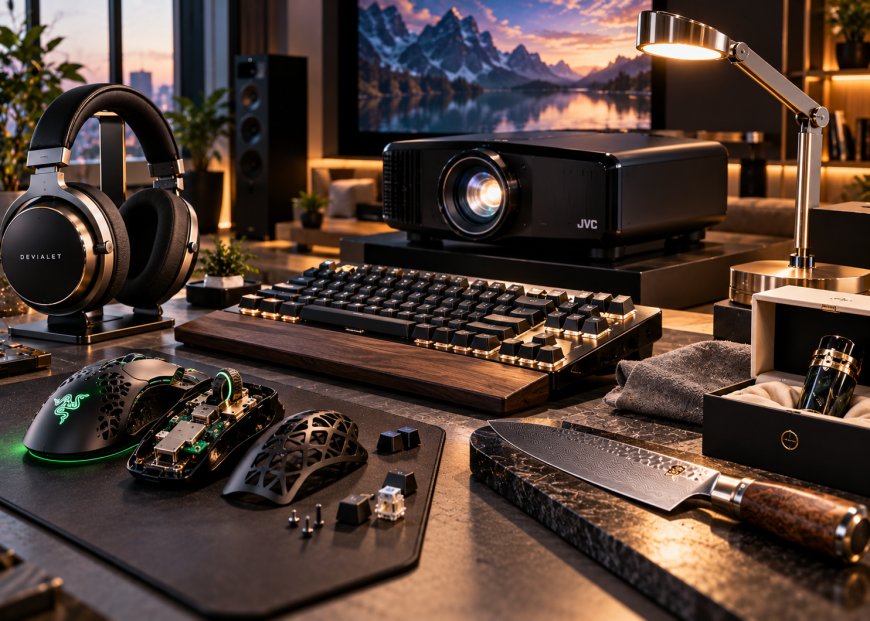
A hands-on experiment involving roughly $50,000 of premium technology exposed that divide. The products ranged from custom gaming equipment and luxury audio to handcrafted keyboards, high-end lighting, kitchen knives and home cinema equipment. What emerged was not a simple case for or against expensive gadgets. The more useful distinction was where the money actually went.
Some Premium Tech Is Expensive Because the Engineering Is Difficult
Razer’s Viper Mini Signature Edition is a good example of a product whose price is at least connected to a technical objective.
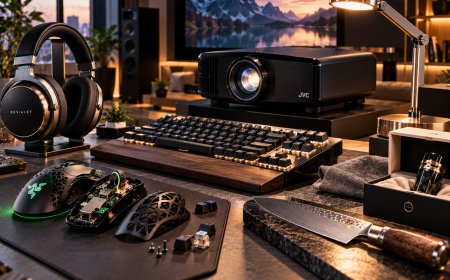
The mouse uses a magnesium-alloy exoskeleton and weighs about 49 grams while supporting an 8,000Hz polling rate on the current model. That means it can report movement to a computer every 0.125 milliseconds. Razer originally launched the Signature Edition at $279.99, with later limited versions reaching $299.99.
None of that means a conventional gaming mouse suddenly becomes inadequate. Most users are unlikely to become better players merely by switching hardware. But the engineering goal is clear: remove mass while retaining structural strength and reduce input latency as much as practical.
That distinction was apparent during the hands-on test. The mouse felt unusually light rather than traditionally “luxurious,” because the engineers deliberately removed material instead of adding it. The benefit came from lower resistance during movement, not from making the product heavier or more ornate.
High-end projectors follow a similar logic at a much larger scale.
JVC’s DLA-NZ9, which matches the projector technology demonstrated in the source, combines native 4K imaging devices with the company’s 8K/e-shiftX system. Its optical assembly uses an 18-element, 16-group all-glass lens in an aluminium barrel, while the laser system produces up to 3,000 lumens. It accepts 8K60 and 4K120 signals and projects images up to 300 inches.
Those specifications address real problems in large-screen projection: focus uniformity, chromatic aberration, brightness, contrast and image detail across a physically enormous picture. In the source test, replacing a much cheaper home projector created one of the most immediately obvious upgrades of the entire experiment.
This is premium pricing at its simplest. The product costs more because producing the result requires more complicated hardware.
Luxury Becomes Harder to Defend When the Upgrade Is Mostly Cosmetic
The calculation changes when technology is sold primarily through materials and appearance.
Several accessories in the source arrived in elaborate packaging and initially looked expensive, but closer inspection exposed inexpensive plastics, poor fit or design compromises. A premium MacBook cover, for example, looked convincing from a distance but fit so poorly that its added weight interfered with the laptop lid.
That is one peculiarity of luxury technology. Traditional luxury goods can derive substantial value from materials, craftsmanship and scarcity because those qualities are central to the product. Technology has another requirement: it still has to work well.
Adding leather, gold colouring, or elaborate packaging to a poorly engineered accessory does not solve bad tolerances or weak materials.
Devialet demonstrates the more convincing version of this strategy. The Opéra de Paris edition of its Phantom is unquestionably decorative, but the ornamentation sits atop serious audio hardware. The legacy Phantom I Opéra de Paris model tested in the source delivered 1,100 watts RMS, a claimed frequency response extending from 14Hz to 27 kHz, and side panels hand-finished with Moon Gold leaf. Devialet says Ateliers Gohard performs the gilding, the same specialist associated with restoration work at the Palais Garnier.
The test found the difference from an inexpensive imitation impossible to miss, particularly in bass output and the sound’s physical impact.
It remains an extravagant way to play music, but the customer is at least buying two things simultaneously: high-end acoustic engineering and luxury finishing.
Better Tools Cannot Replace Skill.
Professional-style equipment creates another complication: Skillability and usefulness are not the same thing.
A customised gaming controller can include rear paddles, specialised grips, interchangeable thumbsticks, and reduced-travel triggers. SCUF’s current Reflex family starts above €200, with higher configurations approaching €300. Its Reflex FPS model uses short, mouse-like instant triggers specifically intended to reduce the movement required in shooting games. Meanwhile, the Reflex Pro retains adaptive triggers for broader game compatibility.
Those features have a legitimate competitive purpose, particularly for skilled players who have trained around them. They do not automatically create Skill.
That limitation became obvious in hands-on testing of the Skillxpensive customised PlayStation controller. The controls felt better engineered and more precise, but the hardware provided little obvious advantage to an inexperienced player.
The same principle applies well beyond gaming.
A premium kitchen knife can use carefully forged steel, hold an edge longer and permit exceptionally precise cuts. In the source test, the expensive knife could produce slices considerably thinner than the reviewer’s ordinary kitchen knife. Eventually, however, the bottleneck became the person holding it rather than the blade itself.
That is common at the top of mature product categories. As hardware improves, the additional capability increasingly matters only to people skilled enough to exploit it.
Sometimes the Premium Is Paying for Longevity
Not every expensive upgrade is about immediate performance.
Dyson’s Solarcycle Morph desk lamp currently costs $649.99 in the United States. That is an extraordinary amount of money for a desk light, but Dyson has built its argument around longevity and controlled light quality rather than brightness alone.
The lamp produces up to 850 lumens, adjusts colour temperature, tracks local daylight and uses a heat-pipe cooling system intended to protect its LEDs from heat-related degradation. Dyson rates the LED system for 181,000 hours and markets the design as maintaining light quality for up to 60 years under its specified usage assumptions.
The source testing found the illumination unusually even and the mechanical articulation exceptionally flexible, although neither changes the obvious fact that far cheaper lamps can illuminate a desk effectively.
That makes products like this difficult to assess through a normal value-for-money calculation. The premium is partly being paid now for the expectation that the object will remain useful for an unusually long time.
Whether that is worthwhile depends on whether the buyer actually keeps it long enough for longevity to matter.
The Best Expensive Technology Makes the Extra Money Visible in Use
No reliable rule says premium technology is wasteful. No rule says spending more produces a proportionately better experience.
The $50,000 experiment suggests a more practical test.
Price makes the strongest case when the extra money can be traced to something hard to reproduce cheaply: precision optics, advanced materials, demanding manufacturing, acoustic engineering, durable components, or specialist craftsmanship. Those improvements may still offer diminishing returns, but they are real.
The argument weakens when the price increase comes mainly from decorative finishes, elaborate packaging, artificial scarcity, or familiar hardware placed inside a more luxurious shell.
That is why a $300 gaming mouse can make more technical sense than a $120 laptop case, even though the mouse sounds far more extravagant at first.
At the highest end of consumer technology, value stops being about whether a product is “better.” Almost everything is better eventually.
The useful question is whether the improvement is happening in the part of the product that actually matters.
What's Your Reaction?
 Like
0
Like
0
 Dislike
0
Dislike
0
 Love
0
Love
0
 Funny
0
Funny
0
 Angry
0
Angry
0
 Sad
0
Sad
0
 Wow
0
Wow
0