
































FDA Authorizes Aletta Robotic System to Automate Blood Draws
The FDA has authorised Vitestro’s Aletta robotic system to perform supervised autonomous blood draws in adult outpatients using imaging, AI and robotics.
One of healthcare’s most routine procedures is becoming a target for medical robotics.
The U.S. Food and Drug Administration has authorised Aletta, an autonomous robotic phlebotomy system developed by Dutch medical technology company Vitestro. According to the FDA’s authorisation announcement, Aletta is the first standalone robotic device authorised in the United States to draw blood from a patient’s arm without hands-on operator intervention.
The decision moves automation beyond software-based clinical assistance and into a physical procedure performed daily in hospitals, laboratories, and outpatient centres.
The FDA granted Aletta marketing authorisation through its De Novo pathway on August 19, 2026. The agency classified the system as a Class II robotic peripheral venous blood collection device.
How Aletta performs a blood draw
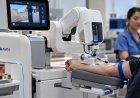
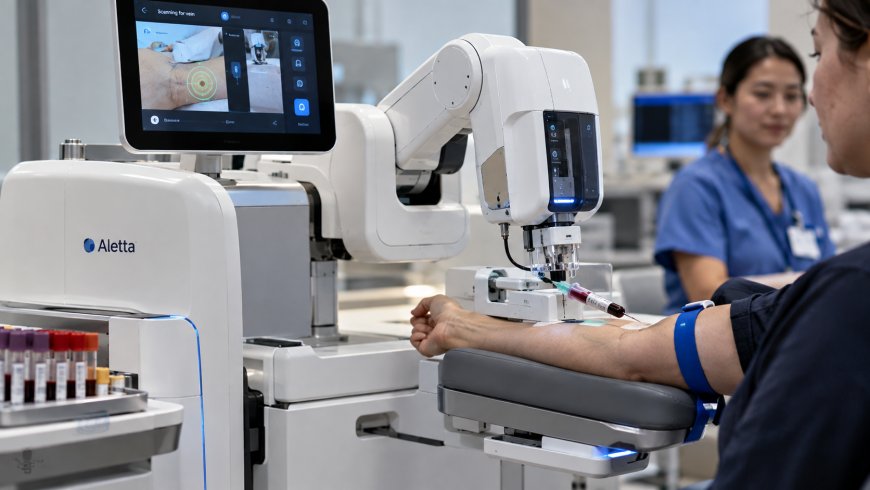
Aletta is designed to automate several steps normally performed manually during venipuncture.
According to Vitestro’s announcement of the FDA decision, the system combines near-infrared imaging, ultrasound and Doppler ultrasound to assess a patient’s blood vessels.
Those imaging systems help the equipment distinguish veins from arteries and identify an appropriate vein for the procedure.
Vitestro says Aletta then combines that imaging information with robotics and artificial intelligence to guide needle insertion and collect a diagnostic blood sample.
The result is medical equipment that does more than analyse clinical information on a screen. It uses imaging and software to understand anatomy and then translates that information into a controlled physical action.
A phlebotomist still supervises the procedure.
FDA authorisation does not make blood collection unsupervised.
Aletta is authorised for autonomous, ultrasound-guided venipuncture and diagnostic blood collection in adult outpatients while being monitored by a trained phlebotomist.
One trained phlebotomist can supervise up to three Aletta devices simultaneously.
That operating model could become one of the system’s more important features for healthcare organisations. Instead of a clinician manually carrying out every blood draw, automation performs the procedure while the professional remains responsible for oversight.
Trained personnel must also clean the equipment between patients.
Safety mechanisms are built into the procedure. The FDA says the needle automatically detaches and the blood draw stops if the patient moves excessively. Other onboard sensors can pause the procedure and alert the supervising phlebotomist when they detect potentially unsafe conditions.
FDA creates a new medical-device category
Aletta did not enter the U.S. market through a conventional comparison with an already marketed equivalent device.
The FDA used its De Novo pathway, intended for certain new types of low- to moderate-risk medical devices without an existing predicate.
The agency’s De Novo database entry for Aletta lists the device under the new classification “robotic peripheral venous blood collection system,” with product code SIW.
Creating the classification also matters beyond Vitestro.
The FDA established special controls covering areas including labelling, performance testing and clinical testing for this type of equipment. Those requirements can help create a regulatory pathway for future devices in the same category.
Clinical testing focused on successful blood collection
According to the FDA, clinical data supporting the authorisation showed successful blood-draw rates comparable to or better than trained human phlebotomists when Aletta proceeded with a needle stick.
The agency said testing included patients with different health conditions, varying skin tones and people who reported having difficult vein access.
The FDA described device-related adverse events in the supporting clinical data as uncommon and mild.
That does not mean automated phlebotomy eliminates every challenge associated with blood collection. Instead, the authorisation indicates that regulators found the device could meet the necessary safety and effectiveness requirements within its defined intended use and controls.
Why automate such a routine procedure?
Blood collection is one of the most common diagnostic procedures in healthcare, but it still relies heavily on trained personnel.
Finding an appropriate vein and successfully inserting a needle can also become more difficult for some patients.
The FDA specifically pointed to shortages of trained phlebotomists when announcing the authorisation.
A system that lets one qualified professional oversee several automated stations could therefore affect high-volume laboratories and outpatient collection centres where large numbers of patients require routine blood tests.
The potential value is not simply replacing a manual action with a robot. It is changing how clinical staff can be deployed around a repetitive medical procedure.
Medical AI is becoming physical.
So far, much of the healthcare industry’s AI adoption has centred on software.
Algorithms can help interpret medical images, analyse patient data, organise clinical information or support healthcare workers with documentation.
Aletta represents another direction: AI and computational imaging integrated directly with equipment that interacts physically with a patient.
Its workflow follows a model likely to appear more frequently in medical technology.
Sensors and imaging systems first capture information. Software analyses that information and determines an appropriate action. A robotic mechanism then performs the physical task, while a trained healthcare professional provides oversight.
This combination of imaging, AI and robotics could broaden the role of automation in medical equipment well beyond operating rooms.
What comes next
Vitestro says Aletta is already CE-marked in Europe, where the company plans its first commercial deployments, with U.S. commercialisation to follow.
The immediate use case remains narrowly defined: diagnostic blood collection from adult outpatients under trained supervision.
But the regulatory decision is notable because it establishes a U.S. device category for autonomous robotic blood collection.
Medical AI is increasingly moving beyond recommendations and analysis. In systems such as Aletta, software is becoming part of equipment capable of carrying out carefully controlled clinical procedures itself.
For medical-device companies, that may be the more significant development: the next generation of AI-enabled healthcare equipment will not always stop at telling clinicians what to do. Some systems will increasingly be designed to perform specific physical tasks under their supervision.
What's Your Reaction?
 Like
0
Like
0
 Dislike
0
Dislike
0
 Love
0
Love
0
 Funny
0
Funny
0
 Angry
0
Angry
0
 Sad
0
Sad
0
 Wow
0
Wow
0