




























Microsoft CEO Satya Nadella Warns Businesses Against Relying on a Single AI Provider
Microsoft CEO Satya Nadella says businesses should avoid depending on a single AI provider, warning that outsourcing AI infrastructure and data could threaten long-term competitiveness.
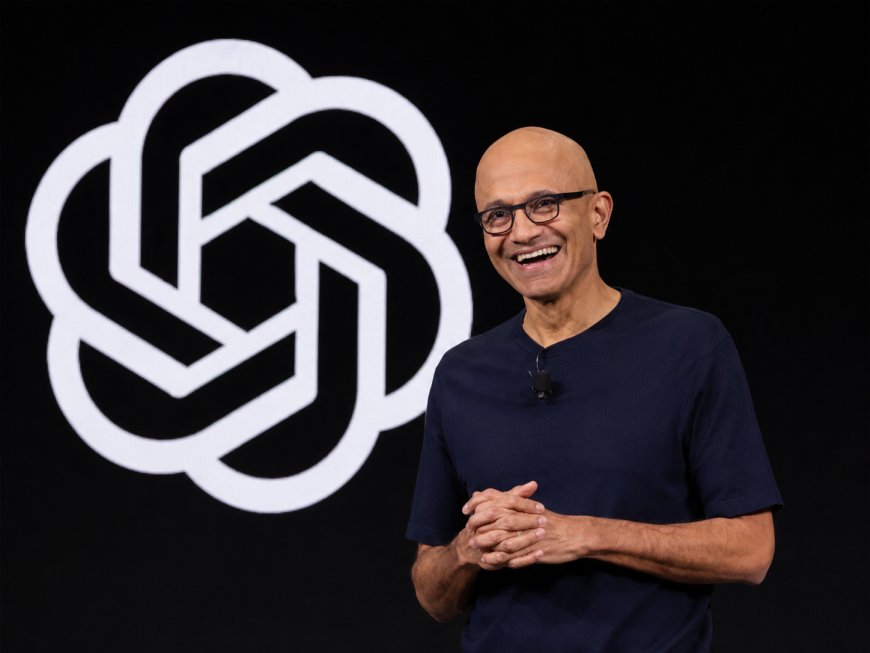
Microsoft CEO Satya Nadella is warning businesses against becoming too dependent on a single artificial intelligence provider, arguing that companies that hand over too much of their data, context and decision-making to proprietary AI platforms could eventually put their independence at risk.
Speaking Sunday on CNN’s “Fareed Zakaria GPS,” Nadella expanded on concerns he raised earlier this month about how businesses deploy AI. He argued that companies should maintain control over the information generated through their interactions with AI models, including prompts, metadata and other usage data.
Nadella said businesses should retain that information so it can potentially be used to train their own models or customise open models in the future. Companies that fail to maintain such control, he argued, risk effectively “outsourcing” their thinking to another organisation.
Nadella wants companies to maintain control of AI infrastructure
His argument extends beyond simply owning data. Nadella said businesses should separate the infrastructure used to manage AI applications from the underlying models themselves, allowing them to switch between different AI providers when necessary.
That includes separating a model from its context, memory and the software layer used to interact with it. Such an architecture could allow businesses to use multiple models depending on which performs best for a particular task while avoiding dependence on any single provider.
Nadella also cautioned against relying entirely on proprietary coding tools provided by major AI labs. Products such as Anthropic’s Claude Code and OpenAI’s Codex combine models with software designed to help developers complete programming tasks. He argued that keeping those tools independent from the underlying model gives companies greater flexibility if a provider’s technology, pricing or availability changes.
Microsoft could benefit from the shift
The comments are notable because Microsoft is an investor in both OpenAI and Anthropic, two of the largest developers of proprietary AI models. Coding agents have also emerged as one of the most popular enterprise applications for generative AI.
At the same time, Microsoft’s cloud business stands to benefit from companies adopting the type of multi-model infrastructure Nadella is recommending. Enterprises increasingly want access to multiple AI models, including lower-cost and open-weight alternatives that can be customised and operated on their own infrastructure.
Using several models also creates demand for AI gateways and management platforms capable of routing prompts, maintaining company data and switching workloads between providers.
AI providers could eventually become competitors
Nadella’s warning goes beyond concerns about rising AI costs. He suggested that companies giving an AI provider extensive access to their internal operations could create another strategic risk: The provider may eventually have enough knowledge to build a competing service.
The concern has circulated through the startup industry for years as founders have questioned whether major technology platforms could observe successful applications built on their infrastructure and later launch competing products.
Similar concerns surfaced in May after OpenAI CEO Sam Altman offered AI credits and potential investment opportunities to startups in a Y Combinator cohort. Investor Jason Calacanis warned founders that providing a major AI platform with detailed insight into how their products operate could create competitive risks if the platform later developed similar functionality.
Nadella is now applying a similar argument to larger enterprises: Businesses should benefit from frontier AI models without surrendering control over the data, infrastructure and institutional knowledge that differentiate them.
Consumers face a different trade-off
Nadella distinguished between businesses and individual consumers. When asked how ordinary users should protect themselves from sharing too much information with AI services, he suggested that personal data can form part of the value exchange involved in accessing free consumer products.
He compared that trade-off with the advertising-supported internet, where consumers often receive services without paying directly while companies use data to support their business models.
For businesses, however, Nadella’s message was considerably stronger: Companies adopting AI should preserve their ability to change models, retain their own data and control the infrastructure surrounding those systems rather than allowing a single AI provider to become indispensable to how the organisation operates.
What's Your Reaction?
 Like
0
Like
0
 Dislike
0
Dislike
0
 Love
0
Love
0
 Funny
0
Funny
0
 Angry
0
Angry
0
 Sad
0
Sad
0
 Wow
0
Wow
0