



































Top 10 Medical Device Companies Building AI Into Healthcare Equipment
Explore 10 medical device companies integrating AI into ultrasound, imaging, endoscopy, surgical robotics, and other clinical equipment.
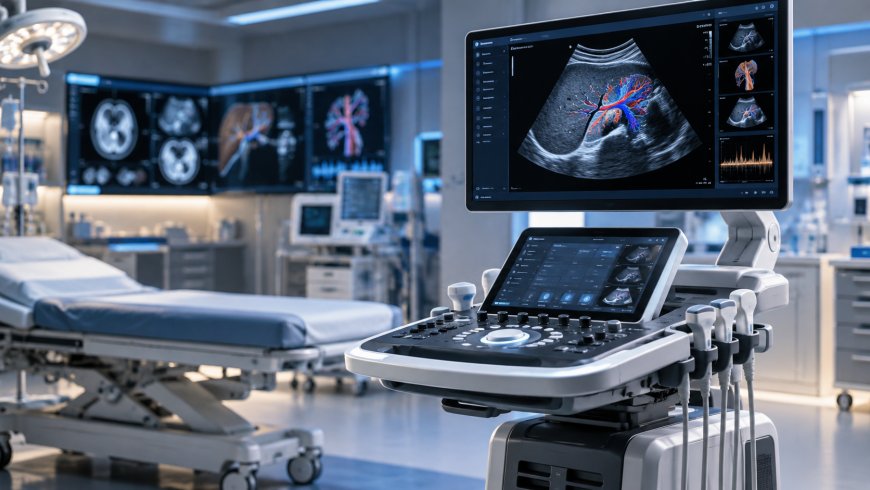
Artificial intelligence is becoming part of the medical equipment clinicians already use.
Rather than existing only as standalone diagnostic software, AI now appears inside ultrasound systems, CT and MRI scanners, mammography workflows, endoscopy platforms, and robotic-surgery technology. In many cases, the goal is practical: automate measurements, improve image quality, identify findings that deserve attention or reduce repetitive steps during an examination.
Several of the world’s largest medical technology companies are already bringing these capabilities into clinical settings.
Here are 10 medical device companies developing or deploying AI-enabled healthcare equipment, along with products that show how they use the technology.
1. GE HealthCare
GE HealthCare has integrated AI across several parts of its medical imaging and ultrasound portfolio.
One example is the Vscan Air SL with Caption AI, a handheld ultrasound system that uses AI-driven software to help clinicians acquire cardiac images.
Caption Guidance provides real-time instructions for positioning and moving the ultrasound probe. The system also includes AutoEF, which can automatically estimate left ventricular ejection fraction from supported cardiac views.
The significance is less about turning ultrasound into an autonomous diagnostic tool and more about assisting the operator. Ultrasound quality can depend heavily on the user’s experience, making acquisition guidance a practical point-of-care AI application.
2. Siemens Healthineers
Siemens Healthineers has focused much of its healthcare AI work on radiology and medical imaging.
Its AI-Rad Companion family uses AI to analyse medical images and automate parts of the radiology workflow.
AI-Rad Companion Chest CT, for example, can analyse chest CT data and perform tasks including coronary calcium recognition and quantification; other applications in the portfolio address areas such as MR imaging and radiation-therapy planning.
The technology is designed to provide additional information to medical professionals while reducing some of the manual work involved in reviewing and processing imaging studies.
For radiology departments handling large numbers of examinations, this type of AI may be most useful when it works within the clinical imaging environment rather than forcing clinicians to move between unrelated systems.
3. Philips
Philips is putting AI-assisted workflows directly into ultrasound equipment.
In July 2026, the company introduced Alturion, an ultrasound system designed for high-volume clinical environments.
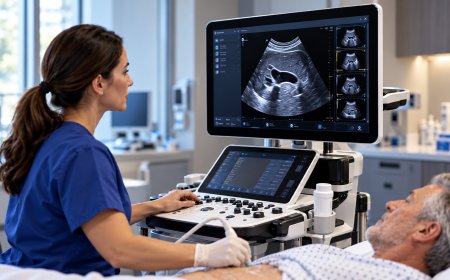
Alturion combines ultrasound imaging hardware with automated workflow tools. One feature, Auto Measure Abdomen, uses AI to identify abdominal anatomy and organ borders and automatically place measurement callipers with limited user input.
Philips said it introduced Alturion in the U.S. and Europe after receiving FDA 510(k) clearance and a CE mark.
The company’s approach illustrates how AI is increasingly becoming part of the normal operating workflow of medical equipment rather than a separate application clinicians open after an examination.
4. Medtronic
Medtronic is using AI during one of the most common gastrointestinal procedures.
Its GI Genius intelligent endoscopy module is a computer-assisted detection system designed to help endoscopists identify potential colonic lesions during colonoscopy.
The system analyses standard white-light endoscopy video in real time and can highlight areas that may contain polyps or adenomas.
GI Genius does not make the final clinical decision. Medtronic states that the system is intended to assist endoscopists and is not a replacement for physician assessment or histopathological evaluation.
That makes it a straightforward example of AI operating alongside a clinician during a medical procedure, rather than analysing results afterwards.
5. Intuitive Surgical
Intuitive is best known for the da Vinci robotic-assisted surgical system, but AI is becoming a larger part of the company’s longer-term technology strategy.
In July 2026, Intuitive outlined an AI-enabled vision for surgical care built around data and experience from more than 20 million da Vinci procedures.
The company described a layered approach that could use AI to generate surgical insights, support training, reduce variation and eventually provide increasingly advanced forms of assistance while keeping surgeons in control.
This is different from claiming that da Vinci systems independently perform surgery using AI. Intuitive’s stated direction is centred on using AI to extend surgical capabilities while maintaining physician oversight and accountability.
The distinction matters as AI moves into robotic surgery: near-term applications are more likely to assist surgeons with information, workflow and training than to remove the surgeon from the procedure.
6. Canon Medical Systems
Canon Medical Systems is using deep learning at an earlier stage of the diagnostic imaging process: image reconstruction.
Its Advanced intelligent Clear-IQ Engine, or AiCE, is a deep-learning reconstruction technology available across parts of Canon’s CT portfolio.
AiCE is trained to distinguish image signal from noise. Canon says the technology can reduce noise while improving spatial resolution and low-contrast detectability compared with its hybrid iterative reconstruction approaches.
The company has also extended AiCE technology into MRI and PET systems.
This is a useful example of AI that does not primarily attempt to diagnose a disease. Instead, the algorithm helps the scanner produce the medical image that a clinician will subsequently interpret.
7. Fujifilm
Fujifilm has applied AI across medical imaging, enterprise imaging and endoscopy.
One particularly direct example is CAD EYE, an AI-powered endoscopic imaging technology that received FDA 510(k) clearance in 2024.
CAD EYE supports real-time detection of colonic mucosal lesions, including polyps and adenomas, during colonoscopy. The technology works with Fujifilm’s endoscopy platform and analyses images during the examination.
Fujifilm is also using deep learning elsewhere in its equipment portfolio. Its ECHELON Synergy 1.5T MRI system, for example, incorporates the company’s Synergy Deep Learning Reconstruction technology.
That gives Fujifilm multiple paths to bring AI into healthcare equipment: improving scanner-generated images and helping clinicians analyse images during procedures.
8. Hologic
Hologic has made AI an important part of its breast-imaging technology.
Its Genius AI Detection software helps radiologists review mammography studies by using deep learning to identify areas that may need additional attention.
Instead of replacing the radiologist, the technology adds computer-assisted analysis to the breast-screening workflow.
Hologic has also developed Genius AI Detection PRO, which combines analysis of 2D and digital breast tomosynthesis images and can incorporate information from prior examinations.
Breast imaging is a natural area for this type of AI because screening programs can produce high volumes of image data that radiologists must review carefully. Automated analysis can provide another layer of information while leaving the diagnostic decision with the physician.
9. Samsung Medison
Samsung Medison is integrating AI into premium ultrasound equipment, particularly for obstetrics and gynaecology.
In September 2026, the company introduced the HERA Z10, expanding its premium HERA Z ultrasound lineup.
The system includes AI-assisted automated measurement and workflow tools. Samsung Medison says features including Live ViewAssist and EzStructure are designed to reduce manual work during supported ultrasound examinations.
The company has positioned the HERA Z10 alongside the higher-end HERA Z20 as part of a broader women’s health imaging platform.
Ultrasound is becoming an important proving ground for medical AI because the technology can assist not only with interpreting information, but also with how images and measurements are acquired during the examination itself.
10. Butterfly Network
Butterfly Network approaches medical imaging differently from companies building large CT, MRI or ultrasound systems.
Its Butterfly iQ3 is a handheld ultrasound device designed to provide multiple imaging capabilities through a portable probe and connected software.
The platform includes AI-assisted tools such as Auto Bladder Volume Calculation and Auto B-Line Counter.
Auto Bladder Volume can estimate bladder volume from an ultrasound sweep, while Auto B-Line Counter analyses a short lung ultrasound clip to produce a B-line count.
The combination of portable imaging hardware and automated software is particularly relevant for point-of-care medicine, where clinicians may need imaging capabilities outside a traditional radiology department.
Medical AI Is Moving Inside the Equipment
The common thread across these companies is not that AI is replacing doctors.
Instead, AI is increasingly disappearing into the equipment clinicians already use.
A radiologist may receive an image reconstructed with deep learning before beginning an interpretation. An ultrasound system may automatically identify anatomy and place measurements. An endoscopist may see an alert about a suspicious lesion while a colonoscopy is still underway.
These are narrower applications than the idea of an autonomous AI doctor, but they may also be more practical.
Medical equipment operates in regulated clinical environments, and capabilities can differ by device, market and approved use. AI-enabled tools still require appropriate validation, regulatory oversight and professional clinical judgment.
For medical technology companies, however, the direction is becoming clear. Competition is no longer based solely on better sensors, scanners, probes or robotic hardware. Software and, increasingly, AI are becoming part of what determines how effectively those machines can assist the people using them.
What's Your Reaction?
 Like
0
Like
0
 Dislike
0
Dislike
0
 Love
0
Love
0
 Funny
0
Funny
0
 Angry
0
Angry
0
 Sad
0
Sad
0
 Wow
0
Wow
0