



































AI Blood Tests Are Opening a New Front in Early Cancer Detection
AI-powered blood tests from companies like GRAIL, Guardant Health and Freenome are exploring new ways to detect cancer signals through molecular data.
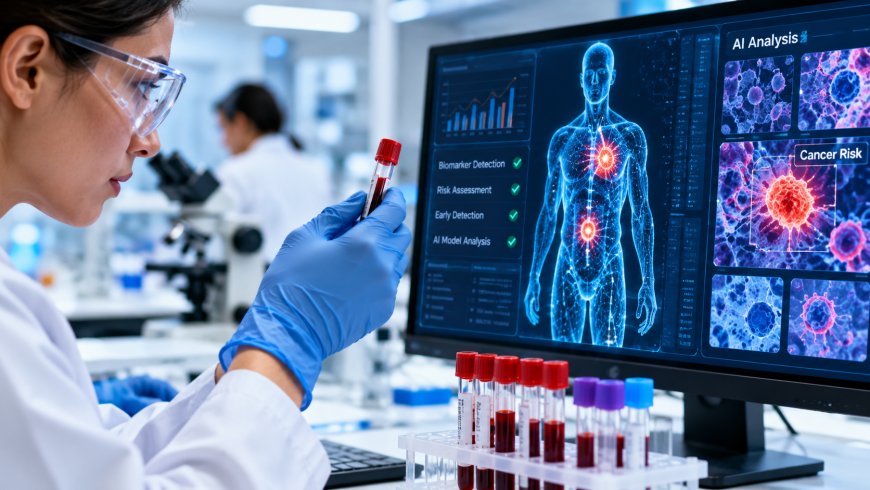
For decades, cancer screening has depended on tools such as imaging, biopsies and laboratory tests designed to detect disease after specific warning signs appear.
A new generation of biotechnology companies is exploring a different approach: using artificial intelligence to analyse blood samples and search for early signals of cancer.
The idea is simple. Cancer can leave biological traces in the bloodstream, including DNA fragments and other molecular changes. The challenge is finding those signals among the enormous amount of information contained in a normal blood sample.
Artificial intelligence is being used to analyse that complexity.
Companies including GRAIL, Guardant Health, Freenome and Exact Sciences are developing blood-based cancer tests that combine molecular biology with machine-learning models. These systems are designed to identify patterns that may indicate cancer and help physicians detect disease earlier.
The technology is still developing, and researchers are continuing to study whether earlier detection through AI-powered blood tests can translate into better patient outcomes.
But the field has become one of the most closely watched areas of AI in healthcare.
GRAIL Is Building Multi-Cancer Detection Through Blood Analysis
GRAIL is one of the most recognised companies in the AI-based cancer detection space.
The company’s Galleri test uses next-generation sequencing and machine-learning algorithms to analyse patterns in circulating cell-free DNA (cfDNA) found in blood.
Cancer cells can release DNA fragments into the bloodstream. GRAIL’s technology is designed to identify patterns associated with cancer and predict where the cancer signal may have originated.
The company says Galleri can detect signals associated with more than 50 cancer types and is intended to be used alongside existing recommended cancer screening methods, not as a replacement.
Read GRAIL’s Galleri test information.
The challenge for a multi-cancer blood test is accuracy.
A screening technology used in large populations must distinguish meaningful cancer signals from normal biological variation. Even a small error rate can have major consequences when millions of healthy people are tested.
That is why large-scale clinical studies remain a critical part of thetechnology’ss development.
Guardant Health Is Bringing AI Into Liquid Biopsy
Guardant Health has focused on another major area of cancer testing: liquid biopsy.
Instead of requiring tissue from a traditional biopsy, liquid biopsy analyses genetic material released by tumours into the bloodstream.
The company’s Guardant360 platform is used in oncology to help identify genetic alterations that may influence treatment decisions for certain cancers.
Guardant has also developed Shield, a blood-based colorectal cancer screening test. The FDA approved Shield in 2024 as a screening option for average-risk adults.
Read Guardant Health’s Shield information.
AI plays an important role in interpreting the large amount of molecular data these tests produce.
A blood sample can contain thousands of biological signals. Machine-learning systems can help researchers identify combinations of markers linked to cancer.
The goal is not simply collecting more data.
It is finding the signals that matter.
Freenome Is Combining Multiple Types of Biological Data
Freenome is taking a broader approach by combining several categories of biological information.
The company uses a multiomics strategy, which brings together different types of molecular data, including genomic and protein-based signals.
The idea is that cancer changes multiple biological systems at the same time. Looking at only one signal may provide an incomplete picture.
By combining different data sources, AI models may identify patterns that would be difficult to detect through traditional analysis.
Freenome has focused much of its development work on early cancer detection, including colorectal cancer.
ReadFreenome’ss technology approach.
Like other companies in this field, Freenome faces the same fundamental challenge: proving that identifying cancer earlier leads to meaningful improvements for patients.
A test that detects more signals is not automatically a better screening tool.
Exact Sciences Is Expanding Beyond Traditional Screening
Exact Sciences is already known for Cologuard, a non-invasive colorectal cancer screening test.
The company combines molecular testing with computational analysis to identify biological signals associated with colorectal cancer and advanced adenomas.
It has also been expanding research into broader cancer detection technologies.
Read Exact Sciences’ healthcare technology research
Exact Sciences represents a larger trend in healthcare.
Traditional diagnostics companies are increasingly combining laboratory science with artificial intelligence, creating systems where biological testing and software analysis work together.
Why AI Matters in Cancer Blood Testing
Early cancer detection is not only about finding a signal.
It is finding a reliable signal before disease becomes easier to detect.
Early-stage cancer may produce only small biological changes. Those changes can be hidden inside millions of other measurements from a patient’s blood sample.
AI can help process this complexity.
Machine-learning models can analyse:
- DNA fragments circulating in blood
- Molecular biomarkers
- Protein patterns
- Patient health information
- Clinical outcomes
The technology is particularly useful because cancer is not a single disease. Different cancers behave differently, and even the same cancer type can vary significantly between patients.
AI models can help researchers search for patterns across large populations.
The Biggest Challenge Is Clinical Proof
The excitement around AI cancer detection does not remove the need for evidence.
A screening test must answer a much bigger question than whether it can find possible cancer signals.
Does finding cancer earlier actually improve survival or treatment outcomes?
That requires long-term clinical studies.
Researchers also have to consider false positives.
If a test identifies too many possible cancers that are not actually present, patients may undergo unnecessary scans, procedures and emotional stress.
For population-wide screening, accuracy and reliability matter as much as technological capability.
AI Could Change the Future of Cancer Screening
Cancer screening today is based on separate methods for different diseases.
Mammography is used to screen for breast cancer.
Colonoscopy and stool-based tests are used for colorectal cancer.
Low-dose CT scans are used for lung cancer screening in eligible high-risk groups.
AI-powered blood tests could eventually add another layer: a single blood sample that looks for signals from multiple cancers.
However, these technologies are still being evaluated. They are not intended to replace existing screening methods today.
The future of AI cancer detection will depend on whether companies can prove that these systems improve real-world healthcare outcomes.
The competition is no longer only about building a better algorithm.
It is about creating a reliable medical tool that can help physicians detect cancer earlier and make better decisions for patients.
What's Your Reaction?
 Like
0
Like
0
 Dislike
0
Dislike
0
 Love
0
Love
0
 Funny
0
Funny
0
 Angry
0
Angry
0
 Sad
0
Sad
0
 Wow
0
Wow
0