
























The Smart Kitchen of 2026 Is Better When the Technology Gets Out of the Way
The best smart kitchen technology of 2026 focuses less on screens and more on reducing everyday friction, from robot cleaning and better appliance design to specialised cooking and frozen-drink machines.
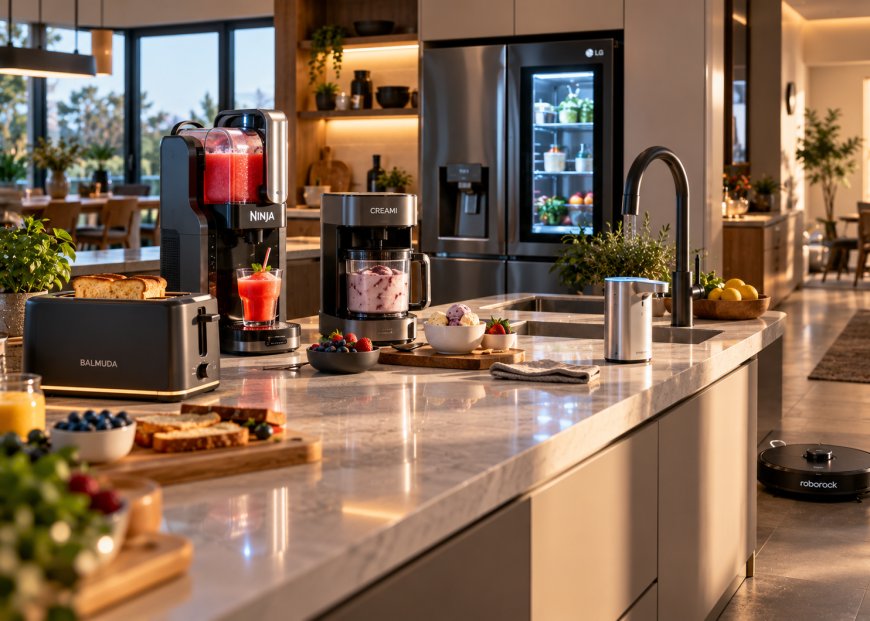
The modern smart kitchen has moved far beyond putting Wi-Fi into a refrigerator.
Premium appliances can now make frozen drinks without ice, turn protein shakes into ice cream, recognise obstacles while cleaning floors and adjust cooking behaviour around specific foods. Even the toaster has become a technology category, with companies competing over touchscreen interfaces, algorithms and specialised heating systems.
Yet one of the clearest lessons from building a kitchen around some of this technology is surprisingly low-tech: adding more gadgets does not automatically improve the room.
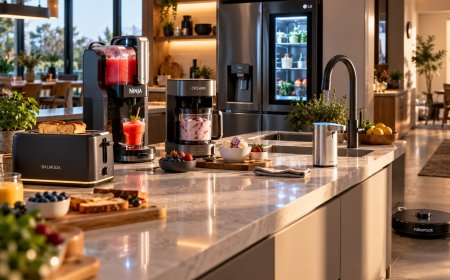
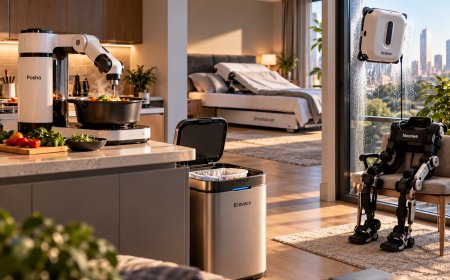
A recent attempt to assemble a “dream” high-tech kitchen combined premium appliances, connected lighting, robot cleaning, smart storage and a collection of countertop machines. The most successful ideas were generally the ones that reduced everyday friction without demanding much attention in return. The weakest were products that took up counter space or added complexity to do a job another appliance already handled reasonably well.
That distinction may matter more than any individual specification as kitchen technology continues to expand.
A Smart Toaster Can Still Lose to Better Toast
Few products illustrate the tension between technology and usefulness as clearly as the toaster.
Revolution Cooking’s current R180 Connect Plus costs $449.95 and offers 38 bread selections, seven browning levels, Wi-Fi, a touchscreen and optional accessories for sandwiches and warming. Its InstaGLO heating system is designed to reach high temperatures quickly, with software selecting different cooking behaviour depending on the bread.
BALMUDA takes almost the opposite approach. Its $379 Toaster Pro asks users to add a small quantity of water before cooking. The machine generates steam early in the cycle and then controls temperature to produce a crisp exterior while retaining moisture inside the bread.
On paper, Revolution is the more obviously technological product. In the source comparison, it was also significantly faster. But the BALMUDA produced the toast the testers preferred, despite taking nearly three times as long in that particular test.
That result captures a recurring problem with smart appliances. An interface can become more sophisticated without improving the core experience proportionally. Thirty-eight bread settings are useful only if the toast coming out of the machine is meaningfully better.
The strongest kitchen technology tends to hide its complexity in the result rather than put that complexity on the screen.
Specialised Appliances Need to Do Something the Kitchen Cannot Already Do
The case for another countertop appliance gets weaker when a kitchen already has capable equipment.
LG’s InstaView refrigerators, for example, can include automatic conventional and speciality ice makers, while some models also use UVnano technology to help clean the dispenser nozzle. The company’s broader InstaView line adds connected controls through ThinQ and the familiar knock-to-view glass panel.
Against that backdrop, a dedicated nugget-ice maker has to justify both its price and the space it takes up.
That was difficult in the source test. The standalone machine took considerably longer than its most optimistic first-ice claim to produce a useful quantity, and the final benefit came down largely to whether the user strongly preferred chewing softer nugget ice.
Ninja’s SLUSHi makes a stronger argument because it creates something a refrigerator generally cannot. The current machine uses a compressor-based RapidChill system to turn liquid into frozen drinks without requiring users to add conventional ice, with presets for slushes, frozen juice, frappés and other drinks. Ninja currently lists its larger 88-ounce model around $350.
During the source testing, a carbonated energy drink was transformed into a frozen drink with a texture the reviewer considered substantially better than the original liquid.
That is the difference between duplicating an existing appliance and expanding what a kitchen can conveniently produce.
The Ninja CREAMi Shows Why Preparation Still Matters
The Ninja CREAMi has become one of the clearest examples of a specialised appliance finding a real audience.
Its appeal is not that it makes traditional ice cream faster. Users still have to prepare a mixture and freeze it in advance. The machine’s value comes later, when its paddle processes the frozen block into a texture that would otherwise be hard to achieve with ingredients such as fruit, protein shakes, or low-fat mixtures.
Ninja’s standard CREAMi currently starts around $200 and includes seven programs, while the larger Swirl model adds soft-serve dispensing and 13 programs at $349.99.
Preparation matters because social media can make products like these look nearly instantaneous. In reality, the frozen base generally has to be prepared well beforehand. The transcript’s test used a pre-frozen mixture of milk and protein powder, required several processing passes, and still produced a result the reviewer considered good enough to use regularly.
That is a more useful measure of kitchen technology than whether an appliance removes every step. A product can still earn its space if the final result would be inconvenient or difficult to reproduce another way.
Automation Works Best on Chores That Repeat Constantly
The strongest kitchen technology may not involve cooking at all.
Robot vacuums have matured from unpredictable gadgets into increasingly autonomous cleaning systems. Roborock’s Qrevo Slim, one of the machines used in the source kitchen, is only 8.2 centimetres tall and combines 3D time-of-flight sensing with an RGB camera. Roborock says it can recognise 73 obstacle categories, while its dock automatically empties dust, washes and dries the mops, and replenishes the robot’s water supply.
That is useful not because any single feature is impressive, but because the entire system reduces intervention.
The source household ultimately installed a robot on each floor and scheduled cleaning to run while people slept. The robots returned to their docks afterwards and handled much of their own routine maintenance.
This is where home automation becomes genuinely persuasive. Floors become dirty again every day. Removing much of that recurring work creates value continuously, not only when someone decides to use a specialised appliance.
The same idea applies at a smaller scale around the sink. Simplehuman’s current rechargeable sensor dispensers can run for months between charges, depending on the model, and dispense soap without requiring the user to touch the pump.
A motorised soap dispenser is far less technologically ambitious than a connected refrigerator. You may also encounter it dozens of times a day.
The Room Matters More Than the Gadgets
The most convincing part of the smart kitchen in the source was ultimately not an appliance.
Power outlets were positioned inside appliance cabinets, allowing machines to remain connected without filling the central work surface with cables. Frequently used equipment was grouped according to where food and drinks were prepared. The kitchen used handle-free storage, large continuous surfaces and lighting that could change automatically for different situations.
Those choices reduce small points of friction before electronics come into play.
This is an important counterweight to the consumer technology industry’s tendency to label individual products “smart.” A kitchen filled with connected appliances can still be frustrating if the blender has to be carried across the room for power, machines permanently occupy the countertop, or every device requires a different app before breakfast.
Conversely, traditional appliances can feel substantially smarter when storage, power, lighting and cleaning are designed around how people actually move through the room.
The same principle explains why some of the source’s simplest purchases earned lasting approval. Seamless tableware that was easy to clean, intelligently stored cookware, and a paper-towel holder that integrated a spray bottle did not depend on AI or Wi-Fi. They removed repeated annoyances.
The Dream Smart Kitchen Is Becoming Less About Screens
At one point, the future of kitchen technology seemed destined to involve displays everywhere. Refrigerators gained touchscreens, ovens gained apps, and manufacturers experimented with putting connected controls onto almost anything with a power cable.
The better direction is becoming clearer.
Useful kitchen technology increasingly operates in the background. A robot cleans after everyone goes to bed. A dishwasher dries its own load. Lighting changes without requiring several switches. A frozen-drink machine handles a texture that would otherwise require more manual work. Even premium appliances such as BALMUDA’s toaster show that sophisticated engineering doesn’t necessarily require a complicated interface.
None of this means expensive kitchen gadgets suddenly make financial sense for everyone. A $450 toaster remains a luxury purchase, and a dedicated slush machine makes little sense for somebody who rarely drinks frozen beverages.
The more interesting change is that the criteria for a genuinely smart kitchen are becoming easier to define. The best technology either removes recurring work, produces an outcome that is difficult to achieve otherwise, or quietly improves a task people already perform.
Everything else is another appliance looking for somewhere to live on the counter.
What's Your Reaction?
 Like
0
Like
0
 Dislike
0
Dislike
0
 Love
0
Love
0
 Funny
0
Funny
0
 Angry
0
Angry
0
 Sad
0
Sad
0
 Wow
0
Wow
0