



























Convenience Tech Is Automating More of Daily Life — but Not Every Chore Needs a Robot
Home robots can now cook meals, clean windows, manage trash and even make beds. But the best convenience tech saves meaningful time, not just automating tasks that were already easy.
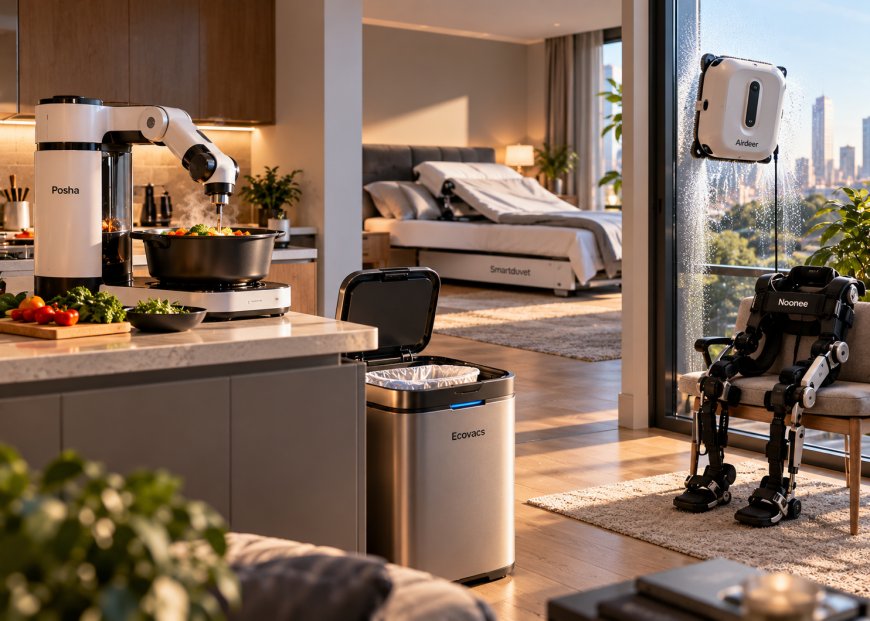
The next phase of consumer automation is moving beyond robot vacuums.
Companies are now selling machines that cook dinner unattended, seal and replace trash bags, clean windows, straighten bedding, and even create a place to sit without a chair. The engineering can be impressive, but the usefulness varies dramatically. Some products genuinely remove repetitive work from daily life. Others automate such a small part of a task that the owner ends up managing another appliance without saving much meaningful time.
That distinction matters more as household robotics expands. The most useful technology does not simply act automatically. It removes enough of the surrounding work that people can stop thinking about the task altogether.
Cooking Robots Show Both the Promise and the Limitation
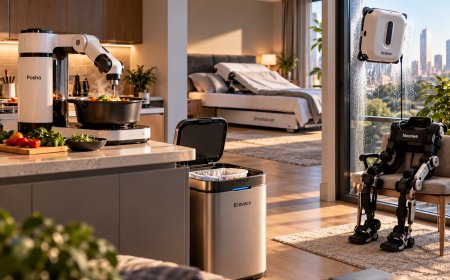
Posha’s countertop cooking robot comes closer than most products to the popular idea of an automated kitchen.
Users choose a recipe, load ingredients into separate containers and let the machine control when those ingredients are added. It also manages stirring and cooking while dispensing spices, oil and water during the process. Posha currently advertises more than 1,000 recipes through its broader library, while the machine itself is priced at $1,750 with a temporary $1,500 offer. Access to the full recipe library through Posha Circle costs $14.95 a month or $139.95 annually.
In the hands-on test that inspired this article, the robot successfully transformed prepared ingredients into a paneer dish while operating largely unattended. The finished meal impressed the reviewer considerably more than expected.
The more revealing part came afterwards. Posha still requires somebody to buy the ingredients, prepare them, load the containers and clean the removable cooking components. Posha acknowledges that users do the preparation, while the robot handles much of what happens after the food is loaded. The company says the pan, ingredient containers, spatulas, and other removable parts are dishwasher-safe, which helps but doesn’t eliminate cleanup.
That makes Posha a credible unattended cooker, not an autonomous kitchen. For households where standing over a stove is the main source of friction, that could still be valuable. For anyone who dislikes chopping vegetables and cleaning dishes more than the cooking itself, the time savings may feel less transformative.
Simpler Automation Can Be More Convincing
Some of the strongest convenience products solve much smaller problems.
Airdeer’s A1 smart trash can, for example, automatically heat-seals a full trash bag and installs another liner. The company currently sells the 15-litre model for $99 and claims 90 to 180 days of battery life per charge. Each proprietary refill ring supplies roughly 20 bags.
The task isn’t especially futuristic, which is partly why it works. The product targets a repetitive job that most people would rather avoid and requires little behaviour change from the owner.
The transcript’s test reached a similar conclusion. After sealing the existing bag, the trash can used internal airflow to pull a fresh liner into place without manual fitting. The reviewer ultimately rated it among the most successful labour-saving products in the group.
That convenience hides a cost because owners need compatible refills. That recurring-consumable model is becoming common across smart-home products, where labour savings can come with longer-term dependency on proprietary bags, filters, cartridges, or software subscriptions.
Even so, the trash can illustrates a useful rule for automation: eliminating an unpleasant task can matter more than automating a complicated one.
Window Robots Are Getting Close to the Robot Vacuum Model
Window-cleaning robots make a similarly strong argument because the work they replace can be inconvenient and physically awkward.
Ecovacs’ WINBOT W2 OMNI attaches itself to glass and navigates the surface while spraying cleaning solution and wiping the window. The company specifies maximum suction of approximately 5,500 Pa, multiple anti-fall systems and several cleaning modes. The station version can also operate for up to 110 minutes on its internal battery.
The hands-on test showed where the technology currently stands. Routine fingerprints and light grime were handled well, while heavier messes still produced smearing and occasionally needed manual attention.
That result does not make the robot unsuccessful. It may actually describe the path successful home robotics tends to follow.
Robot vacuums did not become popular because they instantly cleaned floors better than a person with a high-end vacuum. They became useful because they could complete most routine cleaning without supervision. Once a machine reliably handles the majority of a repetitive chore, occasional human intervention can become an acceptable compromise.
Window robots appear to be approaching the same threshold.
Other Gadgets Automate Problems That Hardly Exist
The weaker category of convenience technology is not necessarily badly engineered. Its problem is that the task being automated was already easy.
Nékojita FuFu is a small cat-shaped device that clips to a cup or bowl and blows air across hot food. The concept attracted nearly 1,800 Kickstarter backers and more than ¥18 million in crowdfunding, demonstrating that novelty itself can create a market.
During the transcript’s test, however, five minutes of automated blowing produced less than a four-degree Celsius difference compared with a drink left to cool naturally. The device technically performed its assigned task, but waiting a little longer required no storage space, charging or additional hardware.
That difference separates automation from convenience theatre. A gadget can execute a clever solution perfectly and still leave the user wondering whether the original problem justified a dedicated product.
The Smart Bed Raises a Different Question
Automating bed making sounds similarly excessive until you see the engineering in action.
The Smartduvet system places an inflatable layer beneath the bedding. When activated, that layer fills with air and pulls the duvet toward a flatter position before deflating again. The broader system also includes dual-zone climate features and other comfort functions.
In testing, the automatic bed-making mechanism worked surprisingly well, producing a neat result with little intervention. The reviewer was less convinced by its temperature-management capabilities but described the self-making function as one of the more impressive automations tested.
Whether that justifies the cost depends heavily on the user. A non-disabled person may reasonably decide that making a bed takes too little time to automate. Someone with limited mobility could reach the opposite conclusion.
That is an important consideration as home robotics becomes more sophisticated. Technologies marketed as luxury convenience can overlap significantly with accessibility technology, where eliminating even a small physical task may create substantial independence.
Even a $2,000 Wearable Chair Has a Serious Use Case
The Chairless Chair 2.0 offers one of the clearest examples of how context can completely change an unusual product’s value.
Noonee’s passive exoskeleton weighs less than three kilograms and lets its wearer move between walking, standing and supported sitting without carrying a conventional chair. The current listed price is €2,190, and the manufacturer explicitly sells it to business customers rather than the general consumer market. Noonee positions the device for industrial, trade and medical environments where workers may need support while repeatedly changing positions.
A casual test found the device less comfortable than expected and noted that the wearer still needed to maintain some body tension while using it. That does not necessarily undermine its industrial purpose, where the alternative may involve workers remaining in awkward positions for long periods or trying to place conventional seating in areas where chairs interfere with movement.
What looks like an absurd gadget in a home can therefore become an ergonomic tool on an assembly line.
The Best Automation Makes Itself Forgettable
Consumer technology companies increasingly have enough sensors, motors, software and inexpensive computing power to automate almost any small action around the home. The harder challenge is deciding which actions deserve automation.
That is why an automatic trash can can make more practical sense than a far more sophisticated cooking robot. One removes a clearly defined unpleasant task with almost no additional thought. The other performs impressive work but still leaves significant preparation and cleanup.
The same principle explains why robotic floor cleaners became mainstream while countless other smart-home gadgets disappeared. Successful automation eventually fades into the background. People stop thinking about the technology because they have also stopped thinking about the chore.
That should be the standard for this new generation of convenience devices. The question is not whether a robot can make a bed, cook a curry or clean a window. Engineers have increasingly demonstrated that it can.
The more important question is whether owning the machine makes life genuinely easier once you include charging, preparation, maintenance, subscriptions, and cleanup.
What's Your Reaction?
 Like
0
Like
0
 Dislike
0
Dislike
0
 Love
0
Love
0
 Funny
0
Funny
0
 Angry
0
Angry
0
 Sad
0
Sad
0
 Wow
0
Wow
0