































IKEA’s New Smart Home Tech Is Shockingly Cheap but Matter Is Still the Weak Link
IKEA’s new Matter smart home devices bring bulbs, sensors, and remotes at unusually low prices, but pairing issues and Thread reliability show why affordability alone may not make the smart home simple.
IKEA has spent decades convincing shoppers that decent furniture does not have to cost much. In 2026, it is trying to apply the same idea to the smart home.
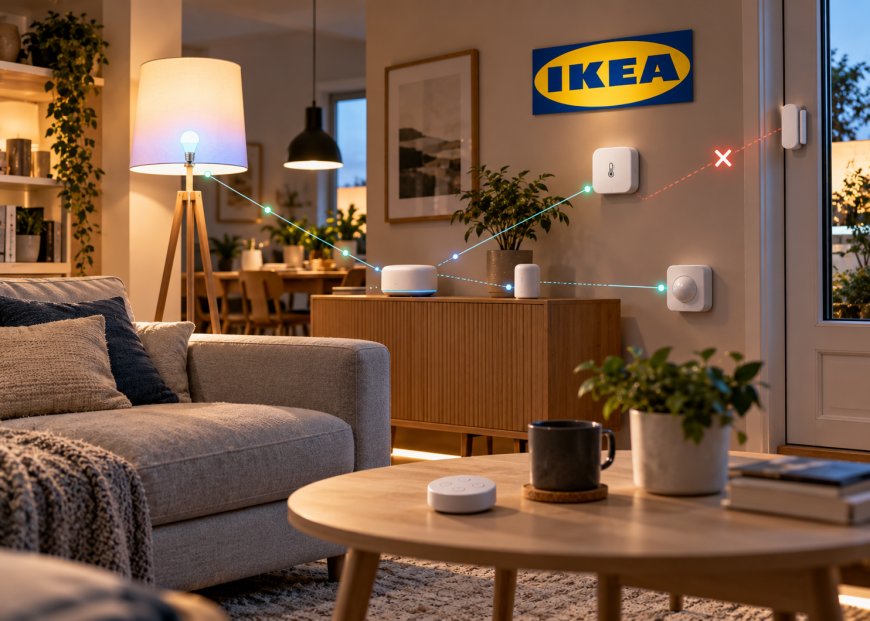
The company’s latest technology lineup includes smart bulbs, motion sensors, door sensors, remotes, and environmental monitors at prices that look unusually low compared with established smart-home brands. IKEA UK currently sells a Matter-compatible KAJPLATS colour bulb with 1,055 lumens for £9, while a white-spectrum version costs £6. Its MYGGBETT door and window sensor is £7, and the MYGGSPRAY motion sensor is also £ 7. These are clearance products built around an obsolete proprietary standard. They are part of the 21-device smart-home range IKEA announced for 2026, rebuilt around Matter with the stated goal of making connected-home technology cheaper and easier to mix across ecosystems.
That makes IKEA’s strategy potentially important beyond the company itself. Smart homes have traditionally demanded either patience, money or both. IKEA is betting that standardised connectivity and enormous retail scale can turn smart lighting and sensors into ordinary household purchases.
The problem is that cheap hardware only works as a bargain when the networking behind it behaves reliably.
IKEA Is Taking Matter Seriously
IKEA’s shift did not happen overnight. The company had already added Matter support to its DIRIGERA hub in 2024, allowing older Zigbee-based IKEA devices connected through the hub to appear in compatible Matter ecosystems. The newer generation goes further by building Matter directly into many devices.
That matters because Matter is intended to reduce one of the smart home’s biggest historical frustrations: ecosystem lock-in. Instead of buying a bulb and then discovering it only works properly inside one company’s app, Matter provides a common application standard supported by platforms including Apple Home, Google Home, Amazon Alexa and Samsung SmartThings.
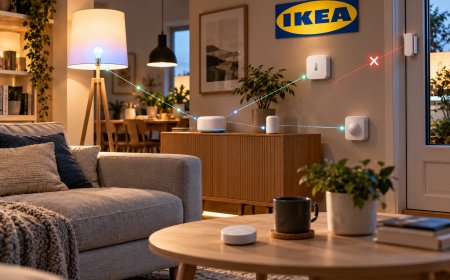
IKEA says its new Matter products can be added to its own DIRIGERA system or other compatible platforms. Products such as the BILRESA remote and MYGGBETT sensor use Matter over Thread, allowing them to participate in low-power Thread networks rather than relying on conventional Wi-Fi for every device.
The approach is particularly attractive for sensors. A door sensor does not need high-bandwidth Wi-Fi. It needs to wake up, report that a door has opened and then return to a low-power state. Thread was designed for exactly that class of connected device.
One important correction to a common explanation of Thread, including the one in the source transcript: Not every Thread device acts as a signal repeater. Always-powered devices such as compatible bulbs and plugs can operate as mesh extenders, while battery-powered “sleepy” devices such as many door sensors communicate through parent routers and generally do not forward traffic for other devices.
The broader advantage remains real: a well-built Thread network can expand coverage through powered devices and recover automatically when network paths change.
The Prices Are Hard to Ignore
The most surprising part of IKEA’s technology push is how little some of it costs.
A £7 door sensor can report whether a cabinet, window or door has opened and can trigger other smart-home actions. IKEA explicitly suggests pairing MYGGBETT with a smart bulb so a light turns on when a door opens and off again when it closes. The sensor uses a replaceable AAA battery, which IKEA sells separately.
MYGGSPRAY brings motion detection to the same £7 price point and works indoors or outdoors. IKEA says it can control up to 10 light sources and integrate through DIRIGERA.
The TIMMERFLOTTE temperature and humidity sensor is another example of the company pushing connected hardware toward impulse-purchase territory. IKEA’s UK smart-lighting catalogue listed it at £5. At the same time, the device supports Matter over Thread and can display local temperature and humidity readings without requiring the phone app for every check.
The transcript behind this article documents the same surprise during hands-on testing. Cheap bulbs, remotes and sensors initially appeared to deliver much of the functionality expected from more expensive smart-home equipment, including phone control, automations and interoperability with third-party systems.
However, no public evidence shows that IKEA is literally selling these devices at a loss. The more credible explanation is a combination of scale, simplified product design, shared components and the economics of Matter itself.
A common standard means IKEA does not have to invent every layer of interoperability from scratch. That does not eliminate engineering costs; Matter devices still require firmware, testing, certification, and support, but it reduces the value of maintaining a fully proprietary smart-home stack.
IKEA also has something most specialist smart-home companies do not: enormous existing retail distribution and customers already visiting its stores specifically to furnish homes. A £7 sensor does not need to generate the same margin as a standalone consumer-electronics business if it also makes IKEA lighting, furniture and other home products more attractive.
Then the Pairing Problems Start
The case for IKEA becomes less convincing when setup reliability enters the discussion.
After several days with the new equipment, the hands-on testing described in the transcript encountered repeated commissioning failures. Some bulbs connected immediately while another apparently identical unit failed repeatedly. QR-code setup did not always work, devices that had initially connected later appeared offline, and a Matter remote became noticeably unreliable.
Those experiences are anecdotal rather than a controlled reliability study, but they are not isolated.
IKEA’s own UK product listings provide some evidence of uneven customer experiences. The KAJPLATS 1,055-lumen colour bulb currently carries a rating of roughly 3.1 out of five stars across more than 170 reviews, while IKEA’s BILRESA scroll-wheel remote has been listed at around 2.8 stars.
Recent user reports tell a similar story. Some owners describe IKEA’s new Matter devices as reliable once installed. In contrast,e others report bulbs or remotes that require repeated pairing attempts, drop from networks or behave differently depending on the Thread border router and platform being used. One recent Home Assistant user reported good results from IKEA temperature and humidity sensors while complaining about limitations and latency with Matter lights and remotes.
Another user described several KAJPLATS bulbs timing out during commissioning despite already having Apple TV, HomePod and other Thread equipment in the home.
That does not establish a 50% defect rate, despite the more dramatic figure cited in the transcript. Online complaints are self-selecting, and failed pairing can come from device firmware, the commissioning phone, the border router, network topology or the smart-home platform rather than faulty IKEA hardware alone.
IKEA itself acknowledges common setup scenarios in its support documentation, including QR codes that fail to scan and Matter devices appearing offline. The company advises users to enter the 11-digit setup code manually when needed and to check Wi-Fi or Thread network stability and controller availability.
Matter Is Not a Finished Consumer Experience Yet
It would be too simple to conclude that IKEA’s hardware is bad. It would also be too generous to blame every failure on Matter.
The larger issue is that interoperability standards involve several layers. Matter can define a common language, but the experience still depends on device-manufacturer firmware, Thread infrastructure, operating-system commissioning software, and the implementation provided by Apple, Google, Amazon, Samsung, or another controller vendor.
That leaves plenty of opportunities for something to go wrong.
Thread itself is technically capable of providing a resilient mesh. The Thread Group recommends a network built around enough always-powered mesh extenders, while battery-operated devices connect through those routers rather than extending the network themselves. A user with weak Thread coverage can therefore experience problems even when every individual product is functioning as designed.
The frustrating part for consumers is that they generally do not care which layer failed. A smart bulb that refuses to pair is simply a smart bulb that refuses to pair.
That is precisely the problem Matter was supposed to make disappear.
IKEA May Still Be One of Matter’s Most Important Tests
The interesting thing about IKEA’s smart-home push is that the company does not need enthusiasts to succeed.
Its opportunity is the person who visits a store for a lamp, notices that the connected bulb beside it costs only a few pounds more than an ordinary bulb, and decides to try smart lighting for the first time.
That is a very different route into the smart home from buying a premium starter kit or spending a weekend researching hubs and networking protocols.
IKEA has explicitly said affordability is one reason behind its 21-device Matter range. The company argues that smart-home technology has historically been too difficult and too expensive for many households.
On price, IKEA has already made a convincing case. A £5 sensor or £9 colour bulb dramatically lowers the financial risk of experimenting with home automation.
Reliability is now the harder part.
If Matter and Thread can become boring enough that an IKEA customer scans a code, adds a device and never thinks about the network again, IKEA could help move smart-home technology from an enthusiast category into the mass market.
If consumers instead spend their evening resetting bulbs and re-entering pairing codes, then even £7 starts to feel expensive.
What's Your Reaction?
 Like
0
Like
0
 Dislike
0
Dislike
0
 Love
0
Love
0
 Funny
0
Funny
0
 Angry
0
Angry
0
 Sad
0
Sad
0
 Wow
0
Wow
0