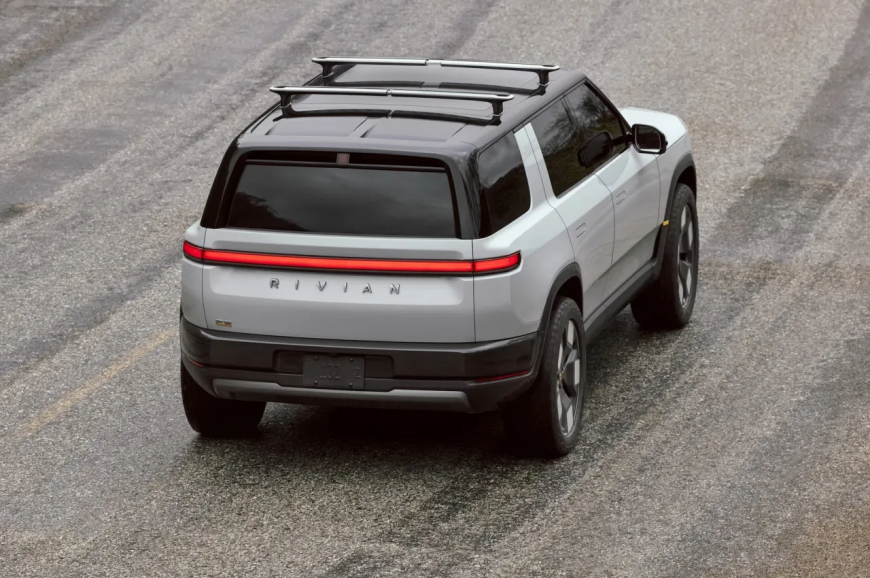
Rivian is preparing for what could become one of the quickest launches of a new all-electric vehicle in the United States with its upcoming R2 SUV, according to the company's projections.
If Rivian succeeds, it would mark a powerful opening for a vehicle that founder and CEO RJ Scaringe has described as "maybe the most important thing we've launched to date."
The company has limited room for error. Rivian's long-term future — and its path toward profitability — depends heavily on the R2's performance. If the company has trouble ramping up production and moving units, investors could lose confidence. At a minimum, it would raise fresh concerns about Rivian's strategy of spending billions now to prepare for mass-market scale later.
Last month, Rivian told investors it expects to sell between 20,000 and 25,000 R2 SUVs this year, with the first vehicles likely reaching customers in June after production starts. Even if the company lands at the bottom of that range, its sales pace would still be faster than nearly every comparable electric vehicle priced at or below $60,000, with the Tesla Model Y standing as the major exception.
The Model Y, which launched in March 2020, needed only about four months to pass 20,000 units sold. Rivian is aiming to reach that level in roughly six months, about the same time it took the Honda Prologue to hit that mark after its 2024 debut.
Among EVs in the U.S., the next-fastest model to cross 20,000 sales was the Chevy Equinox EV, which did so in about eight months after arriving on the market in 2024. Ford's Mustang Mach-E needed around the same amount of time following its 2021 launch, while Korean electric models such as the Hyundai Ioniq 5 and Kia EV6 took approximately 10 and 11 months, respectively.
Vehicles that experienced more difficult launches, such as Tesla's Model 3 — remembered for Elon Musk's famous "production hell" period — or the Chevy Blazer EV, which went through a major stop-sale and recall, took just as long or even longer to get there.
Rivian, however, is bringing the R2 into a very different environment. Almost all of those earlier models benefited from the $7,500 federal EV tax credit, which Congress and President Trump eliminated in September of last year. Large automakers are also slowing or cancelling some EV plans as emissions rules become less strict. On top of that, Trump's unpredictable tariffs have pushed up vehicle prices, including those in Rivian's current lineup.
Scaringe has framed these obstacles as potential advantages, arguing that the EV market still lacks enough options, particularly on the more affordable side. Rivian has said the R2 SUV will start at $45,000, with Scaringe presenting that lower price point as essential to the vehicle's mass-market appeal.
That lower entry price may improve the odds of a strong launch, but neither Scaringe nor the company has clarified when a $45,000 version of the R2 will actually be available to buyers. Rivian is instead starting with a dual-motor, higher-trim edition of the SUV that will almost certainly carry a higher price tag.
The company is expected to reveal more pricing information and additional details at an event on March 12. But in early February, Rivian removed the phrase "Starting at $45,000" from the R2 page on its website. Last month, the company said it remains "committed" to that base price despite the change. Rivian did not respond to emailed requests for comment regarding its R2 launch plans.
Even with the current headwinds facing EVs in the U.S., demand appears strong for upcoming electric SUVs priced near or somewhat above the R2, including models like Volvo's EX60, BMW's iX3, and the Mercedes-Benz GLC. Those vehicles are not expected to arrive in the U.S. until later this year, which could give the R2 a meaningful competitive edge, according to Edmunds consumer insights analyst Joseph Yoon.
"[Scaringe is] right that, that kind of compact-ish, mid-size-ish segment is really kind of missing" for EVs, he said. Yoon also noted that Rivian has made significant efforts to simplify the R2 manufacturing process compared with its current vehicles, which should help the company scale more quickly.
Still, not everyone on Wall Street is convinced. Last month, D.A. Davidson analyst Michael Shlisky lowered his price target for Rivian, pointing to what he described as the company's "aggressive" expectations for the R2 launch.
Barclays analyst Dan Levy wrote in a note published last year that he expects Rivian's average transaction price for the R2tod to remain around $60,000 or higher "for the next several years" while the vehicles are produced in Illinois, at least until the company's new Georgia factory is operating.



































 Like
0
Like
0
 Dislike
0
Dislike
0
 Love
0
Love
0
 Funny
0
Funny
0
 Angry
0
Angry
0
 Sad
0
Sad
0
 Wow
0
Wow
0