

































Evotrex Secures $30 Million to Develop a Self-Charging Electric RV
Evotrex has raised $30 million to accelerate the development of its innovative self-charging electric recreational vehicle (RV), aiming to reduce dependence on public charging infrastructure and transform sustainable road travel.
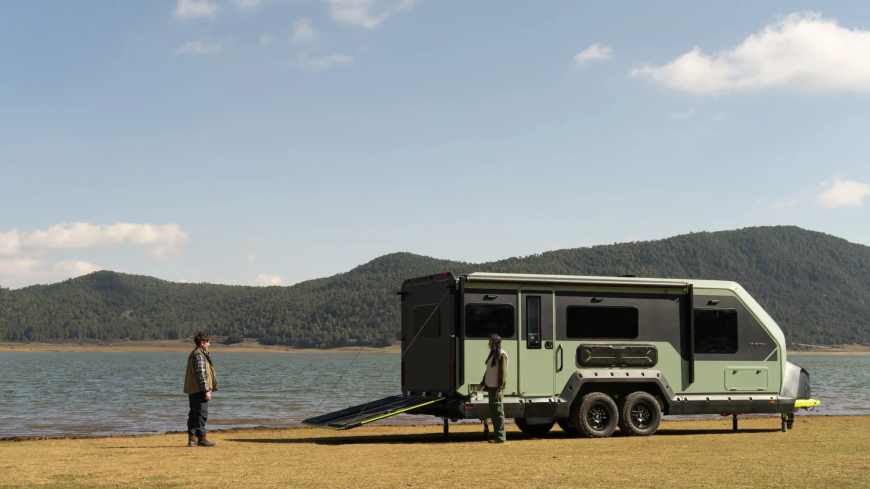
Evotrex may only be two years old, but the startup is already preparing to bring its first hybrid RV travel trailers to market. The company plans to begin selling the vehicles next year and is targeting annual production of roughly 1,000 units.
To support that goal, Evotrex has secured $30 million in a Series A funding round, increasing its total funding to $46 million. A significant portion of the new capital came from a group of investors based in China and Hong Kong, including GSR United Capital, Forebright Concerto Capital, TTGG Ventures, and Pegasus Capital. Consumer electronics company Anker, meanwhile, was among the startup’s earliest backers during its seed round.
The Los Angeles-based company will use the funding to complete development and testing of its RV platform, which it publicly showcased at this year’s Consumer Electronics Show. The unveiling followed the company’s emergence from stealth mode last year.
The additional capital will also help Evotrex compete in an increasingly crowded market. Traditional RV manufacturers have been relatively slow to introduce electric offerings. Thor’s first electric vehicle is being deployed to rental fleets rather than retail customers, while Winnebago’s eRV2 has remained in testing since 2023 without reaching consumers. That delay has created an opportunity for startups, and Evotrex is among several companies aiming to establish an early lead.
Co-founder and CEO Alex Xiao said he welcomes the growing competition and is applying lessons learned as a product manager at Anker to help distinguish Evotrex from rivals.
“We are not afraid of competition; competition is a good thing. We educate the market together; we grow the market together,” Xiao said. “I think in the long term the strongest companies will have many things — you must be very good at product definition, R&D, and supply chain. You also need to be very good at distribution and service. Many things together. It’s a very complicated business.”
While some RV startups, including Lightship and Pebble, are focusing entirely on battery-electric travel trailers, Evotrex has taken a different path. The company is one of the few pursuing a hybrid configuration.
Its RV combines a battery-powered system with an onboard gasoline engine that can recharge the battery pack as needed. The setup is commonly known as an extended-range electric vehicle, or EREV, and is designed to provide greater flexibility than fully electric alternatives.
According to Xiao, the objective is to create an RV that genuinely enables extended off-grid living. He argues that relying solely on battery power can make long-term remote travel difficult, while traditional gas-powered RVs still often depend on external electrical hookups for certain functions.
The concept appears to be attracting interest from buyers. Evotrex said that approximately 90% of current reservations are for the fully equipped Premium version of its PG5 RV, which carries a price tag of roughly $160,000.
Xiao said the company has already validated a working version of its first RV. However, the next 10 to 12 months will be dedicated largely to extensive durability testing of the PG5 before it reaches customers.
Durability remains a well-known challenge within the RV industry. Because recreational vehicles contain numerous interconnected systems and moving components, long-term reliability can be difficult to guarantee. Xiao said Evotrex is treating that issue as a priority.
As evidence of that focus, he noted that the company hired its first service employee approximately six months ago, while its first sales employee joined only recently. The hiring sequence, he said, reflects Evotrex’s commitment to building strong customer support capabilities before aggressively pursuing sales growth.
The startup still intends to manufacture its RVs in China before completing final assembly in California. Xiao said locations for both operations are still being finalised. He added that maintaining a presence in Los Angeles offers strategic advantages, including proximity to target customers and access to a wide range of environmental conditions useful for vehicle testing.
Xiao also pointed to another lesson he took from his experience at Anker, one that helped transform the electronics company into a widely recognised brand: identify genuine customers and create products that customers are eager to recommend themselves.
“The first thing is you need to find the real customer demand,” Xiao said. “The second is you need to deliver a really good product, and third is: The customer will tell the story for you.”
As Evotrex moves toward commercial production, the company is betting that a combination of hybrid technology, customer-focused product development, and strong post-sale support will help it stand out in a rapidly evolving RV market.
What's Your Reaction?
 Like
0
Like
0
 Dislike
0
Dislike
0
 Love
0
Love
0
 Funny
0
Funny
0
 Angry
0
Angry
0
 Sad
0
Sad
0
 Wow
0
Wow
0