






























Former SpaceX Founders Turn to Solar and Battery Power to Fuel the AI Data Centre Boom
Two former SpaceX executives are betting on large-scale solar and battery projects to meet the growing electricity demands of AI data centres. Discover how Ambrosia Energy plans to deliver affordable, clean, and reliable power for the next generation of artificial intelligence infrastructure.
Two former SpaceX executives believe they have a solution to one of the biggest challenges facing the AI industry today: providing enough power for the rapidly growing number of data centres being built worldwide.
Their startup, Ambrosia Energy, has emerged from stealth mode with a plan that does not rely on breakthrough technology or futuristic concepts. Instead, the company is combining large-scale solar generation with lithium-ion battery storage to create power plants that it says can be built more quickly and at a lower cost than conventional natural gas facilities.
“A power plant should be able to be built at any scale in 12 months from contract signing to power on,” said Sara Spangelo, co-founder and president of Ambrosia Energy. “Our ambition is to go to gigawatt scale.”
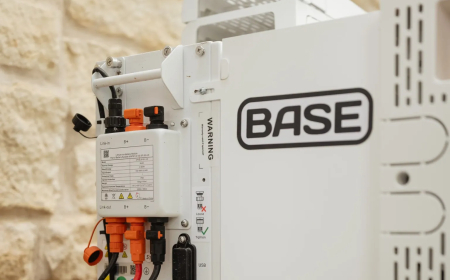
Rather than reinventing battery technology, Ambrosia has focused on improving how battery systems are used. Most utility-scale battery installations are designed to charge and discharge over periods of two to four hours, placing greater stress on the equipment.
Ambrosia takes a different approach. The company slowly charges its batteries throughout the day using solar power and gradually releases that energy overnight. According to the founders, this strategy reduces system strain and enables a simpler battery pack design.
Combined with additional engineering improvements, the company says those changes have significantly lowered costs. Ambrosia claims the total system cost is around 1.5 times the cost of the battery cells themselves, below the level typically seen across the industry.
If the company can scale successfully, it could present a serious challenge to traditional energy infrastructure. According to data from Lazard, a new combined-cycle gas turbine power plant — widely regarded as one of the most efficient forms of gas generation — costs roughly $107 per megawatt-hour to build and operate. Even then, obtaining gas turbines can be difficult due to industry backlogs that currently stretch between five and seven years.
“We’re also way more reliable than gas,” Spangelo said.
Spangelo and Ambrosia co-founder and CEO Ben Longmier previously worked together on Starlink after SpaceX acquired their earlier startup, Swarm. That company developed a low-power satellite network designed for Internet of Things (IoT) devices using dozens of small satellites.
Before SpaceX, Spangelo worked at Google, while Longmier held positions at Apple and several other space-focused startups.
The founders initially financed Ambrosia themselves before securing investment from venture firm DFJ Growth. Spangelo declined to disclose the size of the funding round.
Spangelo sees clear similarities between Ambrosia’s mission and her experience at SpaceX.
“A lot of these challenges are very similar across regulatory, technical, and go-to-market. If we can bring some of that experience to this, hopefully we can have an impact,” she said.
She also compared deploying the company’s power systems to launching satellite constellations.
“Building the power plant modules has been kind of like deploying a satellite constellation,” Spangelo said. “You launch four, you learn, you iterate.”
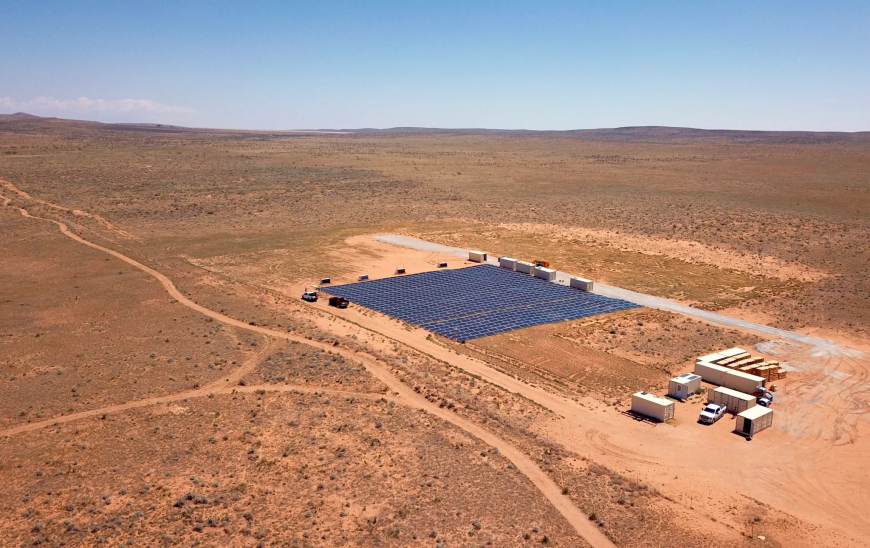
To validate its approach, Ambrosia began construction on a power plant in West Texas in January, just one month after the company was formally incorporated.
“After this week, we’ll be almost halfway complete with that power plant,” Longmier said.
He added that portions of the facility were switched on approximately six weeks ago and have been operating at full capacity ever since.
“Our system is basically infinitely scalable,” Spangelo said, explaining that customers can test smaller deployments before committing to larger installations.
The company’s power plants can be connected directly to the electrical grid or deployed behind the meter for dedicated customers.
Future projects could become substantially larger. Longmier said Ambrosia is already working with partners that have access to as much as one million acres of land. Based on recent research on solar land requirements, a project of that scale could support a power facility capable of generating roughly 30 gigawatts of power.
For now, however, Ambrosia is focused on projects ranging from 20 to 30 megawatts. Many of the components currently used are commercially available products, though the company intends to replace more of them with proprietary designs over time.
Ambrosia also plans to build a manufacturing facility in Austin, Texas, enabling it to deliver larger projects more quickly as demand grows.
The company’s long-term goal is ambitious.
“We want to deliver gigawatts by the end of the decade,” Spangelo said. “We’re pretty ambitious.”
What's Your Reaction?
 Like
0
Like
0
 Dislike
0
Dislike
0
 Love
0
Love
0
 Funny
0
Funny
0
 Angry
0
Angry
0
 Sad
0
Sad
0
 Wow
0
Wow
0