























Former Tesla Robotics Engineer’s Startup Resolves Trade Secret Dispute, Secures $11 Million Funding
Proception, the robotics startup founded by a former Tesla engineer, has settled its trade secret dispute with Tesla and raised $11 million in seed funding to advance high-dexterity robotic hand technology.
Proception founder Jay Li says he would not recommend being sued by Tesla while trying to build a startup. However, he believes the experience ultimately made his company stronger.
In an interview, Li described the legal battle as a test of resilience, saying that difficult experiences can strengthen a company if it successfully overcomes them.
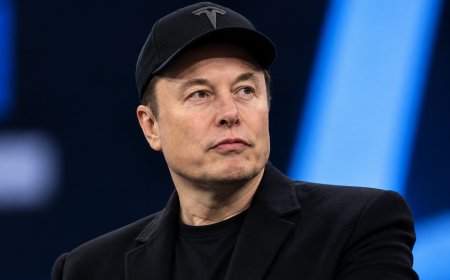
Li previously served as a technical lead on Tesla’s Optimus humanoid robot programme before the EV maker accused him last year of taking trade secrets to establish Proception. After several months of legal proceedings between the two sides, the dispute has now been resolved through a settlement, with Tesla voluntarily dismissing the lawsuit earlier this month. Tesla has not publicly commented on the settlement.
With the legal matter behind him, Li says he is now focused on tackling what he considers an even more complex engineering challenge: building robotic hands that function as naturally as human hands.
To support that mission, Proception announced on Monday that it has raised an $11 million seed funding round led by First Round Capital, with additional backing from Y Combinator and BoxGroup.
The company also revealed that it has begun shipping the first batch of its high-dexterity robotic hands to research organisations and robotics companies while opening broader customer orders. According to Li, Proception aims to become the preferred supplier of robotic hands for businesses that would rather purchase the technology than invest years developing advanced dexterous manipulation systems themselves.
Although robotics has attracted enormous investment and industry attention in recent years, Li believes far less focus has been placed on replicating the remarkable capabilities of the human hand.
Interestingly, one of the strongest advocates for solving this challenge has been Li’s former employer. Tesla CEO Elon Musk has repeatedly described robotic hands as one of the most difficult engineering problems remaining in humanoid robotics.
While Musk has suggested that Optimus robots could begin performing factory work within the next few years, many robotics experts believe that matching the dexterity of human hands remains much further away. Last year, Kevin Lynch, director of Northwestern University’s Centre for Robotics and Biosystems, told The Wall Street Journal that his team expects it could take roughly a decade before robotic hands become functional enough to perform many everyday human tasks.
Li believes Proception can significantly accelerate that timeline, largely because of its unique approach to collecting training data.
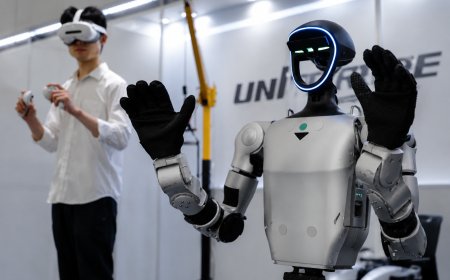
Most companies developing humanoid robots currently rely on teleoperation systems. Human operators wear virtual reality headsets that allow them to view what the robot sees while remotely controlling its movements. The robot then learns by analysing those human actions.
According to Li, one major limitation of this approach is that operators receive little or no physical feedback from the objects being handled. He also noted that data collection is constrained by the number of available robots, limiting how quickly companies can scale training.
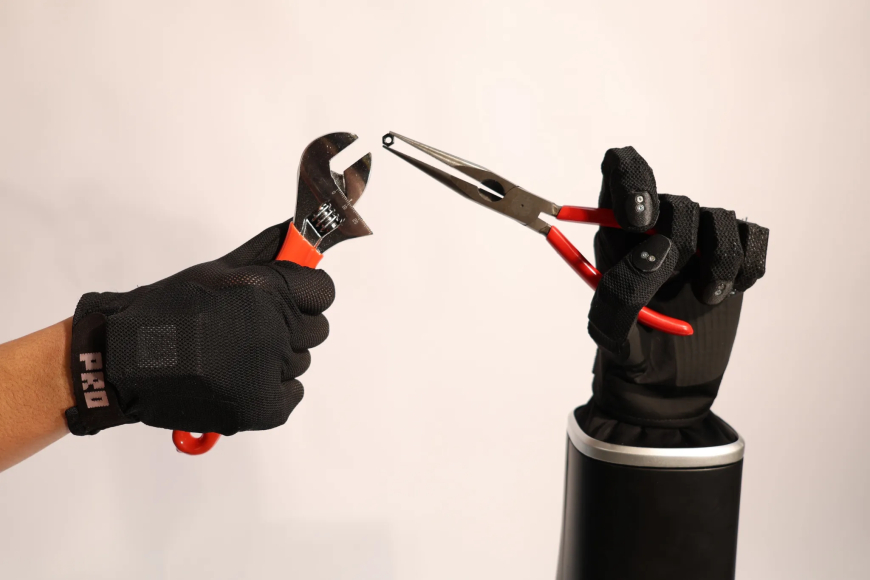
Proception has taken a different approach by developing a sensor-equipped glove. Human participants wear the glove alongside a headset, enabling the company and its customers to collect detailed hand-interaction data without requiring a physical robot to perform every task, according to the company’s announcement.
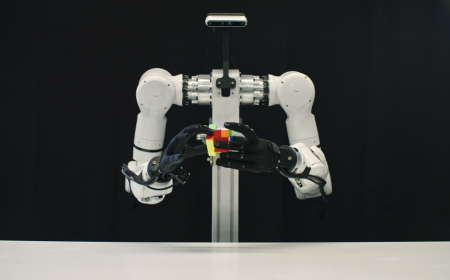
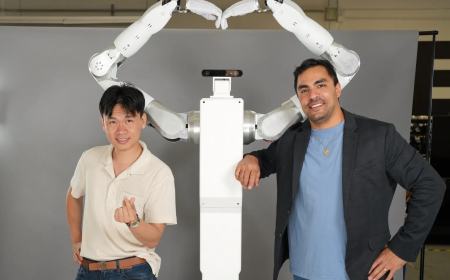
The same sensor-equipped glove technology is also incorporated into Proception’s robotic hand, effectively serving as an electronic skin. The robotic hand features 22 degrees of freedom along with multiple joints in each finger, allowing it to perform a broad range of highly dexterous movements.
Li said this method enables Proception and its customers to gather richer, task-specific datasets that more closely represent how humans naturally manipulate objects. He also believes the approach can be expanded far more efficiently than conventional robot-based training systems.
According to Li, solving dexterous manipulation requires both advanced hardware and highly scalable data collection. He argued that many robotics companies focus primarily on hardware or combine it with limited data-gathering methods. In contrast, Proception is building sophisticated robotic hands alongside a scalable system for collecting high-quality interaction data. He believes that the combination is essential for solving one of robotics’ biggest remaining challenges.
First Round Capital partner Bill Trenchard, who led the investment, said the company’s integrated approach was one of the main reasons the firm backed Proception.
Trenchard said he believes Proception is developing one of the most advanced robotic hands currently available while also building the data models needed to support it. He added that dexterous manipulation represents one of the final major obstacles to making humanoid robots truly capable in real-world environments.
He also praised Li for remaining focused throughout the legal dispute with Tesla, noting that the founder had been transparent with investors from the beginning and that the team continued executing despite the lawsuit. Trenchard described Li as a strong leader.
Li remains optimistic about Proception’s future. Reflecting on the experience of facing Tesla’s legal team, he said he would not be surprised if the company eventually became a customer as Proception continues to grow.
“I think it will happen,” Li said.
What's Your Reaction?
 Like
0
Like
0
 Dislike
0
Dislike
0
 Love
0
Love
0
 Funny
0
Funny
0
 Angry
0
Angry
0
 Sad
0
Sad
0
 Wow
0
Wow
0