
































Northrop’s Mission Robotic Vehicle Advances Satellite Servicing
Northrop’s Mission Robotic Vehicle is heading to geosynchronous orbit to install propulsion pods and expand commercial satellite servicing capabilities.
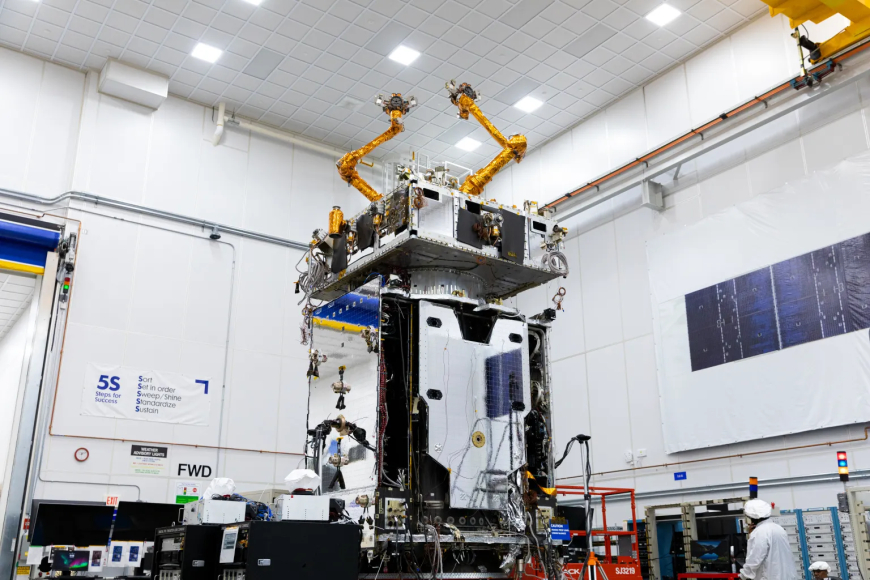
Northrop Grumman is moving into a new phase of satellite servicing with a robotic spacecraft designed to install propulsion systems and perform work on satellites already operating thousands of miles above Earth.
The transition is already underway around Optus D3, an Australian communications satellite launched in 2009. Northrop Grumman’s Mission Extension Vehicle has undocked from the satellite after providing propulsion and attitude-control support for more than a year, clearing the way for a more flexible robotic servicing system.
Mission Robotic Vehicle heads toward geosynchronous orbit
Northrop Grumman’s Mission Robotic Vehicle, or MRV, launched July 21 aboard a SpaceX Falcon 9 alongside three Mission Extension Pods. The spacecraft is now making an approximately yearlong journey to geosynchronous orbit, about 22,000 miles above Earth.
The MRV carries a robotic servicing system developed through the Defence Advanced Research Projects Agency’s Robotic Servicing of Geosynchronous Satellites program. Its two robotic arms each have seven joints and can work with interchangeable tools, cameras and sensors designed for operations around satellites in orbit.
Among the MRV’s first jobs will be installing a Mission Extension Pod on Optus D3. Optus says that installation is scheduled for late 2027 and could extend the satellite’s operational life by up to six years.
Propulsion pods change Northrop’s servicing model
The new approach differs from NorthropGrumman’ss existing Mission Extension Vehicles. An MEV docks directly with an ageing satellite and uses its own propulsion system to help control the combined spacecraft, remaining attached while providing the life-extension service.
A Mission Extension Pod is smaller and remains permanently attached to thecustomer’ss satellite after the MRV installs it. The pod provides additional propulsion, while the robotic vehicle is free to move on to another servicing assignment.
That separation could allow a single MRV to support multiple spacecraft, rather than dedicating an entire servicing vehicle to each customer. Optus will own and control the pod installed on Optus D3 after docking.
Northrop Grumman has already demonstrated the underlying life-extension concept with two MEVs The first vehicle previously serviced Intelsat 901 before moving to Optus D3. In contrast, a second vehicle remains attached to another Intelsat satellite.
Robotic servicing goes beyond adding fuel
The MRV is designed for more than installing propulsion pods. DARPA says its robotic system is capable of inspections, satellite relocation, on-orbit upgrades and work intended to resolve certain spacecraft problems.
Those capabilities address a longstanding limitation of satellites in geosynchronous orbit. Many spacecraft were not designed to be repaired or upgraded after launch, even though some can remain technically useful after their available propulsion resources become a constraint.
Mission-extension technology offers operators another option. Instead of replacing an otherwise functional satellite solely because it can no longer manoeuvre as required, a servicing spacecraft can provide additional propulsion and potentially keep the asset operating longer.
Northrop sees a broader market for in-space servicing
The MRV is also designed to be refuelable, fitting into Northrop Grumman’s broader work on spacecraft that can be replenished and serviced after launch. The company is developing in-space refuelling capabilities separately as commercial and government customers explore ways to make expensive orbital assets more flexible and resilient.
DARPA developed the MRV’s robotic servicing system with support from the Naval Research Laboratory, while Northrop Grumman’s SpaceLogistics integrated it with the spacecraft and will own and operate the vehicle. After initial demonstrations, DARPA plans to transition the program to the U.S. Space Force for coordination with its servicing and logistics efforts.
The MRV is expected to operate for more than a decade, according to DARPA. Its first commercial assignments will provide an important test of whether robotic servicing can develop from specialised demonstrations into a repeatable business for satellites already in orbit.
For Optus D3, the shift is especially tangible. One spacecraft has now detached after keeping the satellite working, while another is travelling toward orbit with robotic arms and a propulsion pod intended to extend that mission again.
What's Your Reaction?
 Like
0
Like
0
 Dislike
0
Dislike
0
 Love
0
Love
0
 Funny
0
Funny
0
 Angry
0
Angry
0
 Sad
0
Sad
0
 Wow
0
Wow
0